
If you need to clean out an inherited house in Portland, you can also sell your inherited house as-is, belongings included, instead of emptying every room first. The right process starts with confirming who has legal authority over the property and its contents.
The first steps are to secure the home, document estate property, locate important papers, and sort belongings into five groups: keep, share, sell, donate, and discard. In a probate estate, the personal representative should handle estate property according to their legal duties before valuable items are distributed or discarded. You do not have to complete a cleanout before selling, but confirm the authority to sell and the agreed terms first.
A few points most cleanout checklists leave out:
- Nothing should leave the house before the personal representative has documented it. The estate inventory comes before distribution, and a missing heirloom can turn into a family fight or a court question.
- The most valuable things in an older house are often paper. Deeds, account statements, and life insurance policies hide in books, freezers, and coat pockets.
- Computers, monitors, and TVs cannot go in the trash in Oregon. A state disposal ban sends them to free recycling sites instead.
- An empty house in a Portland winter carries different risks than a lived-in one. Heat, water, and insurance decisions come before the first box goes out the door.
- You do not have to finish the cleanout to sell. Take what matters to your family, and the rest can stay.
Before You Start: Legal Authority and the Estate Inventory
Before you remove anything, make sure someone has legal authority over the estate and that the contents have been documented. In Oregon, that person is usually the personal representative. A court appoints the personal representative in a probate case. Often it is the person the will names as executor.
Until the personal representative or trustee has confirmed their authority, heirs should avoid selling, giving away, or discarding items that may belong to the estate. This includes valuable furniture, jewelry, collections, financial papers, and belongings that family members may dispute. If urgent safety or sanitation issues require something to be removed, document it and ask the estate attorney how to handle it. Having a key to the property does not automatically give someone authority to distribute estate assets.
Not every estate goes through full probate. Oregon has a simpler small estate affidavit process for some estates. Other homes pass through a living trust, where a trustee plays a similar role. Which path applies depends on the will, the deed, and the size of the estate. An Oregon probate attorney can usually tell you which one you are on in a single conversation.
Why the personal representative should inventory the inherited house before anything leaves
Under ORS 113.165, a personal representative generally must file an inventory of estate property within 90 days after appointment, unless the court allows more time. The inventory covers property that has come into the personal representative’s possession or knowledge and estimates its fair market value as of the date of death.
Household goods are part of that estate. So are jewelry, firearms, vehicles, coin collections, and art. If items disappear before they are listed, the inventory is wrong. That puts the personal representative in a tough spot, because they owe duties to every heir and creditor.
The rule of thumb is simple: document first, distribute later. Confirm deadlines and details with your attorney or the county probate court, because each estate is different.
Documenting the house is easier than it sounds. Walk through with your phone before you move a thing. Take wide photos of every room, then close-ups of anything that looks valuable or sentimental. Open closets, cabinets, drawers, the attic, and the garage. A narrated video of each room works well for a first pass. Those photos support the inventory, settle later questions about who took what, and help an appraiser see what is there.
Step 1: Secure the House
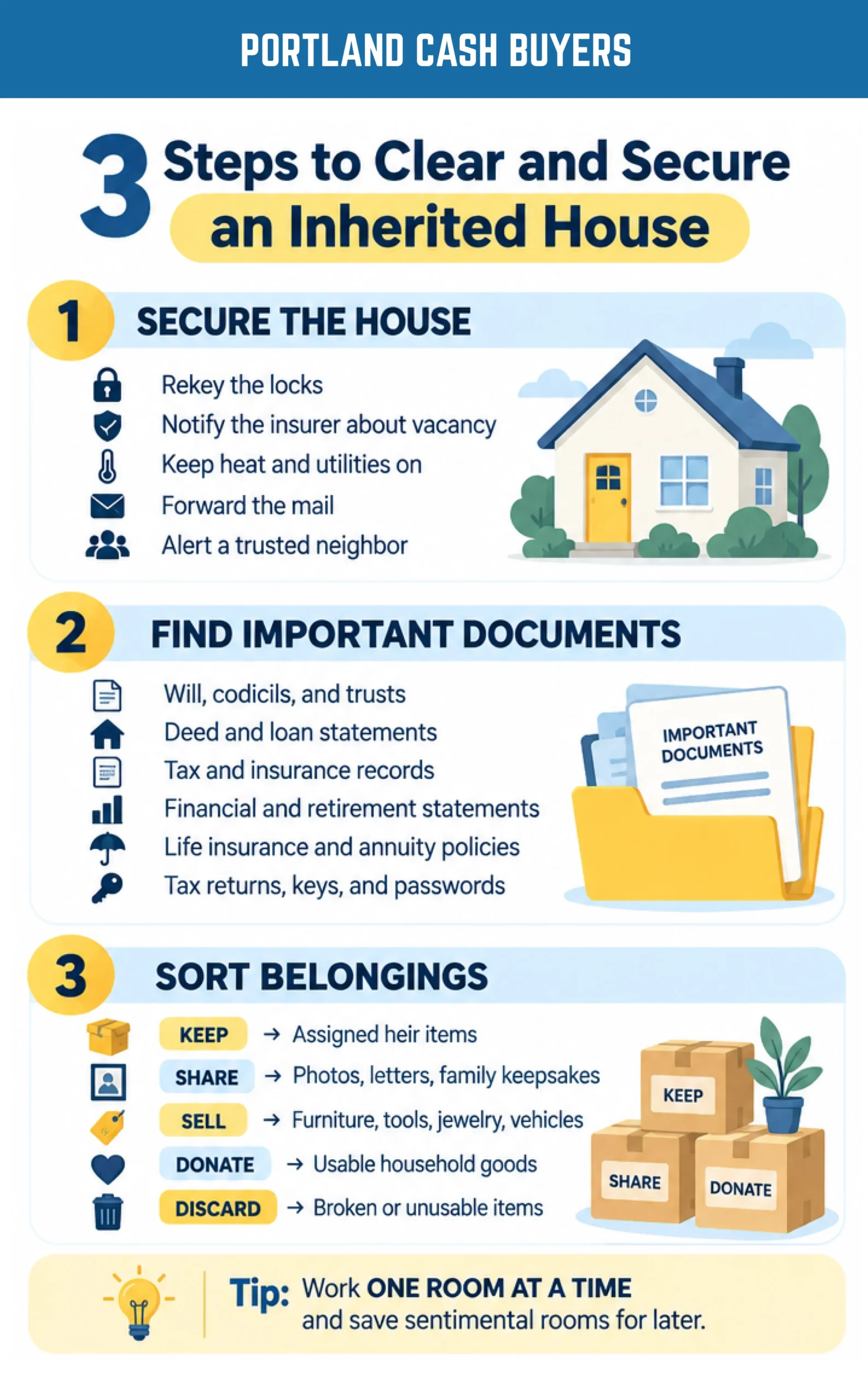
Securing the house comes first, because an empty home full of belongings is both a target and a maintenance risk. Start with the locks. Over the years, neighbors, caregivers, cleaners, and relatives may all have had keys. Rekeying is a small cost, and afterward you know exactly who can get in.
Call the homeowner’s insurance company next. Tell them the owner has died and the home may sit empty. Many policies limit coverage once a home stays vacant for a set period. Ask what the policy requires and whether you need a vacancy endorsement.
Do not automatically shut off or leave every utility running. Tell the homeowner’s insurance company that the property is vacant and ask what the policy requires. In cold weather, maintain sufficient heat to protect the plumbing or arrange for a qualified professional to winterize the house. Ask a plumber or property manager whether the water should remain on, especially if the home has leaks or other maintenance issues. If you need utilities for cleaning, use them only when the property is safe.
Deal with the mail. A pile on the porch tells everyone the house is empty. The personal representative can arrange forwarding through the post office. That mail also shows you which accounts, bills, and subscriptions exist.
Last, tell a trusted neighbor what is going on. Someone who notices an unfamiliar truck in the driveway is worth more than a camera.
Step 2: Find the Important Documents First
Find the papers before you sort anything else, because the documents you need to settle the estate are the easiest things to throw out by mistake. Set aside one sturdy box labeled “estate papers.” Put these in it as you find them:
- The original will, any codicils, and any trust documents.
- The deed to the house, plus mortgage, reverse mortgage, or home equity loan statements.
- Property tax statements and homeowner’s insurance policies.
- Vehicle titles and registration papers.
- Bank, brokerage, pension, and retirement account statements.
- Life insurance policies and annuity contracts.
- The last few years of tax returns.
- Safe deposit box keys and any passwords written on paper.
People of that generation often hid things well. Check inside books and Bible covers, under drawer liners, in the freezer, in coat pockets, and in shoe boxes on closet shelves. Look behind framed pictures, too. Cash, savings bonds, and jewelry turn up in places no one expected.
Keep the box in a locked room, or take it home with you. Do not shred anything yet. An old statement for a closed account may point to another account nobody knew about.
Step 3: Sort Everything Into Five Categories
Sort every item into one of five groups: keep, share with family, sell, donate, or discard. The table shows what belongs in each group and where it ends up.
| Category | What goes here | Where it ends up |
| Keep | Items the will or a family agreement assigns to a specific heir | Labeled and set aside until the personal representative approves distribution |
| Share with family | Photos, letters, recipes, and holiday items several people may want | Scanned, copied, or divided by an agreed method |
| Sell | Furniture, tools, collectibles, vehicles, and jewelry with resale value | Estate sale, auction, consignment, or an online listing |
| Donate | Usable clothing, housewares, linens, and furniture with little resale value | Portland-area reuse nonprofits and thrift stores |
| Discard | Broken items, spoiled food, worn-out textiles, and true trash | Curbside pickup, a rented container, or a transfer station |
Work one room at a time. Colored tape or sticky notes make the groups visible at a glance. Start with a room that carries less emotion, like the garage or a spare bedroom. Save the main bedroom and the photo closet for later, once you have a rhythm.
Handling disagreements over sentimental items
Family arguments over a cookie jar are rarely about the cookie jar. A clear method keeps things fair. Have each heir walk the house and list their top items. Then take turns choosing in a rotating order, and draw straws for who picks first. For anything with real dollar value, get an appraisal and count it against that heir’s share. Write the agreement down, and let the personal representative make the final calls the will allows.
Siblings often have to decide about the house itself at the same time. My post on dividing an inherited house among siblings walks through those choices.
Estate Sale, Auction, or Online Marketplace?
The right choice depends on what is in the house and how much time you have. An estate sale fits a house full of decent furniture and household goods. An auction house fits a few high-value pieces like art, antiques, or jewelry. Online marketplaces work for a handful of items when you have time to answer messages.
| Option | Best fit | What you give up | What to ask first |
| Estate sale company | A full house of furniture, housewares, and tools | A share of sales; the public walks through the house during the sale | Commission, minimums, insurance, and who clears unsold items |
| Auction house | Art, antiques, jewelry, and collections | Seller fees and a wait for payment | Fees, reserve prices, and payout timing |
| Consignment shop | Quality furniture and clothing | A slower sale and a split of the proceeds | The split and how long they hold items |
| Online marketplace | A few valuable items | Your time, plus meeting strangers | Use public meetup spots and keep the empty house address private |
A professional estate sale company makes the most sense in Portland when there is enough value to justify the commission. Ask for references and proof of insurance. Get a written contract that spells out the fee, the sale dates, and what happens to everything that does not sell. Tell your insurer before a sale, since the public will be inside the house.
Keep a record of every sale, whatever route you choose. That money belongs to the estate, and the personal representative will need the numbers for the estate accounting.
Where to Donate and Recycle in the Portland Area
Most usable goods can go to Portland-area reuse nonprofits, while electronics and hazardous products have their own free disposal routes. Community Warehouse collects furniture and household goods for families who need them. Habitat for Humanity ReStores take furniture, appliances, and building materials. Local thrift stores take clothing and housewares.
Acceptance rules change, so call or check each website before you load the car. Ask whether they offer pickup for large pieces. Many groups turn down stained mattresses, damaged upholstery, and older cribs.
Electronics require separate handling. Oregon prohibits disposing of computers, monitors, and televisions in the garbage or at disposal sites. The Oregon E-Cycles program lists free recycling locations for eligible electronics. Securely erase personal information or remove storage devices before donating computers and phones.
Paint, chemicals, and medications
Paint, pesticides, cleaners, batteries, and medical sharps require proper disposal and should never be poured down a drain or placed in ordinary garbage. Metro’s household hazardous waste facilities provide free household disposal, with a daily limit of 35 gallons measured by container size. Prescription and over-the-counter medicines should be handled separately. Use Oregon’s Drug Take-Back Program to find a participating drop-off site or request a mail-back envelope.
One note for families on the Washington side of the river: Vancouver and Camas homes fall under Clark County programs, not Metro’s, so check with the county there.
Hoarding Situations and Heavy Cleanouts
A hoarded house is a safety job before it is a sorting job, so bring in help before you start pulling things out. Piles can block exits and hide soft floors. Mold, rodents, sharp objects, and unlabeled chemicals are common. Wear gloves, sturdy boots, and a well-fitted respirator mask. Never work in a heavily packed house alone.
Hoarding cleanup and biohazard companies have the gear and training for this. A general junk hauler may not. Either way, valuables still hide in the piles. Tell any crew to set aside paper, envelopes, and small boxes for you to check.
Go easy on yourself, too. A hoarded house often carries hard family history, and grief can come out sideways. It is fine to decide this part is not your job.
If a hoarding situation, family disagreement, or the distance from Portland makes the cleanout overwhelming, you do not have to decide everything today. Compare the time, cost, and effort of clearing the house with the option of selling it with belongings still inside. The next section explains what to consider before choosing that alternative.
How Long a Cleanout Takes and What It Costs
A cleanout takes as long as the volume of belongings, the number of decision-makers, and your distance from Portland allow, and the cost depends on how much you hand off. The table compares the common approaches.
| Approach | Your time | Main costs | Fits best when |
| Do it yourself with family | Highest, often spread over many weekends | Truck or container rental, dump fees, and supplies | You live nearby, and the house is manageable |
| Estate sale company plus hauler | Moderate | Sale commission plus hauling for leftovers | There is enough of value to sell |
| Full-service estate cleanout company | Low | Labor and disposal, often priced by volume | You live far away or need it done fast |
| Hoarding or biohazard cleanup | Low, with some oversight | Specialized labor, protective gear, and possibly pest control | Safety hazards are present |
| Sell with contents inside | Lowest | No cleanout bill; the offer reflects the house as it sits | A cleanout does not make financial or emotional sense |
I am not going to give you dollar figures, because they swing widely with volume, access, and haul distance. Get at least three written quotes. Ask how each company prices the job: by the truckload, by the hour, or as a flat fee. Ask whether donation drop-offs are included.
Keep receipts. The estate usually pays these costs, and the personal representative will need records. Also count the carrying costs that run while the house sits. Property taxes, insurance, utilities, and any mortgage payment keep coming every month of the cleanout.
When It Makes Sense to Clean Out the House and List It
If the house is in good shape, you live close enough to do the work, and the family is in no hurry, clean it out and list it on the open market. A clean, well-kept house in a strong neighborhood draws retail buyers. A cash sale is the right tool for speed and simplicity, not for topping the market.
I tell people this on the phone all the time. My cash offer will be lower than retail. The number that matters is what you net after commissions, repairs, seller closing costs, and months of carrying costs. My guide to comparing a cash offer with listing lays out that math line by line.
Taxes belong in the comparison too. Heirs often receive a stepped-up basis on inherited property, which can shrink or erase the taxable gain. Ask a tax professional how it applies to you, and read my overview of capital gains on an inherited house in Oregon before you decide.
The Alternative: Sell the House With Everything Inside
Yes, you can sell an inherited house without cleaning it out. I buy houses full of belongings as they sit. Take the photos, heirlooms, and papers that matter to your family. Leave the rest.
Here is how it works with me. You tell me about the house by form or phone. I pull recent comparable sales for the neighborhood and look at the public records. Then I schedule a private walk-through at a time that works for you. If you live out of state and cannot meet, I can make a sight-unseen offer from your description and photos.
You get a no-obligation cash offer within 24 hours, and I walk you through the math. I base it on comparable sales, condition, repair costs, and carrying costs, and nothing changes at closing. You pick the closing date. A typical close takes 7 to 14 days, and it can happen in as little as 7. There is no financing contingency, so the sale cannot fall apart because a lender declined.
Every closing runs through a licensed and insured title company in Portland. I pay all closing costs, and there are no commissions or fees to you. The personal representative or trustee signs for the estate. If there is a mortgage, the title company pays it off from the proceeds at closing.
One detail matters to many families. If I find sensitive papers after closing, like tax returns or bank statements, I shred them to protect the estate and the heirs from identity theft.
Christina C. sold her late mother’s home with her brothers. Her words: “He came the day we called and did a walk thru. Gave us an offer the following day.” She also wrote that I gave the family extra time and that the closing went smoothly. You can read more reviews from Portland-area families.
I have been buying Portland-area homes since 2004, and I carry a BBB A+ accreditation. I answer my own phone, and you can read who I am and how I work. I buy across Portland and the surrounding communities I serve. If you are also downsizing your own home at the same time, I can help with that sale as well.
Frequently Asked Questions About Cleaning Out an Inherited House
These are the questions heirs ask me most about cleaning out an inherited house in Portland.
Who is responsible for cleaning out a deceased person’s house in Oregon?
The personal representative of the estate is usually responsible, or the trustee if the home was in a trust. Heirs often do the physical work, but the personal representative decides what is sold, given, or discarded. I recommend confirming the specifics with an Oregon probate attorney, since duties depend on the will and the court.
Can I throw things away before probate is open?
Clear trash and spoiled food are generally fine to remove for safety and sanitation. Anything with possible value should stay until the personal representative documents it for the estate inventory. Throwing out papers early is a common and costly mistake. When in doubt, photograph it, box it, and ask your attorney.
How much does an estate cleanout cost in Portland?
Costs vary widely with the volume of belongings, access to the house, and disposal needs, so there is no single price. Get at least three written quotes, and ask whether pricing is by truckload, by the hour, or flat. The estate usually pays, so keep every receipt for the accounting.
Can I sell a house with stuff still in it?
Yes. Portland Cash Buyers buys inherited houses with belongings inside, so families can take what matters and leave the rest. I make a no-obligation cash offer within 24 hours, and the seller picks the closing date. A listing usually needs the house emptied and cleaned before showings.
What happens to personal papers left in the house after it sells?
Portland Cash Buyers shreds sensitive documents found after closing, such as tax returns and bank statements, to protect the family from identity theft. Even so, I suggest pulling the estate papers first. The will, deed, account statements, and insurance policies are often needed to settle the estate.
More answers are on my full seller FAQ page.
Your Next Step With an Inherited House Cleanout in Portland
Cleaning out an inherited house in Portland can be manageable when you start with legal authority, an inventory, and a clear sorting plan. But you do not have to empty the property before selling. Compare the cost and time of a cleanout with the terms of selling the house with its contents still inside.
If you want to compare the as-is option, get a cash offer with no cleanout from Portland Cash Buyers. Ask for the proposed price and terms in writing, including which belongings can remain and who pays closing costs. Call or text (503) 770-0145 or use the offer form. Compare the estimated net proceeds with a traditional listing before deciding.