

Selling an inherited house with multiple heirs in Oregon can quickly become overwhelming when siblings or relatives disagree about what should happen next. If you inherited a Portland home with family members who are not on the same page, there are practical legal options that can help you move forward without unnecessary conflict. I am Quinn Irvine, and I have helped Portland-area heirs resolve shared property situations since 2004. This guide explains how Oregon law handles co-owned inherited property, what happens when heirs disagree, and the fastest ways to reach a fair resolution. You can also learn more about how to sell an inherited Portland house from start to finish.
Selling an inherited house with multiple heirs usually goes smoothly when everyone agrees on a buyer and price. However, Oregon law also provides legal solutions when co-heirs cannot agree. An heir can request a partition action, negotiate a buyout, or work toward a voluntary sale before the dispute reaches court. Understanding these options early can help families avoid unnecessary delays, legal expenses, and additional stress during an already difficult time.
Key Takeaways
- Oregon heirs who co-own an inherited house do not need unanimous consent to sell; any co-owner can file a partition action under ORS 105.205.
- A buyout lets one heir keep the house by paying the others their share of its value, often the simplest fix when one sibling wants to stay.
- The personal representative controls the sale only during active probate; once the house is distributed to the heirs, each heir owns and votes on their own share.
- Proceeds are typically split according to each heir’s ownership percentage as set by the will or Oregon intestacy law, not evenly by headcount unless shares are equal.
- A single cash buyer who works with all heirs and the estate at once can close in as few as 7 to 14 days, which sidesteps months of a partition case.
Selling an Inherited House With Multiple Heirs: Where to Start
Start by confirming exactly how the title is held and how many heirs have a legal share, because that determines who has to sign and who has to agree. If the house went through probate, the personal representative typically has authority to sell during the estate administration, sometimes with court confirmation depending on the will’s terms. Once the house has been formally distributed to the heirs, though, it becomes co-owned property, usually as tenants in common, and every named heir becomes a legal owner with a voice in what happens next.
That shift matters because a tenant-in-common share is fully yours to sell, keep, or fight over, independent of what your siblings decide to do with theirs. I have worked with families at every stage of that process, from an estate still open in probate to heirs who inherited a house together a decade ago and are only now sorting it out. If your situation also involves probate mechanics, my guide to how Oregon probate works when selling an inherited house covers the personal representative’s authority in more depth. You can also read about how I work with heirs and executors on my About Us page.
What If Heirs Disagree About Selling?
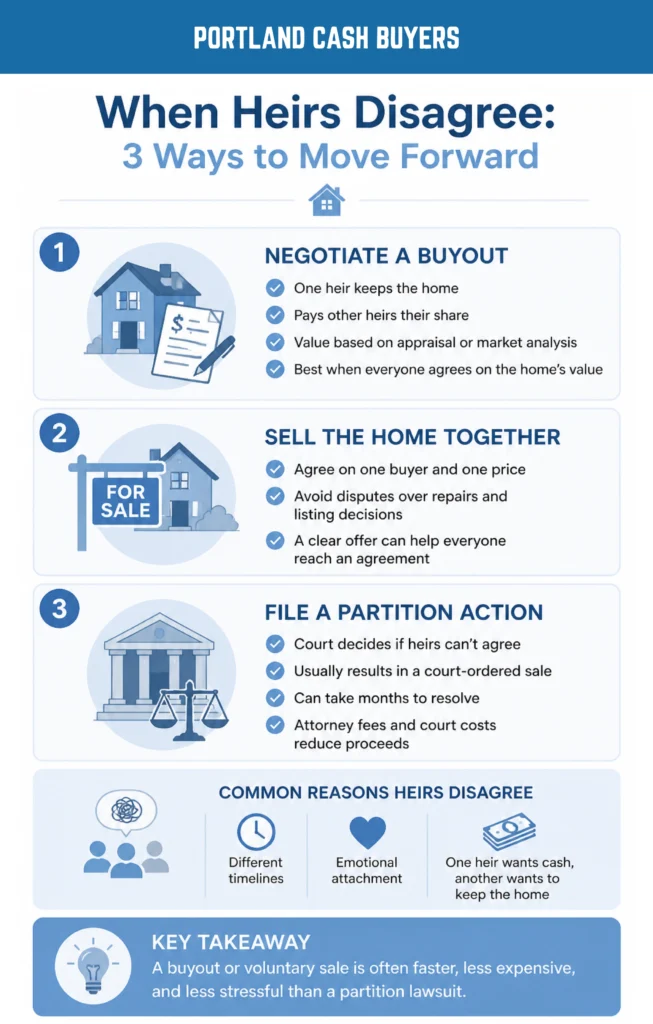
When heirs disagree about selling, Oregon law gives you three realistic paths: negotiate a buyout, sell to a buyer everyone can accept, or ask a court to force a resolution through partition. Most disagreements are not really about the house itself. They are about timing, sentimental attachment, or one heir wanting cash now while another wants to hold the property. Naming that difference honestly is usually the fastest way through it.
I have handled sales where three or four siblings had three or four different opinions, and the deal still closed because everyone agreed on one buyer and one number. A single, clean offer removes the guesswork that keeps families stuck arguing over listing price, repairs, and who fields the showings.
Buying Out the Other Heirs
A buyout lets one heir keep the house by paying the others the value of their share, usually based on a current appraisal or a comparative market analysis. The heir who wants to stay typically needs to qualify for financing to cash out the rest, which is often the hardest part in practice. Buyouts work best when the numbers are clear from the start, and every heir agrees on the valuation method before money changes hands.
Filing a Partition Action in Oregon
Filing a partition action is the legal fallback when heirs cannot agree, and any co-owner with an inheritable interest has the right to bring one under Oregon law. Oregon courts prefer to physically divide property when practical, but a single-family house almost never allows that, so judges typically order a sale instead and divide the proceeds. A partition case can take several months to resolve, and it adds attorney fees and court costs on top of the eventual sale, which shrinks what every heir walks away with. A partition action forces a resolution, but it is rarely the fastest or cheapest way to get there.
Who Has Authority to Sell: Executor vs. Heirs
Authority to sell an inherited house depends on whether the estate is still in probate or has already been distributed, and the table below breaks down who can act at each stage.
| Role | Selling Authority | Limits |
| Personal representative (executor) | Can sell estate property during open probate, per the will and Oregon probate law | May need court confirmation; must act in the estate’s best interest |
| Single heir (post-distribution) | Can sell only their own ownership share | Cannot force a sale of the whole house alone without partition |
| All heirs together | Can sell the whole property by unanimous agreement | Requires every co-owner’s signature on the sale |
| Court (via partition) | Can order a sale and divide proceeds | Only reached when heirs cannot agree voluntarily |
If the estate is still open, my earlier guide on how probate works when selling an inherited house in Oregon walks through the personal representative’s specific duties and timeline.
Comparing Your Three Paths Forward
Once you know who has authority to sell, the real decision is which path fits your family: a buyout, a voluntary sale to one buyer, or a court-ordered partition. Each one trades speed, cost, and control differently, and the table below lays out how they compare for a typical Portland-area estate.
| Path | Typical Timeline | Cost to the Estate | Who Decides |
| Heir buyout | 4 to 8 weeks, pending buyout financing | Appraisal fee plus loan costs for the buying heir | Buying heir and remaining heirs agree on value |
| Voluntary sale (agent or cash buyer) | 7 days to several months, depending on buyer type | Agent commission and closing costs, or none with a direct cash sale | All heirs sign off together |
| Partition action | 6 months or longer | Attorney fees, court costs, and referee fees where ordered | A judge orders the outcome |
A partition case is always available as a last resort, but it is the slowest and most expensive path for every heir involved, since legal costs come out of the estate’s value before anyone sees a check. Most Portland families I have worked with reach a buyout or a voluntary sale well before a partition filing becomes necessary, simply because it is faster and keeps more money in the family’s hands.
An Oregon-Specific Wrinkle: Estate Deadlock on a Vacant House
A house sitting vacant while heirs sort things out creates its own Oregon-specific risk, separate from the ownership dispute itself. Vacant homes in Multnomah, Washington, and Clackamas counties still accrue property taxes, insurance premiums, and utility costs every month the estate stays open, and an unoccupied house is also more exposed to weather damage, break-ins, and code violations than an occupied one. Homeowner insurance policies frequently reduce or exclude coverage on a property that has sat vacant beyond a set window, often 30 to 60 days, which can leave an estate uninsured against a burst pipe or a break-in right when heirs can least afford it.
I have seen estate deadlocks stretch a house’s vacancy past that insurance window more than once, and it rarely benefits anyone. Every month of delay is a month of carrying costs split among the same heirs who are trying to maximize what they walk away with. That carrying-cost math is often the detail that moves a stalled family toward a decision, whether that is a buyout, a sale, or at minimum an agreement on who is responsible for upkeep while the sale is worked out. The same math applies if the house is sitting with a code violation or deferred repairs; my page on rental property problems covers a similar carrying-cost squeeze for co-owned properties that are tenant-occupied.
Splitting the Proceeds Fairly
Proceeds from an inherited house sale are split according to each heir’s legal ownership percentage, which comes from the will or, if there is no will, from Oregon’s intestacy statutes. That percentage is not always an even split by headcount. A will can leave unequal shares, and a surviving spouse’s share under intestacy differs from a child’s share depending on the family structure.
- Confirm each heir’s exact percentage in writing before listing or accepting an offer.
- Net proceeds are what is left after paying off any mortgage, liens, closing costs, and estate expenses.
- Capital gains on an inherited house are usually calculated using the stepped-up basis at the date of death, which I cover in my guide to inherited house capital gains in Oregon.
- Get the split agreement in writing before closing so no one is surprised at the settlement table.
The Fastest Way to Resolve a Multiple-Heir Inherited House Sale
The fastest way to resolve a multiple-heir inherited house sale is a single cash offer that every heir can review, sign off on, and close on together, without a listing, showings, or a partition filing. I work directly with the personal representative and every heir at once, and I can present the offer as one number so your family is deciding on a deal, not negotiating a listing price among yourselves first.
This approach also helps families who are under real-time pressure, whether that is a probate deadline or a co-heir who needs cash from their share for their own financial situation. I buy the house directly with my own funds, not as a wholesaler putting it under contract to resell to someone else for a fee. Oregon’s HB 4058, the state’s new wholesaler registration law, exists to protect sellers from exactly that kind of assignment deal, and it does not describe how I operate. I will show proof of funds on request, and every closing runs through a licensed, insured title company so each heir gets their share cleanly and on record.
One family I worked with sold their parent’s home after a passing, and I gave them extra time to sort through personal belongings before we closed. That kind of flexibility is harder to get from a traditional buyer working on a mortgage timeline. If you would rather compare that path against listing with an agent, get a no-obligation cash offer and see the numbers side by side before you decide.
The offer I quote is the number at closing, with no last-minute deductions for repairs or fees. I close in 7 to 14 days on average, or as fast as 3 days if your family needs it, and every heir picks the date together.
Why a Cash Sale Resolves a Multiple-Heir Standoff Fast
A cash sale resolves a multiple-heir standoff fast because it removes the two things that usually stall these deals: financing risk and disagreement over listing decisions. There is no buyer financing to fall through, no repairs to argue about, and no commission eating into what each heir receives. Every heir sees the same number and signs off on the same closing date, which ends the back-and-forth that a traditional listing tends to drag out.

Frequently Asked Questions About Co-Owned Inherited Property
Can one heir force the sale of an inherited house in Oregon?
Yes. Any co-owner who holds an inheritable interest in the property can file a partition action under ORS 105.205, and Oregon courts will typically order a sale and divide the proceeds when the house cannot be physically divided.
What is a partition action and how long does it take?
A partition action is a lawsuit asking the court to divide co-owned property or order it sold and the proceeds split. It generally takes several months to resolve once filed, plus attorney fees and court costs that reduce everyone’s eventual share.
How do you split proceeds among heirs?
Proceeds are split according to each heir’s legal ownership percentage from the will or Oregon intestacy law, after paying off any mortgage, liens, and closing costs. Get the exact percentage confirmed in writing before you close.
Can one sibling live in the inherited house without paying the others?
Not indefinitely without some agreement. A co-owner living in the house generally owes the other owners for their share of the property’s value or fair rental value, and this is a common trigger for a partition filing when no agreement is reached.
Do all heirs have to agree to sell to a cash buyer?
For a voluntary sale, yes, every heir with an ownership share needs to sign off. I work directly with every heir and the personal representative to get everyone the same information at the same time, which is usually faster than negotiating a listing.
Selling an Inherited House With Multiple Heirs
If your family is dealing with selling an inherited house with multiple heirs in Oregon, you do not have to figure everything out on your own. Whether you are considering a buyout, trying to avoid a partition action, or simply want to explore your options, I am here to help. You can also learn more about the process of selling your house before deciding which path is best for your situation.
When your family is ready, request a free cash offer with no obligation. I work directly with heirs, executors, and title companies to make the process as simple and transparent as possible. Every offer is straightforward, with no agent commissions, no repair costs, and a closing timeline that works for everyone involved.
Still deciding if I am the right person to work with? Take a look at what other Portland homeowners have shared on my testimonials page, then reach out whenever you are ready. Whether you need to close in a few days or simply want honest guidance, I am happy to answer your questions and help your family move forward.
This is general information, not legal or financial advice. Every family’s situation is different, so talk with an Oregon attorney about your specific ownership rights and, if taxes are a factor, a tax professional about your net proceeds.