
You filed, or you are about to. One of you may already be sleeping somewhere else. And the mortgage is still due on the first of the month. Who pays the mortgage during a divorce in Oregon is one of the first money questions people bring to me, usually long before they are ready to talk about selling. The house does not pause while the case moves forward.
Here is the short answer. The lender can collect from anyone whose name is on the loan, no matter who lives in the house or what the two of you agreed. Until a temporary order or a final judgment says otherwise, both borrowers stay responsible, and a missed payment can show up on both credit reports. I buy houses, and I have been buying Portland-area homes since 2004. If carrying the house is turning into the real problem, I also explain how people sell your house during a divorce in Portland without waiting for the decree.
A few things catch most people off guard during this stretch:
- The deed and the loan are separate documents. Moving out does not take your name off either one, and it does not end your promise to the lender.
- Oregon has an automatic restraining order in divorce cases. Once it applies, neither spouse should let the homeowners policy lapse or sell the house without the other spouse agreeing in writing or a court order.
- A standard homeowners policy can lose key coverage once a house sits empty for a stretch. That matters most when both of you have moved out.
- Property taxes and HOA dues do not care whose turn it is. If they are not paid through escrow, someone has to decide who covers them before the bill arrives.
- A short written cost-sharing agreement heads off most of the arguments I hear about. It also gives your attorneys a clean record to work from.
Who Is Legally Responsible for the Mortgage During a Divorce in Oregon?
Everyone who signed the promissory note is responsible to the lender for the full payment, and filing for divorce does not change that. The loan is a contract between the borrowers and the lender. Your divorce is a case between you and your spouse. The lender is not a party to it.
That gap is where people get hurt. Experian’s guide to divorce and credit explains that a divorce decree does not end your responsibility for joint debts, including a home mortgage. It also notes that a lender can report late payments on a joint account to the credit bureaus, even when a judge ordered the other spouse to pay.
So the practical rule is simple. If your name is on the loan, you want to know every month that the payment went through. Ask the servicer for online access in your own name if you do not have it.
Whose Name Is on the Loan vs. Whose Name Is on the Title
The title, or deed, says who owns the house. The loan, or note, says who owes the money. They often match, but not always. Here is how the common setups break down.
| Setup | Who the lender can look to | Who owns the house on record |
| Both spouses on the loan and the deed | Both borrowers, each for the full payment | Both spouses |
| Both on the deed, one on the loan | Generally the borrower on the note, with the house as security | Both spouses |
| One spouse on both the loan and the deed | That spouse | That spouse, though title alone does not decide how a court divides the house |
If only one of you signed the loan, the other spouse may feel off the hook. With the lender, they may be. With the court, it is a separate question. A judge can still order either spouse to help cover the house while the case is open, and a home bought during the marriage can be divided no matter whose name is on the deed. Your attorney can tell you how that applies to your house.
How Temporary Orders Can Assign Mortgage Payments During a Divorce in Oregon
Yes, a judge can decide who pays before the divorce is final. Under ORS 107.095 in chapter 107 of the Oregon Revised Statutes, once a dissolution case starts, the court may provide for the temporary use, possession, and control of the couple’s property. It may also provide for payment of installment liens on that property. In plain terms, a judge can let one spouse stay in the house for now and tell one or both of you to keep the mortgage current.
Temporary spousal support or child support can also be set with the house payment in mind. The spouse who stays may carry the payment, or the other spouse may send money toward it.
Keep one limit in mind. A temporary order binds the two of you. It does not bind the lender. If the spouse ordered to pay stops, the servicer can still look to every borrower on the note. The fix for that is back in court, not with the bank. Ask your attorney how quickly your county schedules temporary-order hearings.
What Happens If Neither Spouse Pays the Mortgage?
The loan goes delinquent, late fees start, both borrowers’ credit can take the hit, and after enough missed months the servicer can begin foreclosure. None of it happens overnight. Here is the general order of events.
| Stage | What generally happens | Where to confirm |
| Payment date passes | The payment is late. Your promissory note sets any grace period and late fee. | Your note and monthly statement |
| Late payment reported | The lender can report the late payment for every borrower on a joint loan. | Experian divorce and credit guide |
| Early delinquency | The servicer contacts you about the missed payments and options to catch up or modify the loan. | Your servicer |
| More than 120 days delinquent | Federal rules generally bar the first foreclosure notice or filing until this point. | Consumer Financial Protection Bureau |
| Oregon foreclosure | Most Oregon home loans use a trust deed. A trust-deed foreclosure follows ORS chapter 86 and can include a notice of default and a trustee sale. | An Oregon attorney |
The 120-day point comes from federal servicing rules. The Consumer Financial Protection Bureau’s summary of its mortgage servicing rules says servicers cannot make the first notice or filing for foreclosure until a loan is more than 120 days delinquent. That window gives you room to act. It is not a reason to wait. What a lender or trustee does after that depends on your loan and Oregon law, so check the details with an Oregon attorney.
Credit is the part that surprises people most. The damage lands on both spouses, regardless of who lives in the house or who a temporary order names. A spouse who plans to refinance and keep the house may find that a recent late payment makes approval harder.
A missed payment can also slow the settlement. Late fees and back payments eat into the equity you are dividing. They also add one more thing to argue about, which usually means more attorney time.
If you are already behind, my page on being late on mortgage payments walks through the options. If a notice has arrived, start with the page on facing foreclosure in the Portland area.
Who Pays for Utilities, HOA Dues, and Property Taxes While the Divorce Is Pending?
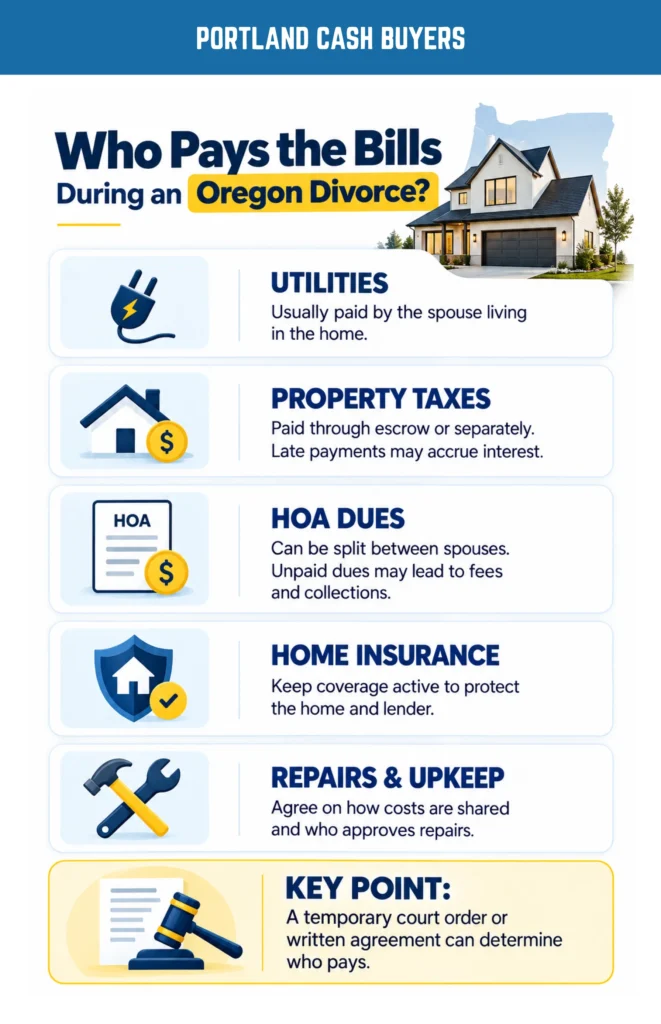
No Oregon rule automatically assigns these bills, so they get paid by whoever a temporary order names, whoever you agree on in writing, or whoever steps up to keep them current. The table below lays out each cost and what happens if it slips.
| Bill | Who it protects | Common arrangement to discuss | If it goes unpaid |
| Utilities (power, gas, water, sewer, garbage) | The person living there, plus the house itself | The spouse in the house pays | Shutoffs, and in an empty house, a higher risk of frozen or leaking pipes |
| Property taxes | Both owners | Paid through escrow if the loan has one; split if not | Interest on delinquent taxes, which Oregon law requires |
| HOA dues | Both owners | Split, often in the same ratio as the mortgage | Late fees and collection under your HOA rules |
| Homeowners insurance | Both owners and the lender | Through escrow, or split | A lapse can leave the house uncovered and trigger lender-placed coverage |
| Routine upkeep and repairs | Both owners | Split, with a dollar limit that needs both approvals | Deferred repairs lower what the house will sell for |
Start with your mortgage statement. If it shows an escrow balance, your property taxes and insurance are likely built into the monthly payment. That means keeping the mortgage current covers them too.
If you pay taxes yourself, the timing matters. Multnomah County’s property tax payment page says payments are due November 15, with the option to pay in up to three installments in November, February, and May. The county also notes that state law requires interest on late payments. Other metro counties follow the same state deadline, but check your own county’s statement.
If the combined costs are stretching you thin, you are not the first person in that spot. I wrote a separate guide on how to sell a house during a financial hardship in Oregon that covers the options besides a sale, too.
Insurance Considerations When the House Sits Vacant or Only One Spouse Lives There
Your homeowners policy has to match how the house is actually being used, and neither spouse should cancel or change it alone. Oregon’s automatic restraining order is the reason. The Oregon Judicial Department’s notice of the statutory restraining order lists what both spouses may not do once it applies. That includes canceling, modifying, or letting homeowners insurance lapse for nonpayment when it covers the other spouse, and changing who is covered.
So insurance changes during a divorce are a two-signature job. Talk to your attorney before you call the insurance company, and get any change agreed in writing.
Why a Standard Homeowners Policy May Not Cover a Vacant Home
Many homeowners policies cut back coverage once a house has been vacant for a while. The International Risk Management Institute’s article on vacant-home risk explains that after 60 days of vacancy, a standard homeowners policy automatically removes important coverages, such as vandalism and glass breakage. Some policies use different windows, so read your own.
Insurers also draw a line between vacant and unoccupied. A vacant house has little or no furniture. An unoccupied house still has furniture, but nobody is living there. If both of you have moved out and taken most of your things, your house may count as vacant. Ask your insurer whether you need a vacancy permit or a vacant-home policy. Keep the heat on at a safe setting through the winter and have someone check the house regularly.
Updating Your Policy After One Spouse Moves Out
When one spouse moves out, the policy still needs to reflect the house as it is. These are the steps worth talking through with your attorney first:
- Tell the insurer who is living in the house now. Occupancy changes can matter at claim time.
- Do not remove the other spouse as a named insured without their written consent or a court order.
- The spouse who moved should look at a renters policy for belongings at the new place. The house policy may not follow them.
- Keep premium payments current, and save the confirmation for your records.
How to Structure a Temporary Cost-Sharing Agreement
Put it in writing: list every house bill, who pays what share, from which account, by what date, and what happens if someone falls behind. A text thread is better than nothing. A signed page your attorneys have reviewed is better still. Here is what a solid one covers.
| Term | What to write down |
| Bills covered | Mortgage, utilities, insurance, property taxes, HOA dues, and routine upkeep |
| Each share | A percentage or a fixed dollar amount for each bill |
| How payments are made | One joint account both spouses fund, or each spouse pays set bills directly |
| Due dates | The date each spouse’s share must be in place, a few days before the bill is due |
| Proof of payment | Screenshots or a shared spreadsheet updated each month |
| Repairs | A dollar limit above which both spouses must approve the repair |
| If someone falls behind | Who covers the gap, and whether it gets credited back in the final division |
| When it ends | At closing on a sale, a completed buyout, or the final judgment |
Your attorneys or a mediator can turn this into a stipulated temporary order if you both agree. That gives it more weight than a private note. The line about credits matters most. Whether money one spouse paid gets credited back is a question for the property division, so let your attorneys word it.
Can One Spouse Sell the House While the Divorce Is Pending?
No, not alone. The same statutory restraining order bars either spouse from transferring property the other has an interest in without written consent or a court order. In practice, a sale during the case goes one of two ways. Both spouses agree and sign, or the court orders the sale.
When both of you agree, the mechanics are straightforward. Every sale I do closes at a licensed and insured title company. The title commitment shows who holds title and which liens are recorded. At closing, the title company handles the lien payoff on the mortgage from the sale proceeds. Many couples then have the rest of the proceeds held until the property division is final. That decision belongs to you and your attorneys, not to me.
I deal with both spouses directly, and I show both of you the same numbers. The offer comes with the math: recent comparable sales, the condition of the house, repair costs, and carrying costs. When two people do not trust each other much right now, one set of numbers helps.
Divorce sales tend to have a lot of moving parts. On my testimonials page, Matthew C. wrote about a tough timeline with many moving pieces and said I came through. Lindsay L. said she was nervous to sell without a lawyer or a realtor, and that everything I told her played out as promised. One more detail matters in a divorce. Couples often leave papers behind. Any sensitive documents I find after closing, like tax returns or bank statements, get shredded.
Why Many Portland Couples Choose to Sell Sooner Rather Than Keep Splitting These Costs
I can close a cash sale in 7 to 14 days from an accepted offer, and the fastest I have closed is 3 days. A traditional Portland listing usually runs longer once showings, inspections, and buyer financing are included. Every month you wait is another month of shared carrying costs. Here is how that adds up in an example scenario with round numbers.
| Months the house is carried | Total carrying costs (example: $3,000 a month) | Each spouse’s half |
| 1 month | $3,000 | $1,500 |
| 3 months | $9,000 | $4,500 |
| 6 months | $18,000 | $9,000 |
| 9 months | $27,000 | $13,500 |
That example assumes a combined $3,000 a month for the mortgage, utilities, insurance, and HOA dues. It is not a figure for your house. Plug in your own numbers.
Listing time moves with the market. Portland metro put the average total market time at 55 days this June, and a February summary from the same source reported 91 days. That is the time to an accepted offer. After that come the inspection, the appraisal contingency, the buyer’s financing contingency, and closing.
I will be straight with you. My cash offer will be lower than retail. The gap that matters is what you net. After agent commissions, repairs, seller closing costs, and months of carrying costs, the difference is often smaller than the sticker price suggests. I break that down line by line in my comparison of a cash offer versus listing when you need to sell fast.
Selling to me runs in three steps. You tell me about the home by form or phone. I review the comps and walk through the property privately, or make an offer from your photos. Then you pick a closing date at a licensed title company. I pay all closing costs, and there is no buyer financing contingency, so the deal cannot fall through because a lender said no. If one of you needs to stay a while after closing, a leaseback is an option. You can read more in my answers to common seller questions.
When Keeping the House or Listing It Is the Better Call
If one of you can refinance the loan into your own name and afford it alone, a buyout may beat any sale. If the house is in good shape, you have a few months, and you can keep splitting the costs without falling behind, list it. A cash sale is the right tool for speed and simplicity, not for topping the market.
| Your situation | Often the better fit |
| One spouse wants the house and can refinance and afford it alone | A buyout |
| The house shows well, bills are current, and there is time | A traditional listing |
| Payments are slipping, the house needs work, or you want one clean closing date | A cash sale |
| One spouse needs time to stay after closing | A cash sale with a leaseback |
I would rather you pick the right option than the one that suits me. I buy across the metro, from Portland out to the other cities I serve, and I tell people when listing makes more sense. You can read more about me and how I work before you decide anything.

Frequently Asked Questions About Who Pays the Mortgage During a Divorce in Oregon
Can I refuse to pay the mortgage during the divorce?
You can stop paying, but if your name is on the loan, the lender can still hold you responsible and report the late payment on your credit. A temporary order may assign the payment to one spouse, but it does not change the loan contract. Quinn Irvine is a home buyer, not a lawyer, and suggests talking with an Oregon family law attorney before you stop any payment.
What if my spouse will not leave and will not pay their share?
Ask your attorney about temporary orders. An Oregon judge can decide who stays in the house and who pays the mortgage while the case is open. Keep a record of every payment you make. If you later decide to sell and access is hard, Quinn Irvine can make an offer from a description and photos, though a sale still needs both spouses’ signatures or a court order.
Does paying the mortgage give me a bigger claim to the house?
Not automatically. Oregon judges divide property based on what is fair in all the circumstances, and payments made during the case can be part of that picture. How much weight they get depends on your facts. Keep receipts, and ask your attorney whether to request a credit in the final division.
Should we sell the house before the divorce is final to stop the ongoing costs?
Often it helps, as long as both spouses agree in writing or the court orders the sale. Selling early stops the shared bills and turns the house into money your attorneys can divide. Portland Cash Buyers typically closes in 7 to 14 days, and the net proceeds can be held until the property division is settled.
Who pays the mortgage during a divorce in Oregon if only one spouse is on the loan?
The lender generally looks to the spouse who signed the note. The court can still order either spouse to help cover the payment while the case is open. If the house was bought during the marriage, it may be divided no matter whose name is on the loan.
Does the mortgage get paid off automatically when we sell?
Yes, at closing. The title company pays off the mortgage and any other recorded liens from the sale proceeds. What is left goes out according to your agreement or a court order.
Settling Who Pays the Mortgage During a Divorce in Oregon Without Losing Ground
Who pays the mortgage during a divorce in Oregon comes down to three things: whose name is on the loan, what a temporary order says, and what the two of you put in writing. Keep the payment current, keep the insurance matched to how the house is used, and keep a record of every dollar. When carrying the house starts costing more than it is worth to either of you, a sale can end that.
If you want to see what a sale would actually net you both, I will give you a fair, no-obligation cash offer within 24 hours, from me personally. I am BBB A+ accredited and Google 5-star rated, and I answer my own phone. Call or text me at (503) 770-0145, seven days a week, 8 am to 8 pm, or reach me through my contact page. When you are ready, get your cash offer here.