
You and your spouse own a rental together, and now you are getting divorced. The family home gets most of the attention, but the rental is its own problem. Selling rental property during divorce in Oregon works differently from selling the house you live in. The taxes are different. There may be a tenant with a lease. And nobody is arguing over who gets to stay, because neither of you lives there.
Yes, you can sell a jointly owned rental during an Oregon divorce. Once the divorce petition is filed and served, though, you generally need written consent from both of you or a court order. Before you pick a path, you need three answers. Is the rental marital property? What will a sale cost in taxes? And what happens to the tenant? For the family home, see my guide on selling a house during a divorce in Portland. This page is its companion. I’m Quinn Irvine, owner of Portland Cash Buyers. I have been buying Portland-area homes since 2004, and I hold a BBB A+ accreditation. Every deal I do closes through a licensed and insured title company.
Here are a few things most couples hear about late in the process, when they would have been useful early:
- The home sale tax exclusion that shields a lot of gain on a primary residence usually does not cover a rental. Depreciation you claimed over the years can come back as taxable gain.
- A buyout between spouses is generally not a taxable sale under federal rules. But the spouse who keeps the rental also keeps its tax history. That hidden cost belongs in the buyout number.
- In Oregon, selling a rental does not end the tenant’s rental agreement. The tenancy generally carries over to whoever buys the property.
- A 1031 exchange has hard 45-day and 180-day deadlines. With a rental, the date you close can matter more than the price.
How Is a Rental Property Divided in an Oregon Divorce?
An Oregon court divides a rental the same way it divides other property: in a way that is “just and proper in all the circumstances,” which is not an automatic 50/50 split. Oregon is not a community property state. The rule comes from ORS 107.105, which you can read in Oregon Revised Statutes chapter 107. The statute also starts from a presumption that both spouses contributed equally to property acquired during the marriage.
In practice, a rental usually ends up one of three ways. It gets sold and the proceeds get divided. It goes to one spouse, who buys the other out or gives up other assets to balance it. Or the two of you keep owning it together. Which one happens depends on your agreement or on the judge. I can’t tell you what a court will do in your case. Only an Oregon family law attorney can.
What I can tell you is what the rental is worth to a cash buyer today. That means as-is, with the tenant in place. That is one real number. It is often a useful one when two attorneys are trying to put a value on the same property.
One more rule matters before you list or sign anything. After a petition is filed and served, Oregon puts an automatic restraining order in place. It generally bars either spouse from transferring property the other has an interest in. The exceptions are written consent or a court order. The Oregon Judicial Department’s statutory restraining order notice spells out the exact terms. A sale of the rental falls squarely in that territory, so get the consent in writing.
Is the Rental Marital Property, Even If Only One Spouse’s Name Is on It?
Often, yes. The presumption of equal contribution in ORS 107.105 applies to property acquired during the marriage whether it is held jointly or separately. So the name on the deed does not settle the question.
There are exceptions. A rental one spouse owned before the marriage, or received as a gift and kept separate, may be treated differently. The same can be true of a rental one spouse inherited. Mixing matters, though. Say marital money paid the mortgage or covered repairs. That can change how the property is treated. These are fact-specific questions for an attorney. Did the rental come to you through a parent’s estate? My page on selling an inherited house covers that side of it.
At closing, the title company works from the deed and the divorce paperwork. Say only one name is on the deed, but the divorce gives the other spouse an interest. Expect the title company to ask for both signatures or a court order.
Tax Differences: Investment Property vs. Your Primary Residence
A rental is taxed as investment property, so you usually owe tax on the full gain, including a slice tied to past depreciation. A primary residence, by contrast, can often exclude a large part of its gain. The table below lays out the main differences using IRS rules.
| Tax question | Rental or investment property | Primary residence |
| Home sale exclusion (Section 121) | Generally not available unless you meet the ownership and use tests | Up to $250,000 of gain, or $500,000 on a joint return, if the tests are met |
| Depreciation | Claimed each year; lowers your adjusted basis | Not claimed on a personal residence |
| Gain tied to depreciation | Unrecaptured section 1250 gain, taxed at a federal maximum of 25% | Not applicable |
| 1031 exchange | Possible if the property was held for investment | Not available for a primary residence |
| Transfer to your spouse incident to divorce | Generally no gain or loss recognized | Generally no gain or loss recognized |
The exclusion figures come from IRS Topic 701 on selling your home. The 25% maximum rate comes from IRS Topic 409 on capital gains and losses. Oregon adds its own layer. Your Oregon taxable income starts from your federal taxable income, with state additions and subtractions, as the Oregon Department of Revenue explains. I’m not a tax professional, and nothing here is tax advice. Take your actual numbers to a CPA before either of you signs.
Depreciation Recapture and Capital Gains on a Rental Sale
Every year you owned the rental, depreciation lowered your taxable rental income. It also lowered your adjusted basis, the number the IRS subtracts from your sale price to find your gain. When you sell, that depreciation comes back into the math.
Here is an example scenario with round numbers. It is only an illustration, not your numbers. Say a couple bought a rental for $300,000 and claimed $50,000 of depreciation over the years. Their adjusted basis is now $250,000. If they sell for $400,000, ignoring selling costs, their gain is $150,000. Of that, $50,000 ties back to depreciation. Federal rules generally tax that slice at a rate of up to 25%. The rest is typically treated as long-term capital gain if they held the property for more than a year.
In a divorce, the next question is whose tax it is. That depends on how you file for the year of the sale and how your settlement assigns the gain. Ask your CPA to run it both ways. Also ask whether any depreciation you were entitled to take but never claimed still counts against you. People are often surprised by that answer.
Why the Home Sale Tax Exclusion Doesn’t Apply the Same Way Here
The Section 121 exclusion is built for your main home. To qualify, you generally must own and live in the home for at least two of the five years before the sale. A rental you have never lived in does not meet the use test. So the exclusion usually does not apply at all.
There is a gray area. If one of you lived in the rental within that five-year window, part of the exclusion might still be available. Even then, the gain tied to depreciation generally cannot be excluded. This is exactly the kind of question worth an hour with a CPA. If this were your primary residence instead, the tax picture would look very different. My divorce page walks through how selling the family home works.
Your Three Options for the Rental Property
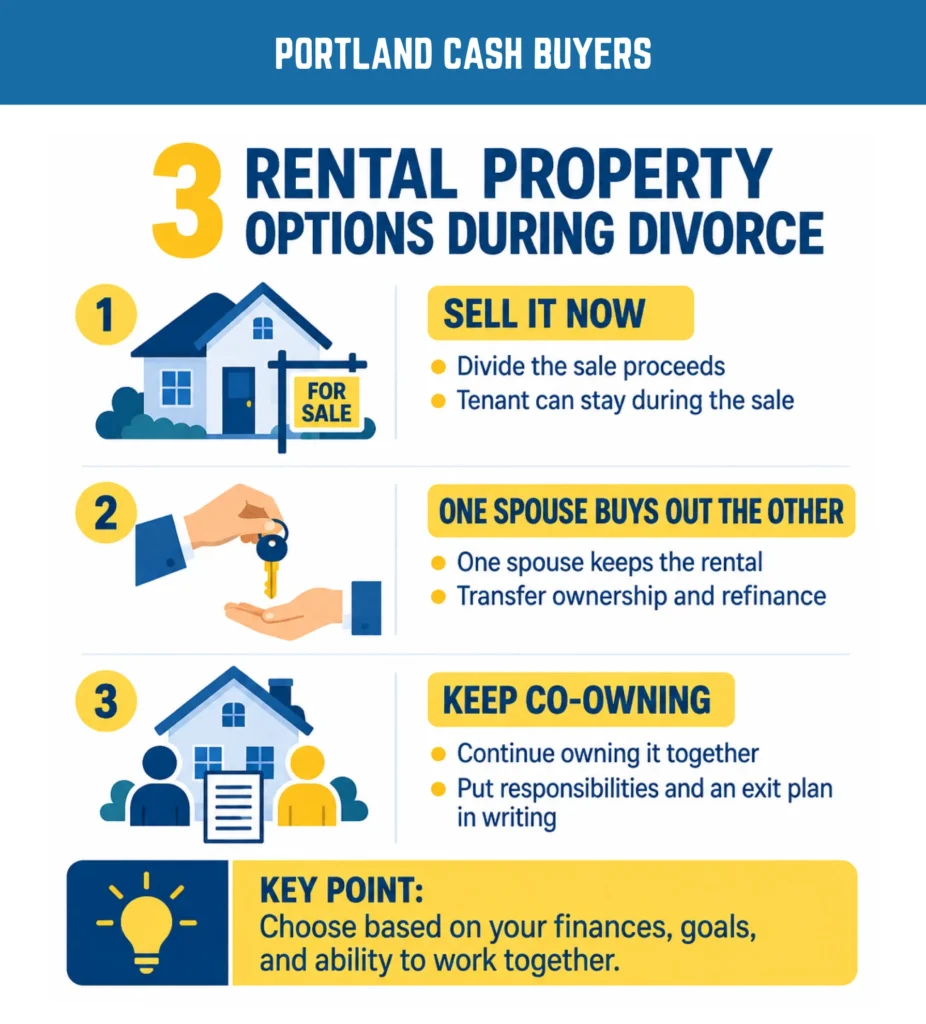
You have three realistic options: sell the rental now and divide the proceeds, have one spouse buy out the other and keep it, or keep owning it together after the divorce. The family home usually has a fourth option, where one spouse keeps living there for a while. With a rental, that option drops out, because neither of you lives in it.
| Option | What it takes | Works well when | Watch out for |
| Sell it now | Both spouses agree in writing, or a court orders it | Neither of you wants to be a landlord, or you need cash to divide | Tax on the gain and depreciation lands in the year of sale |
| One spouse buys out the other | An agreed value, then a refinance or payoff and a deed transfer | One spouse wants the rental income and can qualify to refinance | The keeping spouse takes on the rental’s tax basis and depreciation history |
| Keep co-owning it | A written co-ownership agreement | Cash flow is strong and the two of you can still work together | Every future decision needs two signatures |
Sell it now, tenant or no tenant. This is the cleanest split. The title company pays off the mortgage and any liens from the proceeds. Then it pays out the rest the way both of you, or the court, direct. A tenant does not have to move out first. I buy occupied rentals with tenants in place, and I don’t require a seller to evict.
One spouse buys out the other and keeps it as a landlord. Under federal rules, a transfer between spouses, or to a former spouse incident to the divorce, generally triggers no gain or loss. IRS Publication 504 for divorced or separated individuals covers this. The catch is that the spouse who keeps the rental also keeps the original adjusted basis. The whole depreciation history comes along. A buyout priced only on today’s equity can quietly hand one spouse a larger future tax bill. Ask a CPA to estimate that embedded tax and build it into the number.
Continue co-owning the property after the divorce. Some couples keep a rental because it cash-flows and neither wants to sell in a soft moment. That can work. Put it in writing. Cover who manages it, who takes tenant calls, and how repairs get approved. Cover the reserve fund and how either of you can exit. Without an exit clause, co-ownership can turn into a second divorce years later. If the rental itself is the real headache, not the divorce, read my page on a rental property causing you problems.
Selling a Tenant-Occupied Rental During a Divorce
Yes, you can sell a rental with a tenant living in it. In Oregon, the sale generally does not end the tenant’s rental agreement. The buyer steps into the landlord’s role. Oregon’s Residential Landlord and Tenant Act, in ORS chapter 90, sets the rules for when and how a tenancy can end.
The tenant is not part of your divorce. They keep paying rent under the lease. While your case is open, agree in writing on three things: who collects rent, who pays the mortgage, and who handles repairs. That one page heads off a lot of arguments.
For a tenant-occupied rental, I schedule a private walk-through. The tenant gets proper notice, as your lease and Oregon law require. If that is not workable, I can make a sight-unseen offer from your description and photos. For more on how this works day to day, see my post on selling a house with tenants in place.
What Happens to the Existing Lease
It depends on the type of tenancy. Under ORS 90.427, a landlord generally can end a fixed-term lease during its term only for cause. A sale by itself is not cause. So a fixed-term lease usually runs to its end date, and the new owner honors it.
Month-to-month tenancies after the first year work differently. Oregon allows a landlord to end one with at least 90 days’ written notice for a short list of qualifying reasons. One of them is a sale. It applies when you accept an offer from a buyer who intends in good faith to live there. In many cases, the landlord must also pay the tenant one month’s rent. Landlords with interests in four or fewer units are exempt from that payment. Cities can add rules on top of state law, and Portland has its own tenant relocation requirements. Check with an Oregon landlord-tenant attorney before you send any notice.
At closing, the security deposit and prorated rent typically move to the buyer through escrow. The buyer then holds the deposit and answers to the tenant for it.
Selling to a Cash Buyer vs. Waiting for the Lease to End
Selling to a cash buyer lets you close with the tenant in place on a date you pick. Waiting for the lease to end lets you list a vacant, cleaned-up house to buyers who plan to live in it, usually for a higher price. The tradeoff is time, carrying costs, and how long the two of you can keep making joint decisions.
| Factor | Sell to Portland Cash Buyers with the tenant in place | Wait for the lease to end, then list |
| Timing | Cash offer within 24 hours; typical close 7 to 14 days from an accepted offer | The rest of the lease, then prep time and time on the market |
| Tenant | Stays under the existing lease; no eviction needed | Must move out under the lease and Oregon law before a vacant listing |
| Repairs | Buys as-is; repair costs are factored into the offer | Often repairs, cleaning, and paint to compete with other listings |
| Price | Lower than retail | Usually higher, if the house shows well |
| Buyer financing | No financing contingency on the buyer’s side | Most buyers need a loan, appraisal, and inspection to close |
| Costs to the seller | Quinn Irvine pays all closing costs; no commissions or fees | Listing commissions, seller closing costs, and carrying costs until closing |
| Joint decisions | One offer, one closing date to agree on | Price changes, repair requests, and offers to agree on for months |
My offer will be lower than what a well-prepared house could get on the open market. I say that plainly, and my FAQ answer on getting lowballed says the same thing. The honest comparison is what each of you nets. Subtract commissions, repairs, and closing costs. Then subtract months of mortgage, taxes, and insurance on a property you both still pay for. For a fuller side-by-side, read my post on a cash offer versus listing when you need to sell fast.
1031 Exchanges and Divorce Timing
A 1031 exchange can defer tax on a rental sale, but only if it is set up before closing and you meet two deadlines. According to the IRS fact sheet on like-kind exchanges, you have 45 days from the sale to identify replacement property in writing. You then must receive the replacement property within 180 days, or by your tax return due date if that comes sooner. The IRS says these limits cannot be extended except for presidentially declared disasters.
Divorce makes this harder. Often one spouse wants cash, and the other wants to stay invested. Can one of you exchange a share while the other cashes out? That depends on how title is held and when the sale happens relative to the divorce. That is a question for a CPA and a qualified intermediary, and it needs an answer before closing, not after.
A 1031 exchange also puts the calendar in charge. The sooner the sale closes, the sooner the 45-day clock starts. If an exchange is part of the plan, tell me up front. The title company can then coordinate with your intermediary, and you can pick a closing date that fits the exchange.
When Keeping or Listing the Rental Is the Better Call
If the rental has a good tenant, solid cash flow, and one of you genuinely wants to own it, a buyout usually beats a sale. If the house is in good shape, the lease is ending, and you both have a few months, list it. A cash sale is the right tool for speed and simplicity, not for topping the market.
A sale to me tends to fit these situations:
- The rental needs work that neither of you wants to fund or manage during a divorce.
- The tenant situation is messy: late rent, months left on the lease, or a tenant who won’t cooperate.
- You cannot agree on a list price, a repair budget, or how to respond to offers.
- You both want a firm date when the property, the mortgage, and the joint decisions are behind you.
If none of those fit, you may do better another way. I would rather tell you that now than have you find out later.
What to Ask Any Cash Buyer Before You Both Sign
Ask four things: will you take title or assign the contract, can you show proof of funds, which title company will close it, and how did you get to your number. The answers tell you who you are really dealing with.
The first question matters most. A wholesaler signs a contract to buy your property and then sells that contract to another investor. They hold only an equitable interest, never title. Oregon now regulates this. House Bill 4058 is Chapter 3 of the 2024 Oregon Laws. Under it, residential property wholesalers must register with the Oregon Real Estate Agency, starting July 1, 2025. They must also give buyers and sellers a written disclosure before a wholesale contract and include it in their advertising. The agency’s overview of Oregon’s property wholesaling law gives the definition. Wholesaling means marketing property where you hold only an equitable interest or option. You have also held it for fewer than 90 days and invested less than $10,000 in improvements. If you have a specific question about how the law applies to your deal, ask an Oregon real estate attorney.
Here is how I work. I take title in my own name, and I don’t assign contracts. As I see it, the wholesaling rules don’t change anything about how I do business, because I’m the buyer who closes. On the other three questions:
- Proof of funds. I provide a bank letter or statement on request. Ask every buyer for one.
- Title company. Every closing runs through a licensed and insured title company in Portland. You can contact the title company directly for status updates, not just me.
- The math. I show you the comparable sales, the condition, the repair costs, and the carrying costs. Then I walk through how they add up to my offer.
The number also does not move at closing. No last-minute deductions and no hidden fees. That matters in a divorce. A change at the closing table means two people and two attorneys must agree all over again. Lindsay L. was nervous to sell without a lawyer or a realtor. She wrote that everything played out the way I said it would. You can read her words and others on my seller testimonials page. One more practical step: ask any buyer for the offer and the math in writing. Then both spouses and both attorneys see the same numbers.
How Selling Your Rental to Me Works
Selling to me runs in three steps: you tell me about the home by form or phone, I review the comps and walk through the property privately or make an offer from your photos, and you pick a closing date at a licensed title company.
- Tell me about the rental. Share the address, the tenant situation, the lease terms, and where the divorce stands. Either of you can reach out, and I answer calls and texts seven days a week, 8 am to 8 pm.
- I review it and see it. I pull recent comparable sales and public records. Then I schedule a private walk-through with proper notice to your tenant, or I make a sight-unseen offer from photos. You get a no-obligation cash offer within 24 hours, with the math walked through.
- You pick the closing date. Closing happens at a licensed and insured title company. I pay all closing costs, and there are no commissions or fees. The title company pays off the mortgage from the proceeds and pays out the rest as you both direct.
A typical close takes 7 to 14 days from an accepted offer. It can be as little as 7 days, and the fastest I have closed is 3 days. It can also be much later if you need to wait on the divorce judgment or a 1031 plan. There is no buyer financing contingency, so the sale cannot fall through because a lender says no. Title issues or a court delay can still hold up any closing. If I see one coming, I will tell you. You can read more about me and how I work.
Christina C. sold her late mother’s home with her brothers. She wrote that I came out the day they called and had an offer to them the next day. Several owners, one house, one set of numbers. A rental in a divorce is often the same kind of problem.

Frequently Asked Questions About Selling Rental Property During an Oregon Divorce
Can we sell a rental property before the divorce is finalized?
Yes. Before a petition is filed, co-owners can generally sell if both sign. After it is filed and served, Oregon’s automatic restraining order generally requires written consent from both spouses or a court order. Some couples agree to have the title company or an attorney hold the proceeds until the judgment divides them. Confirm the details with your Oregon family law attorney.
Do we split rental income the same way we’ll split sale proceeds?
Not necessarily. Rent collected during the case is part of the financial picture your settlement or the court will sort out. It may be divided differently from the sale proceeds, depending on who paid the mortgage and expenses. Rental income also goes on your tax returns. Ask a CPA how your filing status affects it.
What if my spouse wants to keep the rental and I don’t?
A buyout is the usual answer. The spouse who wants the rental pays the other for their share, often through a refinance. The hard part is agreeing on value. A written, no-obligation cash offer from Portland Cash Buyers gives both sides one real as-is number to compare with an appraisal. If you still can’t agree, the court decides.
Can you buy a rental property with a tenant still living there?
Yes. Quinn Irvine buys occupied rentals with tenants in place, and Portland Cash Buyers does not require the seller to evict. In Oregon, the rental agreement generally stays in effect after the sale. The tenant keeps living there under the existing terms.
Do both spouses have to sign to sell the rental?
Usually, yes. The title company needs everyone on the deed to sign. Once the divorce is filed, it may also need written consent or a court order. That can apply even if only one name is on title. Your attorneys can confirm what your paperwork requires.
Your Next Step for Selling Rental Property During Divorce in Oregon
Selling rental property during divorce in Oregon comes down to three things. Know whether it is marital property. Know what the tax bill looks like. Know what happens to the tenant. Once you have those answers, the choice between selling, a buyout, and co-owning usually gets clearer. Your attorney and your CPA should be part of it.
If a sale is the right fit, I’ll give you a fair, no-obligation cash offer within 24 hours, from me personally. The math comes with it, so both of you see the same numbers. Get your cash offer, or call or text me at (503) 770-0145. If you’d rather write first, you can send me a message.