
You just signed a separation agreement, or you’re looking at one. The number on it seems large. Then the real questions about severance pay in Oregon start. How much of this check will I keep? Will it hold up my unemployment? Can I keep the house on it, or is it time to sell?
Here’s the short answer. Severance is taxed as regular wage income, and employers can withhold federal tax at a flat 22 percent and Oregon tax at a flat 8 percent. Oregon does not ask you to report severance on your weekly unemployment claim. The check is best treated as runway: time to decide about the house calmly. I’m Quinn Irvine, the owner of Portland Cash Buyers. I’ve bought homes in the Portland area since 2004. If you’re weighing selling a house during a financial emergency, this is how I’d think it through with you.
A few things people usually learn later than they’d like:
- The 22 percent federal withholding is a payroll shortcut, not your tax rate. Depending on your income for the year, you could owe more at filing time or get some back.
- How your separation is worded matters for unemployment. Oregon pays benefits to people who lose work through no fault of their own, so read any “voluntary resignation” language before you sign.
- Every month you carry the house comes out of your severance. The mortgage, taxes, insurance, and utilities keep running whether or not the house is for sale.
- If you qualify for the IRS home-sale exclusion, the profit from selling your main home may not stack on top of your severance income at all.
- Selling doesn’t have to mean moving out the same week. A leaseback can let you close, get paid, and stay put while you look for work.
How Is Severance Pay Taxed in Oregon?
Severance pay in Oregon is taxed as ordinary wage income, both by the IRS and by the state. It is not a gift or a capital gain. It shows up on your W-2 like a paycheck. Federal income tax, Oregon income tax, Social Security, and Medicare all apply.
The IRS treats severance as a supplemental wage. IRS Publication 15, the employer’s tax guide, lets employers withhold federal income tax on supplemental wages at a flat 22 percent. The rate rises to 37 percent on supplemental pay above $1 million in a year. Social Security tax of 6.2 percent and Medicare tax of 1.45 percent also come out. Social Security stops once your wages for the year reach the annual wage base.
Oregon has a similar shortcut. The Oregon Department of Revenue withholding tax tables let employers use an 8 percent flat rate on supplemental wages paid apart from your regular payday. Your employer can also lump severance in with a regular paycheck and withhold as if it were one large payment. Either way, what comes out is an estimate.
Why 22% Federal Withholding on Severance Isn’t Your Final Tax Bill
Withholding is a down payment on your tax, not the final number. When you file, the IRS figures tax on your total income for the whole year. If that income puts you in a bracket above 22 percent, the flat withholding comes up short. You pay the difference when you file. If you’re in a lower bracket, or out of work for much of the year, you may get some back.
This matters for your house decision. Don’t treat the net check as fully spendable until you’ve looked at your year with a tax professional. I’m not a tax advisor, and I won’t guess at your bracket. What I can tell you is to plan for either outcome and ask early.
Lump-Sum vs. Installment Severance
Lump-sum severance arrives all at once. It counts as income in the year you receive it. Installment severance, sometimes called salary continuation, arrives on your normal payroll schedule. If the payments cross into a new calendar year, part of the income moves into that year. That can change your tax picture, so ask payroll or HR exactly how and when you’ll be paid.
Installments also raise an unemployment question. If you’re still on the payroll, or still earning benefits like paid time off, you may not count as separated yet. The next section covers that.
Do You Report Severance Pay to Oregon Unemployment?
No. The Oregon Employment Department says you do not have to report severance pay on your weekly claim for benefits. Its Oregon unemployment insurance FAQ lists severance as non-reportable pay. Accrued leave paid after you separate, jury duty pay, and a few other items sit on the same list. So in Oregon, a severance check by itself generally shouldn’t delay or reduce your weekly benefit.
That’s not true everywhere. Some states reduce benefits week by week while severance is being paid. If you read advice online, check which state it was written for.
Two cautions still apply. First, you have to qualify. The department’s unemployment insurance claimant handbook describes benefits as temporary income for workers who become unemployed through no fault of their own. If a separation agreement describes your exit as a voluntary resignation, that wording could cause trouble with your claim. Read it before you sign. If the language worries you, ask an Oregon employment attorney.
Second, you have to actually be separated. If you’re still employed during a notice period, you’re not unemployed yet. The clock on benefits starts when the job ends.
Reporting Severance Pay on Your Oregon Unemployment Weekly Claim
Your weekly claim asks about work and earnings, and severance isn’t one of the items Oregon wants listed there. You file weekly claims through Frances Online, the state’s claim system. You still report earnings from any work you do during a claim week, including part-time or gig work.
Pay in lieu of notice and salary continuation are less clear-cut. Pay in lieu of notice is money an employer pays instead of giving advance warning. Salary continuation keeps you on the payroll for a set period. Whether either one counts as severance, as wages, or as a sign you’re still employed depends on the facts. When in doubt, ask the department before you file. A quick question now is easier than repaying an overpayment later.
One note for Clark County readers. If you worked in Washington, Washington’s Employment Security Department sets its own rules. Don’t apply Oregon guidance to a Washington claim.
How Much Runway Does Your Severance Actually Buy?
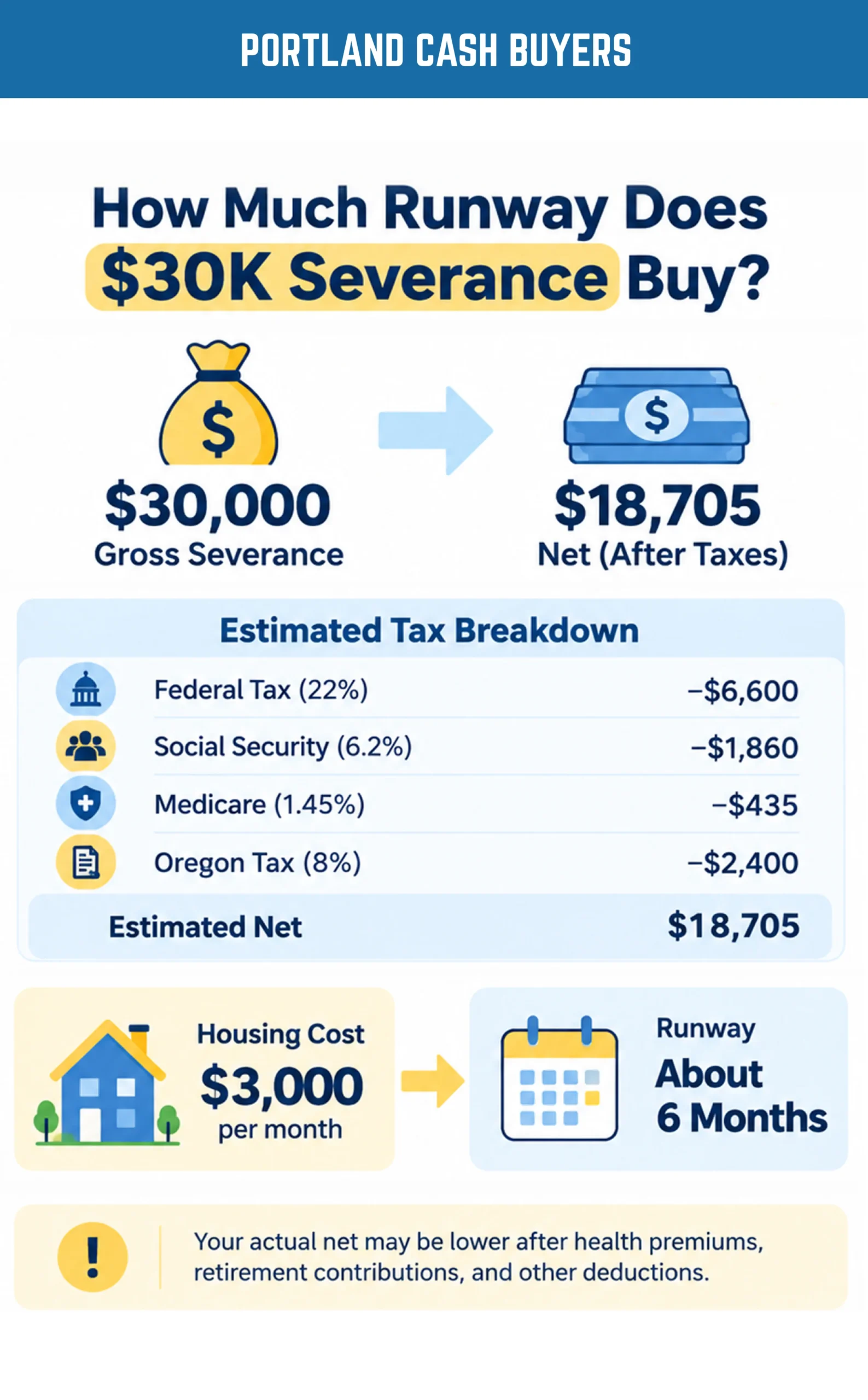
Your runway is your net severance plus any unemployment benefits, divided by what it costs you to live each month. The house is usually the biggest line in that math. Below is an example scenario with round numbers. It is not your tax bill and not a quote. It shows how fast a gross figure shrinks.
| Example scenario: $30,000 lump-sum severance | Amount | Basis |
| Gross severance | $30,000 | Example figure |
| Federal income tax withheld (22%) | -$6,600 | IRS Publication 15 flat supplemental rate |
| Social Security (6.2%) | -$1,860 | IRS Publication 15 |
| Medicare (1.45%) | -$435 | IRS Publication 15 |
| Oregon income tax withheld (8%) | -$2,400 | Oregon DOR flat supplemental rate |
| Net check before other deductions | $18,705 | Gross minus the lines above |
| Example monthly housing cost | $3,000 | Mortgage, taxes, insurance, utilities (example) |
| Months of housing covered by severance alone | About 6 | $18,705 divided by $3,000 |
Your real check could be smaller. Employers may also take out health premiums, retirement contributions, or other items. And as covered above, 22 percent may not be your final federal tax.
Unemployment benefits can stretch that runway. Because Oregon doesn’t count severance on your weekly claim, the two can help you in the same weeks. Look up your likely weekly benefit with the Oregon Employment Department rather than guessing at it.
Write your own version of this table on a sheet of paper. Use your real monthly housing cost, not a hopeful one. Include property tax and insurance even if they’re paid through escrow. That one number tells you more about your house decision than anything else in this article. If you want a companion read, my post on selling your house fast during a financial hardship in Oregon covers the broader hardship picture.
When Your Severance Means You Should Keep or List the House
If your severance and benefits cover six months or more, your house is in good shape, and your market is steady, don’t sell to me. Keep it while you look for work, or list it. A cash sale is the right tool for speed and simplicity, not for topping the market.
I’d rather say that now than have you regret a fast sale. A layoff feels urgent. The house decision often isn’t, at least not in the first week. Here’s how I’d sort the common situations.
| Your situation | What usually makes sense |
| Six months or more of runway, home in good condition, payments current | Keep the house or list it. You have time to aim for full market value. |
| A few months of runway, or the home needs repairs you can’t fund | Get a baseline cash offer and compare it with a listing. Decide with both numbers in hand. |
| Payments already behind, or runway under two months | Call your lender and a HUD-approved housing counselor first. Then compare a sale against the options they give you. |
| A new job offer in another city | Weigh selling against renting the house out before you move. |
| You were already thinking about a smaller place | A layoff can be the moment to act on a plan you already had. |
If payments have slipped, my page on falling behind on mortgage payments explains what I can and can’t do. If a new job means a move, see selling a house because you’re relocating. If the layoff lines up with a plan to get smaller, read my notes on downsizing to a smaller home.
Think about your next place, too. If you plan to rent after selling, a landlord will look at your income. If you plan to buy again, a lender will look at it more closely. Talk to a loan officer before you sell if buying again soon is part of the plan. Severance is a one-time payment, and lenders tend to care about income that continues.
How Fast Can You Sell Your Portland House After a Layoff?
I can close a cash sale in 7 to 14 days from an accepted offer, and the fastest I have closed is 3 days. A traditional Portland listing takes months once showings, inspections, and buyer financing are included.
| Stage | Traditional listing | Cash sale to Quinn Irvine |
| Getting ready | Repairs, cleaning, staging, and photos; time varies | Nothing required; sold as-is |
| Time on market | Average total market time of 54 days in the Portland metro (RMLS, July data) | No public listing period |
| Property access | Repeated public showings and open houses | A private walk-through with me, or a sight-unseen offer from photos |
| Offer | Buyer offer, often with financing and appraisal contingencies | No-obligation cash offer within 24 hours |
| Closing | After the buyer’s loan and appraisal clear | Typically 7 to 14 days; you pick the date |
If your property is outside Portland itself, you can check the Portland-area cities I serve to see whether your home is within my service area.
Total market time measures how long a listing takes to reach an accepted offer. After that, the buyer’s lender still has to finish underwriting before closing. Market time also moves with the season, so check the latest figure before you plan around it.
A cash sale removes the financing contingency. The deal can’t fall through because a buyer’s lender said no. That doesn’t mean nothing can slow a closing. A title problem, an unexpected lien, or a probate question can delay any sale, including mine. What I can tell you is where your file stands at every step. For a side-by-side look at both paths, read my comparison of a cash offer versus listing with a realtor.
Speed helps when your runway is short. Speed is not the same as a better price.
What It Costs to Carry the House While You Decide
Carrying a house costs the same each month whether you’re working or not. Carrying costs include the mortgage, property taxes, insurance, utilities, and upkeep. Using the example numbers above, here’s how they draw down a net severance of $18,705.
| Months carrying the house | Example carrying cost at $3,000 a month | Share of example net severance used |
| 1 month | $3,000 | About 16% |
| 3 months | $9,000 | About 48% |
| 6 months | $18,000 | About 96% |
This isn’t a reason to panic. It’s a reason to decide on purpose. The honest comparison between a cash sale and a listing isn’t the price at the top of the offer. It’s your net-to-seller after commissions, repairs, closing costs, and these carrying months.
My cash offer will be lower than retail. No cash buyer pays full retail, and I won’t pretend otherwise. Sometimes, after every cost is counted, the gap is smaller than people expect. Sometimes listing clearly wins. Either way, I show you how I got to my number: recent comparable sales in your neighborhood, the home’s condition, the repair cost, and the carrying costs I’ll take on.
If you’re already behind and a notice of default has arrived, the timeline changes. Oregon trust deed foreclosure follows its own statutory steps, and the details depend on your loan. My page on what to do if foreclosure is on the table explains the general process. Confirm the specifics with an Oregon attorney or a HUD-approved housing counselor.
Does Selling Your House Add to Your Severance Tax Bill?
Often no, if the house is your main home and you qualify for the IRS exclusion. Under IRS Topic No. 701 on selling your home, you may exclude up to $250,000 of gain, or up to $500,000 on a joint return. To qualify, you generally must have owned the home and lived in it as your main home for at least two of the five years before the sale. Gain within that limit doesn’t get added to your severance income.
If you don’t qualify, or your gain is larger than the limit, the taxable part lands on the same year’s return as your severance. That can push more of your income into a higher bracket. Whether to close this year or next is a question for a tax professional, not for me.
You’ll likely receive a Form 1099-S from the closing. The IRS says to report the sale if you receive one, even when the gain is excludable. For how Oregon treats the sale on your state return, check with the Oregon Department of Revenue or a tax professional.
One more practical point. If you still owe on the mortgage, the licensed title company pays off the loan from the sale proceeds at closing. You receive what’s left. You don’t need to catch up on the loan or pay it down before you sell.
How Selling Your House to Me Works
Selling to me runs in three steps: you tell me about the home by form or phone, I review the comps and walk through the property privately or make an offer from your photos, and you pick a closing date at a licensed title company.
Here’s what that looks like in practice. Within about an hour of your form, I pull recent comparable sales and public records. Within 24 hours, I call you, ask questions, and set up a private walk-through. If you can’t meet, I can make a sight-unseen offer based on your description and photos. You get a no-obligation cash offer within 24 hours, and I walk you through the math behind it.
At closing, a licensed and insured title company in Portland handles the escrow. I pay all closing costs. There are no commissions and no fees to you. You can reach the title company directly for status updates, not just me. You can leave belongings behind. If I find sensitive papers after closing, like tax returns or bank statements, I shred them.
If you need time after closing, ask about a leaseback. You sell, get paid, and stay in the home for a while as you look for work or line up your next place. For someone between jobs, that timing can matter more than anything else in the deal.
Whoever you talk to, ask two questions. First, ask for proof of funds. I provide a bank letter or statement on request. Second, ask whether the buyer takes title or assigns the contract to someone else. An assignable contract means the person you’re talking to may not be the real buyer. I take title in my own name and don’t assign contracts. Oregon now requires residential property wholesalers to register with the Oregon Real Estate Agency and give written disclosures, which makes that question easier to ask of anyone. Because I’m a direct buyer who takes title, my view is that the law doesn’t change how I work. That’s my description of my business, not a legal opinion. For questions about the law itself, talk to an Oregon real estate attorney.
I’ve been at this since 2004. Portland Cash Buyers is BBB A+ accredited and Google 5-star rated. Lindsay L. wrote that she was nervous selling without a lawyer or realtor, and that everything I told her played out the way I said it would. Christina C., who sold her late mother’s home with her brothers, wrote that I came out the day they called and made an offer the next day. You can read what sellers have said, learn how I’ve bought Portland homes since 2004, or browse common questions about how I buy houses.

Frequently Asked Questions About Severance Pay in Oregon
Is severance pay taxable in Oregon?
Yes. Severance pay is taxed as wage income by both the IRS and Oregon. Employers can withhold federal tax at a flat 22 percent under IRS Publication 15 and Oregon tax at a flat 8 percent under Oregon Department of Revenue rules. Social Security and Medicare also apply. Your final tax depends on your total income for the year, so a tax professional can tell you whether to expect a bill or a refund.
Does severance pay affect unemployment benefits in Oregon?
Generally no. The Oregon Employment Department says severance pay does not need to be reported on weekly claims. You still have to meet the normal eligibility rules, including losing work through no fault of your own. Payments like salary continuation or pay in lieu of notice can raise separate questions, so ask the department about your specific arrangement.
Can I sell my house while I’m still receiving severance?
Yes. Nothing about severance stops you from selling. If there’s a mortgage, the title company pays it off from the proceeds at closing. Quinn Irvine buys homes as-is and lets the seller pick the closing date, which can line up with the end of a severance period or a new job’s start date.
Should I use my severance to catch up on a late mortgage?
It depends on how long you expect to be out of work. If a new job is likely soon, catching up can protect the house and your credit. If the gap could be long, using severance to catch up may only delay the same problem. Quinn Irvine suggests calling your lender and a HUD-approved housing counselor first, then comparing those options against a sale.
Can I stay in my house after selling it while I look for work?
Often, yes. We offer a leaseback, which lets a seller stay in the home for a period after closing. The seller gets paid at closing and moves on their own timeline. The length and terms are worked out with Quinn Irvine before closing.
Making Your Oregon Severance Pay Work for You and Your House
Severance pay in Oregon is taxable wage income; it doesn’t go on your weekly unemployment claim, and it’s the runway that lets you make the house decision on your terms. Work out your net check. Write down your real monthly housing cost. Then compare keeping, listing, and selling for cash on what you’d actually net.
If you have time and the house is in good shape, keep it or list it. If the runway is short, or the house needs work you can’t pay for, a cash sale may be the cleaner path. Either way, knowing a real number helps.
If you’d like that number while you plan, I’ll give you a fair, no-obligation cash offer within 24 hours, and I’ll put it together myself. Call or text me at (503) 770-0145, seven days a week, 8 am to 8 pm. Or start here: Get your cash offer.