A WARN Act Oregon layoff notice usually arrives the same way. There is a letter or a meeting, and then there is a date. If you work for a larger employer in Portland, Hillsboro, Beaverton, or anywhere in the metro, you are probably asking two questions. Did my company have to warn me? And how much time does that warning actually buy?
Yes, in many cases your employer has to give you notice. The federal Worker Adjustment and Retraining Notification Act, called the WARN Act, requires most employers with 100 or more employees to give at least 60 calendar days of written notice before a plant closing or mass layoff. Smaller employers and smaller layoffs are often not covered. I’m Quinn Irvine. I have owned Portland Cash Buyers, a locally owned home buyer, since 2004, and the business is BBB A+ accredited. I am not a lawyer. I buy houses, and I talk with a lot of people whose income is about to change. If money is already tight, my page on selling a house during a financial emergency covers that side of things.
Here are a few things most people only learn after the window has closed:
- Notice can come as pay instead of time. One public Oregon filing shows an employer giving about four weeks of notice plus nine weeks of pay and benefits in place of the rest.
- A WARN notice does not stop you from selling a house. You are the seller, and a cash buyer does not verify your employment.
- It can make buying your next house harder. Mortgage lenders verify employment, so the order of your moves matters.
- Oregon posts filed notices publicly. You can search the state’s list to see whether your employer filed one.
- The easiest time to call your mortgage servicer is while your paychecks are still arriving, not after the first missed payment.
What Is the WARN Act and Who Does It Cover?
The WARN Act is a federal law that makes covered employers give at least 60 calendar days of written notice before a plant closing or mass layoff. Its purpose is simple. Workers get time to look for a new job, get training, and adjust before the paychecks stop. The U.S. Department of Labor lays out the basics on its plant closings and layoffs page.
Oregon uses the federal law. Employers here file their notices with the state’s Dislocated Worker Unit, which sits inside the Higher Education Coordinating Commission (HECC) Office of Workforce Investments. The notice goes to more people than you might expect. According to the Department of Labor, it must reach affected workers or their union representative, the local chief elected official, and the state dislocated worker unit. Managers and supervisors are covered too, not only hourly staff.
WARN Act Oregon Layoff Triggers: 100 Employees, 50 Jobs, 60 Days
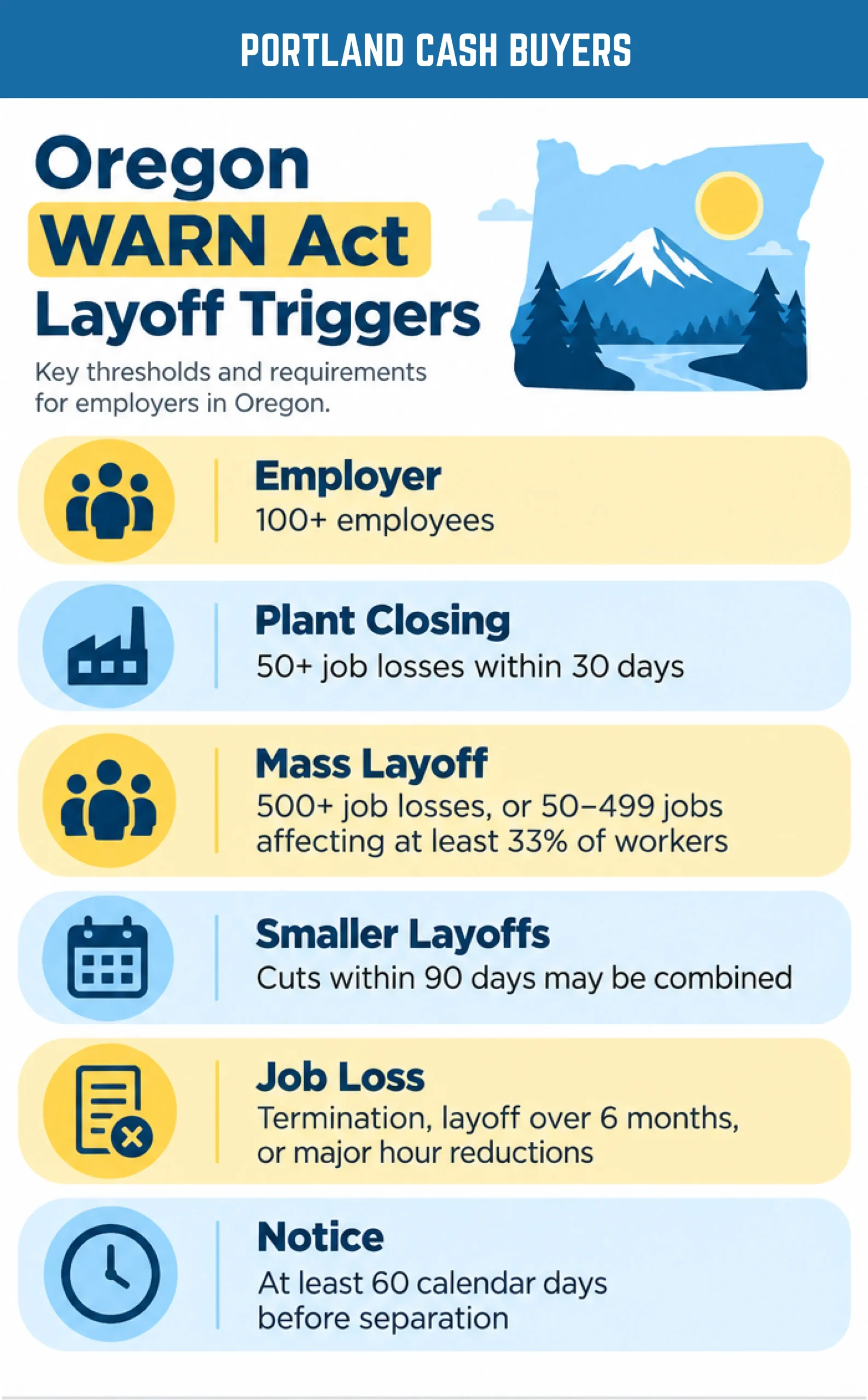
Coverage turns on two things: the size of the employer and the size of the job loss at one site. This table summarizes the federal rules as the Department of Labor describes them.
| Trigger | What the federal rule says |
| Employer size | 100 or more employees, not counting those who worked under 6 of the last 12 months or average under 20 hours a week. Or 100 or more employees, part-time included, who together work at least 4,000 hours a week. |
| Plant closing | A site or operating unit shuts down, and 50 or more employees lose their jobs within a 30-day period. |
| Mass layoff | No full shutdown, but 500 or more employees at one site lose jobs within 30 days. Or 50 to 499 lose jobs, and they make up at least 33% of the active workforce there. |
| Smaller layoffs added together | Several smaller cuts within 90 days can count together if they add up to a covered event. |
| What counts as a job loss | A termination (other than for cause, a quit, or a retirement), a layoff longer than 6 months, or hours cut by more than half in each month of a 6-month period. |
| Notice length | At least 60 calendar days before the separation date. |
Common Exceptions That Shorten or Remove the Notice
The law has exceptions, and they matter. An employer under the 100-employee line is usually not covered at all. A layoff of 6 months or less is generally not a job loss under the law. Closing a temporary facility, or ending a project that workers knew was temporary, usually does not require notice. Strikes and lockouts have their own rules.
Three exceptions allow shorter notice. The first is a “faltering company,” which applies only to plant closings. It covers an employer that was actively seeking money to stay open and believed notice would scare off the funding. The second is “unforeseeable business circumstances,” meaning a sudden event the employer could not reasonably see coming. The third is a natural disaster. In each case, the employer must still give as much notice as it can and briefly explain why the notice is short.
How Can You Tell If Your Layoff Qualifies?
You can usually tell by checking three things: how many people your employer has, how many are losing jobs at your site within 30 days, and whether a notice is on file with the state. The first two come from your employer and coworkers. The third takes about five minutes online.
Start by writing down the facts you know. Note the date you heard, the date your job ends, and whether you got anything in writing. Ask HR whether the company filed a WARN notice. A plain question is fair, and the answer tells you a lot.
What a Real WARN Notice Looks Like and Where Oregon Posts It
A real WARN notice is written, not verbal. The Department of Labor guide says it should include the expected date of the closing or layoff and your own separation date. It should also say whether the action is permanent or temporary, and give a company contact you can call. An all-hands announcement alone is not the same thing.
Oregon makes the filings public. You can search Oregon’s list of filed WARN notices by employer, date, city, and number of workers. The state’s WARN Act notifications page explains how to join an email list for new filings. It also describes Rapid Response sessions, where the state brings unemployment insurance, WorkSource Oregon, and health insurance information to affected workers.
The list is a rolling record, so it changes as employers file. In the past two years, it has included notices from large Washington County employers, including Intel and Wells Fargo sites in Hillsboro and Aloha. Check it again every few weeks if your company is talking about more cuts.
If You Think You Should Have Gotten Notice and Didn’t
If you believe you were owed notice and did not get it, talk to an Oregon employment attorney. WARN is enforced through the federal district courts. The Department of Labor administers the law but does not pursue damages for workers. HECC says its guidance on WARN is not binding and does not replace an attorney.
Under the Department of Labor’s fact sheet, an employer that violates the notice rule can owe each affected worker back pay and benefits for the period of violation, up to 60 days. Keep every email, letter, and pay stub. Write down who said what and when. That record is what an attorney will ask for first. The Oregon State Bar runs a lawyer referral service if you do not know where to start.
What Is the Notice Period Actually For?
The notice period is for getting ready while your paycheck still arrives. That means job searching, lining up benefits, asking about severance, and planning your money before income stops. Each of those gets harder once the last check clears. I also covered the broader money side in my post on selling a house fast during a financial hardship in Oregon.
Negotiate severance while you are still employed. Get any offer in writing. Many severance agreements ask you to sign a release of legal claims, so have an employment attorney read it before you sign. Ask HR how long your health coverage lasts and what your options are after.
Here is a simple way to spread the work across a 60-day notice. Your notice may be shorter or longer, so adjust the weeks.
| Weeks of notice | What to focus on |
| Weeks 1 to 2 | Read every page of the notice. Confirm your last day. Check the state WARN list. Ask HR about severance, final pay, unused leave, and health coverage. |
| Weeks 3 to 4 | Build a monthly budget. Work out your runway in months. Call your mortgage servicer to ask about hardship options before anything is late. |
| Weeks 5 to 6 | Decide on a housing path: keep, list, or sell for cash. Get real numbers for each, including a no-obligation cash offer if you want a baseline. |
| Weeks 7 to 8 | Line up your unemployment claim for the day after your last day. Finalize severance paperwork with legal review. Set a closing or listing date if you are selling. |
Your runway is the number of months you can cover your costs without a paycheck. This worksheet shows what goes into it. Fill in your own numbers.
| Runway line | Where to find it |
| Cash on hand | Checking and savings balances you can reach without penalty |
| Final pay and severance | Your notice letter and severance agreement, after taxes |
| Expected unemployment benefits | The Oregon Employment Department, once you file |
| Mortgage, taxes, and insurance | Your monthly mortgage statement |
| Utilities, food, car, debt payments | Your last three months of bank statements |
| Health coverage after your job ends | HR and the health insurance exchange |
How Does a WARN Notice Period Change Your Housing Timeline?
A WARN notice gives you a known end date for your income, so you can work backward and pick the housing path that fits. I can close a cash sale in 7 to 14 days from an accepted offer, and the fastest I have closed is 3 days. A traditional listing takes longer because it adds prep, repeated public showings, buyer inspections, an appraisal, and lender underwriting. For current local days-on-market figures, check the latest Market Action report from the Regional Multiple Listing Service (RMLS).
| Path | What has to happen | What it depends on |
| Keep the house | Cover the mortgage, taxes, and insurance from savings, severance, or a new job | Your runway and how fast you land new work |
| List on the open market | Prep and repairs, public showings, an accepted offer, inspection, appraisal, and the buyer’s loan approval | Condition, price, the market, and the buyer’s financing contingency |
| Sell for cash | A walk-through or photos, a written offer, and a closing at a licensed title company | Clear title and the date you pick; there is no buyer financing contingency |
| Cash sale with leaseback | The same cash sale, then you stay on after closing while you find your next place | Terms you and I agree on in writing |
A longer notice period can make a traditional listing realistic. Two months of paychecks can cover prep and showings, as long as the house is in decent shape. A short notice, or no notice at all, points toward a faster sale if carrying costs would eat your savings.
Think about your next home too. A lender reviewing a new mortgage application will verify your employment, and a pending layoff can change that answer. Talk to a loan officer before you sell if you plan to buy again. If a new job is taking you out of state, my guide to selling a house out of state for a job relocation walks through the order of steps.
When Should You List Instead of Selling for Cash?
If your house is in good condition, your notice period is long, and your savings can cover the gap, list it. A cash sale is the right tool for speed and simplicity, not for topping the market. I say that on my own offer page, and I mean it here.
My cash offer will be lower than retail. Every cash buyer’s offer is. The fair comparison is what you net after agent commissions, repairs, seller closing costs, and the months of carrying costs while the house is on the market. Sometimes listing still nets more. Sometimes the gap is smaller than the sticker price suggests. I laid out both sides: a cash offer versus listing when you need to sell fast.
A layoff is also a natural time to ask whether the house still fits. If the kids are grown or the payment feels heavy on one income, downsizing to a smaller Portland home might be the real goal. That is a planning decision, not an emergency, and it deserves time.
What Should You Tell Your Mortgage Servicer During the Notice Period?
Tell your servicer early that your income is about to change, and ask what hardship options exist before you miss a payment. Servicers generally have more room to help when the loan is current. Ask what they call these programs, such as forbearance or a loan modification, and ask for the terms in writing.
A HUD-approved housing counselor can help you compare options for free. If a payment has already slipped, my page on being late on mortgage payments explains what usually happens next. If you have received a notice of default, read about facing foreclosure in Portland. Oregon trust-deed foreclosure follows Oregon Revised Statutes chapter 86. Timelines and options depend on your loan and your county, so confirm the specifics with an Oregon attorney or a housing counselor.
What Happens When the Notice Period Ends?
When the notice period ends, your job ends, and that is the day to file for Oregon unemployment. Claims are filed through Frances Online, and the Oregon Employment Department explains eligibility and weekly claims. Ask the department how severance or pay in lieu of notice affects your benefits. The answer depends on how the payment is structured, and I am not the right person to guess.
If you are considering a sale, having a baseline cash offer before this date means you are not starting from zero. Here is how it works with me. You tell me about the house by form or phone. I pull recent comparable sales and public records, then I call you and schedule a private walk-through. If you cannot meet, I can make a sight-unseen offer from your description and photos. You get a no-obligation cash offer within 24 hours, with the math walked through: comps, condition, repair costs, and carrying costs.
You pick the closing date. Every closing runs through a licensed and insured title company. If you still have a mortgage, the title company pays it off from the proceeds at closing. I pay all closing costs, and you pay no commissions or fees. If you need more time, leaseback lets you stay after closing. If the new job is somewhere else, my relocating page covers timing a move.
Ask any buyer for proof of funds, including me. I provide a bank letter or statement on request. I also take title in my own name and do not assign contracts. That matters, because Oregon now requires residential property wholesalers to register with the Oregon Real Estate Agency and give written disclosures. Anyone with a question about how that law applies to a specific contract should ask an Oregon real estate attorney.
Sellers on my testimonials page describe what this looks like in practice. Lindsay L. said she was nervous selling without a lawyer or realtor, and everything played out as promised. Matthew C. said he had tough timelines and several moving parts, and it came together. You can read more about how I work on my About page and in my answers to common seller questions.

Frequently Asked Questions About the WARN Act in Oregon
Does my employer have to tell me why I was laid off?
Generally, no. The WARN Act sets rules for notice, not for explaining the business decision. When an employer relies on an exception to give shorter notice, it must include a brief statement of the reason. For anything beyond that, an Oregon employment attorney can tell you what your employer owes you.
Is WARN pay the same as severance?
No. WARN-related pay covers the notice period, either as pay in place of notice or as damages when notice was not given. Severance is a separate payment, usually set by a company policy or an agreement you sign. Some employers offer both. Read the paperwork closely and have an attorney review any release before you sign.
What if my company has fewer than 100 employees?
The federal WARN Act usually does not apply to employers under the 100-employee line. Check your employment contract, offer letter, and handbook for any notice or severance terms. You can still file for unemployment with the Oregon Employment Department once your job ends.
Can I still sell my house during my notice period, before I’m officially unemployed?
Yes. You can sell at any time, and your job status does not affect a sale to a cash buyer. Quinn Irvine of Portland Cash Buyers makes offers based on the house, not the seller’s employment. Many sellers use the notice period to compare a cash offer against the listing while income is still coming in.
Will a WARN notice affect buying my next home?
It can. Mortgage lenders verify employment before closing a loan, and a pending layoff may affect approval. Talk with a loan officer before you sell if you plan to buy again. Portland Cash Buyers offers a leaseback after closing, which can give you time to sort out the next step.
Turning a WARN Act Oregon Layoff Notice Into a Plan
A WARN Act Oregon layoff notice is hard news, but it is also time. Use it to confirm your rights, work out your runway, talk to your servicer, and compare your housing options with real numbers. Nothing here is legal advice, so bring the legal questions to an Oregon employment attorney.
If you want a number to plan around, I will give you a fair, no-obligation cash offer within 24 hours, and I make every offer personally. Call or text me at (503) 770-0145, seven days a week, 8 am to 8 pm, or send a note through my contact page. When you are ready, get your cash offer.