If you have a vacant house in Portland, you’re probably holding a set of keys and a lot of questions about how to protect it from vandalism, break-ins, and costly damage. Maybe a parent passed, and the estate is still being settled. Maybe a tenant left, you relocated, or a renovation stalled. You haven’t decided whether to sell, rent, or hold.
I’ve been buying Portland-area homes since 2004 and have walked through many empty houses. Here’s the plain version: a vacant house needs regular attention, security, and maintenance to avoid problems that can become expensive quickly. If you ever want the selling side, my page on selling a vacant house in Portland covers the options, including listing.
Yes, you can protect a vacant house in Portland with a short list of steps: confirm your insurance, secure the doors and windows, keep the place looking lived in, control water and moisture, and have someone check it every week. None of it is complicated. Most of the damage I see comes from time passing with nobody looking, not from one bad night.
Here are a few points most checklists skip:
- Many standard policies limit coverage after a set number of empty days, so insurance comes before locks.
- Plywood on the windows can signal “nobody home” and can raise a code problem of its own.
- Federal fire data shows vacant houses that were locked still burned, so locks alone are not enough.
- Portland’s wet season does quiet damage through humidity and slow leaks, not just burst pipes.
- If you cannot visit often, a remote check plus one local contact does more than any single gadget.
Why an Empty House Is a Bigger Risk in Portland Than It Looks
An empty house is riskier than it looks because nobody is there to notice a broken window, a running pipe, or a stranger at the back door. Fire, theft, and water all need the same thing: time without witnesses.
Fire is the risk that worries me most. Updated data from the National Fire Protection Association estimates that U.S. fire departments now respond to 30,000 structure fires in vacant buildings a year. These incidents cause an average of 60 civilian deaths, 160 civilian injuries, and $710 million in direct property loss annually. Intentional fires, or arson, remain the leading cause, accounting for up to 43 percent of all vacant building fires, and that number jumps to 57 percent if the property is left unsecured. Because there is nobody inside to smell smoke or call emergency services, these fires routinely spread to engulf entire structures, resulting in a disproportionate risk to arriving firefighters and far more severe property damage than in occupied homes.
Metal theft is a second worry. A Portland Police Bureau update on a copper theft investigation published September 3 described repeated burglaries and heavy copper wire theft at a vacant former hospital after it closed. The bureau also said an earlier arrest involved a broker who processed more than $487,000 worth of metal over a year. That was a commercial building, not a house. Still, copper pipe, wiring, and appliances have a resale value, and an empty building makes them easier to take.
Water damage is the quiet one. A slow leak in an occupied home gets caught in a day. In an empty home, it can run for weeks. The rest of this guide goes in the order I’d do it myself.
Step 1: Confirm Your Insurance Actually Covers a Vacant Home
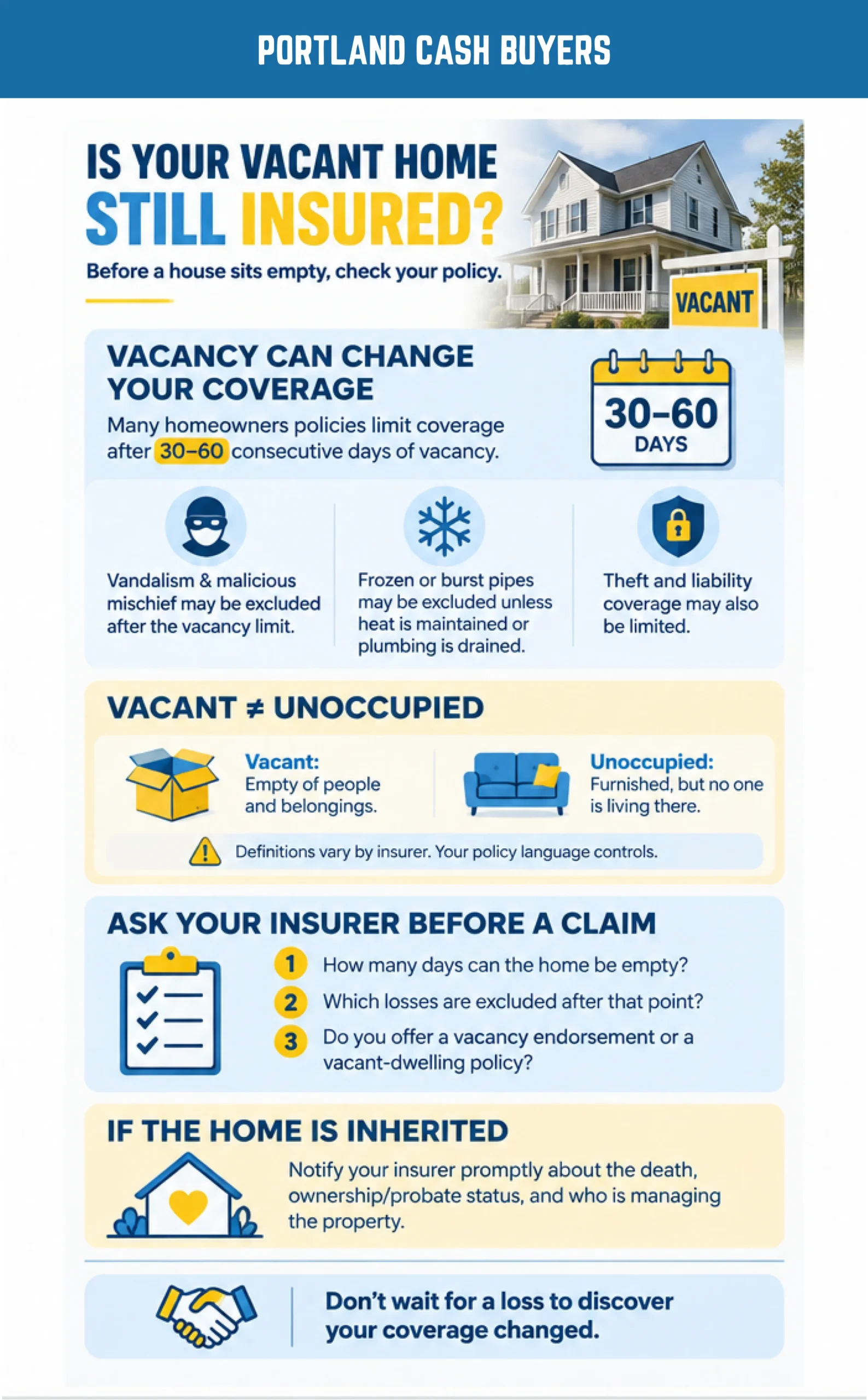
Check your policy first, because many standard homeowners policies limit or drop coverage once a house sits empty for a set number of days. The Oregon Division of Financial Regulation’s home insurance myths guide says vandalism and malicious mischief are typically excluded after 60 days. It also says frozen plumbing damage may not be covered unless you keep the heat on or drain the pipes.
The Insurance Information Institute’s guide to vacancy insurance says most vacancy clauses start after 30 to 60 consecutive days. It puts burst-pipe repairs at $10,000 to $70,000 or more, depending on how long water runs. It also describes an heir who found a $60,000-plus pipe loss that the vacancy clause excluded. I am not an insurance agent, so your own policy language controls.
Vacant vs. Unoccupied Policies: What’s the Difference
Insurers often treat “vacant” (empty of belongings) differently from “unoccupied” (furnished, but nobody living there for now). Definitions vary by company, so ask for yours in writing. Here is how the usual options compare.
| Coverage question | Standard policy once the vacancy limit passes | Vacancy endorsement or vacant dwelling policy |
| Vandalism and malicious mischief | Often excluded after the limit (DFR: typically 60 days) | Typically included or available |
| Frozen or burst pipes | May be excluded unless heat is on or pipes are drained | Typically covered for sudden events if upkeep is shown |
| Theft | Often limited once vacant | Typically included or available |
| Liability if someone is hurt | Could be disputed if the home counts as vacant | Typically included or available |
| What you must show | Heat on or plumbing drained | Heat, regular checks, secured entries |
| Cost | Standard premium | Higher premium |
Questions to ask your carrier before a claim, not after. Call and ask these three, then write down the answers and the date:
- How many days can the house sit empty before coverage changes?
- Which losses stop being covered after that point?
- Do you offer a vacancy endorsement, or do I need a separate vacant dwelling policy?
If you inherited the house, tell the carrier about the death and who now manages the property. Do it early. A personal representative named in probate usually handles this, and an Oregon probate attorney can confirm who has authority. My page on what to do with an inherited house in Portland covers the selling side.
Step 2: Secure the Exterior
Secure the exterior by making every door and window harder to open and every approach easier to see. A thief wants a quiet, quick entry. Your job is to remove both.
Doors, Windows, and Lock Upgrades That Actually Deter Entry
Rekey or replace the locks first. You never know who still holds a key after a death, a divorce, or a tenant move-out. Then work through this list:
- Install deadbolts with at least a one-inch throw on every exterior door.
- Reinforce the strike plate with long screws that reach the framing.
- Pin or add a bar to sliding doors, and check that the door cannot lift off its track.
- Lock every window latch and fix any that are loose or painted shut.
- Secure the garage side door and any basement or crawl space hatch.
- Keep a lockbox only if you must, and change the code after each person finishes.
If a window breaks, replace the glass quickly. A broken window left open is an invitation and may also count as unsecured.
Lighting, cameras, and visibility from the street. Put motion lights at the back door and side yard. Use timers on a few indoor lamps so the house is not dark every night. Trim shrubs so a person standing at a door can be seen from the street. A doorbell camera helps, and so does one aimed at the back entry. Cameras record and warn you. They do not stop a break-in alone, so pair them with a person who can look.
Step 3: Keep the House Looking Occupied
Keep the house looking occupied by removing every sign that nobody is there. Burglars and vandals read an empty house the same way neighbors do.
Forward the mail and stop paper deliveries. Pick up flyers from the porch. Mow, trim, and clear gutters. Park a car in the driveway now and then, or ask a neighbor to. If you can, leave a couch and a few lamps in the front room, and ask your insurer whether furniture changes how it classifies the house. Tell two neighbors your cell number and ask them to text if they see an open door or a strange car. Add one relative or friend as a backup contact.
Why an Unkept Exterior Invites Both Burglars and Code Complaints
An unkept exterior invites both because tall grass, stacked mail, and open gates signal that nobody is watching, and neighbors may report the property to the city. Under Portland City Code Chapter 29.40, a vacant building that is unsecured or boarded can be treated as a derelict building. That is one reason I avoid plywood unless it is a short-term emergency fix. I break down the full code in my post on Portland’s vacant building code and Title 29. If a notice goes to the owner’s address on county records and you have moved, it can sit unopened. Keep that mailing address current. For anything about a notice you receive, talk with an Oregon attorney or the city directly.
Step 4: Prevent Moisture, Mold, and Winter Damage
Prevent moisture damage by controlling water and humidity, because a vacant house in the Pacific Northwest rarely fails from one dramatic event. It fails from slow dampness. The EPA’s brief guide to mold, moisture, and your home says the key to mold control is moisture control. EPA guidance also advises keeping indoor relative humidity below 60 percent, ideally between 30 and 50 percent.
Manage utilities safely instead of shutting everything off. Many owners cut power and heat to save money. That can backfire. Leave the electricity on so sump pumps, smoke alarms, and lights work. For heat, Triple-I suggests keeping the thermostat at 55 degrees or higher in winter. If nobody will check the house often, the safer choice is to shut off the main water valve and have a plumber drain the system, including the water heater. Take photos and keep the receipt. DFR’s guide makes clear that heat or drained pipes can decide whether a freeze claim is paid.
Portland’s Rainy Season and What It Does to an Unmonitored House
Portland’s rainy season hurts an unmonitored house through clogged gutters, damp crawl spaces, and slow roof leaks that nobody sees. Water finds a weak spot, then soaks insulation and drywall for weeks. Before the wet months, do these things:
- Clear gutters and downspouts, and point water away from the foundation.
- Check the roof, flashing, and attic for stains or sagging.
- Look at the crawl space or basement for standing water and run a dehumidifier if it is damp.
- Put a cheap hygrometer in the house and read it each visit.
- Leave interior doors open so air can move.
The Portland Water Bureau’s winter plumbing guide adds the cold-weather steps: know where the main shutoff valve is, drain or cover outdoor faucets, and insulate exposed pipes. Hard freezes are less frequent here than in colder states, but they do happen, and an unheated empty house is where a freeze does the most harm.
Step 5: Monitor the Property Remotely (Especially From Out of State)
Monitor remotely by combining a few cheap sensors with one trusted person who can walk the house, because no device replaces eyes inside the building. If you live out of state, this step matters most.
For remote tools, I’d pick these:
- Water leak sensors under sinks, near the water heater, and in the basement.
- A smart thermostat that texts you if the temperature drops.
- A doorbell camera and one camera on the back entry.
- A smoke and carbon monoxide alarm that sends a phone alert.
Then add the human check. Triple-I suggests a weekly walk-through by a neighbor, family member, or property manager. Give that person a short list:
- Check every door and window for signs of entry.
- Look at ceilings and walls for new stains.
- Check the floor under every sink and near the water heater.
- Read the thermostat and the hygrometer.
- Flush a toilet and run each tap briefly.
- Photograph each room and send the photos to you.
Dated photos also help with any insurance claim later. If a tenant left and the rental is sitting empty, my page for landlords with a problem rental may help.
When Protecting the House No Longer Makes Financial Sense
Protecting the house stops making sense when the monthly cost of carrying it, plus the risk you cannot control, is larger than what keeping it will give you. Only you can run that math, and I’ll show mine. Here is how the main options compare.
| Option | What it handles | What it leaves on you | Fits when |
| DIY security and weekly checks | Locks, lights, yard, winterizing, visits | Your time, travel, and risk between visits | You live nearby and plan to keep or rent the house |
| Vacancy endorsement or vacant dwelling policy | Many losses a standard policy may exclude | Higher premium, upkeep proof, deductibles | The house will sit empty past your policy’s limit |
| Listing with an agent | Exposure to retail buyers | Repairs, prep, repeated public showings, carrying costs until closing | The house shows well and you have time |
| As-is sale to a direct buyer | Repairs, cleanout, and carrying costs end at closing | A price below retail | You cannot carry or protect the house much longer |
Carrying costs add up quietly. The next table is an example scenario with round numbers. It is not a quote, and your numbers will differ.
| Monthly cost (example scenario) | Amount |
| Mortgage payment, if any | $1,500 |
| Property taxes (monthly share) | $400 |
| Vacant dwelling insurance | $250 |
| Utilities with heat on low | $150 |
| Yard, gutters, and small repairs | $100 |
| Monthly subtotal | $2,400 |
| Six-month total | $14,400 |
Here is my honest take. If you can carry those costs and someone can walk the house weekly, holding it can make sense. If the house is in good shape and you have a few months, listing may net you more. A cash offer, mine included, will be lower than a retail sale. The real comparison is what you net after repairs, fees, and months of carrying costs. If you decide the costs are not worth it, I explain selling your vacant Portland property instead on its own page. If payments on the empty house have slipped, Oregon trust-deed foreclosure moves from a notice of default toward a trustee sale under ORS chapter 86, so talk with an Oregon attorney or a HUD-approved housing counselor early.

Frequently Asked Questions About Protecting a Vacant House in Portland
How often should someone check on a vacant house?
At least once a week. Triple-I suggests weekly visits by a neighbor, family member, or property manager. Check more often during freezes and storms. Each visit should cover doors, windows, ceilings, floors under sinks, and the thermostat.
Does a vacant house need special insurance in Oregon?
Often, yes. Many standard policies limit coverage after 30 to 60 days of vacancy, and the Oregon Division of Financial Regulation says vandalism is typically excluded after 60 days. Ask your carrier about a vacancy endorsement or a separate vacant dwelling policy before the limit passes.
What’s cheaper: securing the house or selling it as-is?
It depends on how long the house will sit empty. Securing costs a steady monthly amount for insurance, utilities, upkeep, and your own time. An as-is sale ends those costs at closing but usually nets less than a retail sale. Add up six months of carrying costs, then compare that to an offer’s net. I am glad to show the math either way.
Should I shut off the water in a vacant house?
Usually yes, unless someone checks the house often and the heat stays on. DFR says frozen plumbing damage may not be covered unless you keep the heat on or drain the pipes. Have a plumber drain the lines and water heater, and keep the receipt.
Can I change the locks on an inherited house before probate is finished?
It depends on who has legal authority. Under ORS chapter 114, a personal representative has the right to take possession and control of estate property. Before one is appointed, authority can be unclear, especially with several heirs. Ask an Oregon probate attorney before you change locks or move anyone out.
What should I do if I find someone living in my vacant house?
Do not change the locks, cut utilities, or remove belongings on your own. Oregon’s enrolled House Bill 3522 describes a 24-hour written notice for squatters, followed by a court case if the person stays. Call the police non-emergency line and an Oregon attorney.
How to Protect a Vacant House in Portland, or Let It Go on Your Terms
You can protect a vacant house in Portland with the right insurance, solid locks, a lived-in look, controlled water and humidity, and a weekly check. If you can carry the cost, holding or listing the house may be the right call, and I’ll tell you so. If the empty months are wearing on you, a sale is one more option, not a requirement. You can see what a cash sale looks like for an empty house before you decide.
If you’d like to see the numbers, I’ll make you a fair, no-obligation cash offer within 24 hours, and I make every offer personally. I answer calls and texts seven days a week, 8 am to 8 pm, at (503) 770-0145. Or tap Get My Cash Offer and tell me about the house.