

Got a letter from the City about a vacant house? Or maybe a neighbor’s empty property was boarded up, and now you’re wondering whether your own house could face the same treatment. Either way, you’re trying to understand the Portland vacant building code and what it means for a house that nobody lives in right now.
Here’s the short answer: Portland doesn’t punish a house just for being empty. The trouble starts when an empty house meets one of six conditions in Chapter 29.40 of the City Code, such as being open to entry or boarded up. At that point, it can be legally classified as “derelict.” Notices, monthly fees, and, eventually, a lien on your title can follow. You can see more about how I buy houses in Portland if selling turns out to be your path, but most of this article is simply about the law.
A few things are worth knowing before you dig in:
- Vacancy alone is not a violation. A specific condition, like an open window or plywood on the doors, is what triggers “derelict” status.
- The City has to mail you a notice first, and that notice has to explain your appeal rights.
- You get a 30-day response period before monthly enforcement fees can start, and the fees double if violations remain after three months.
- Unpaid fees are recorded as a lien and can follow the property until they’re paid.
- Repairing, contesting, or selling as-is can each be the right call. Selling is not always the answer.
I’m not a lawyer, and this isn’t legal advice. Title 29 applies only inside Portland city limits. Gresham, Beaverton and unincorporated Multnomah County have their own rules. Confirm the details of your situation with the City or an Oregon attorney.
What Is Portland’s Vacant Building Code, and Why Does It Exist?
Portland’s vacant-building rules are not a separate law. They are part of Title 29, the City’s Property Maintenance Regulations, which establish minimum standards for property maintenance and address dangerous and derelict buildings. The City’s stated purpose includes protecting health, safety and welfare, preventing deterioration, and regulating and abating dangerous and derelict buildings. In practical terms, these rules are designed to address properties that become unsafe, poorly maintained or otherwise problematic when they sit empty.
Portland Permitting & Development (PP&D) handles inspections and code enforcement for the City. The City can inspect properties and determine whether an unoccupied building meets the conditions for “derelict” status. Those conditions can include being unsecured, boarded, subject to certain correction notices, or having certain repeated nuisance violations.
One important point: being empty does not automatically make a building derelict. The property must meet specific conditions outlined in the City’s rules before derelict status can apply.
Because city rules can change, confirm the current requirements with PP&D before relying on this information.
Here’s how the main chapters fit together:
| Title 29 chapter | What it covers | Why it matters to an empty-house owner |
| 29.10 | Definitions | Defines “derelict,” “unsecured,” “boarded” and “warehousing” |
| 29.40 | Dangerous and derelict structures | The six derelict triggers and the “chronic dereliction” rule |
| 29.60 | Administration and enforcement | Notices, inspections, securing open buildings, demolition referrals |
| 29.70 | Costs and penalties | Monthly enforcement fees, abatement costs, liens |
| 29.80 | Appeals | Administrative review and appeal to the Code Hearings Officer |
| 29.90 | Housing receivership | Court-appointed receivers for seriously neglected housing |
How a House Legally Becomes a “Derelict Building” Under Chapter 29.40
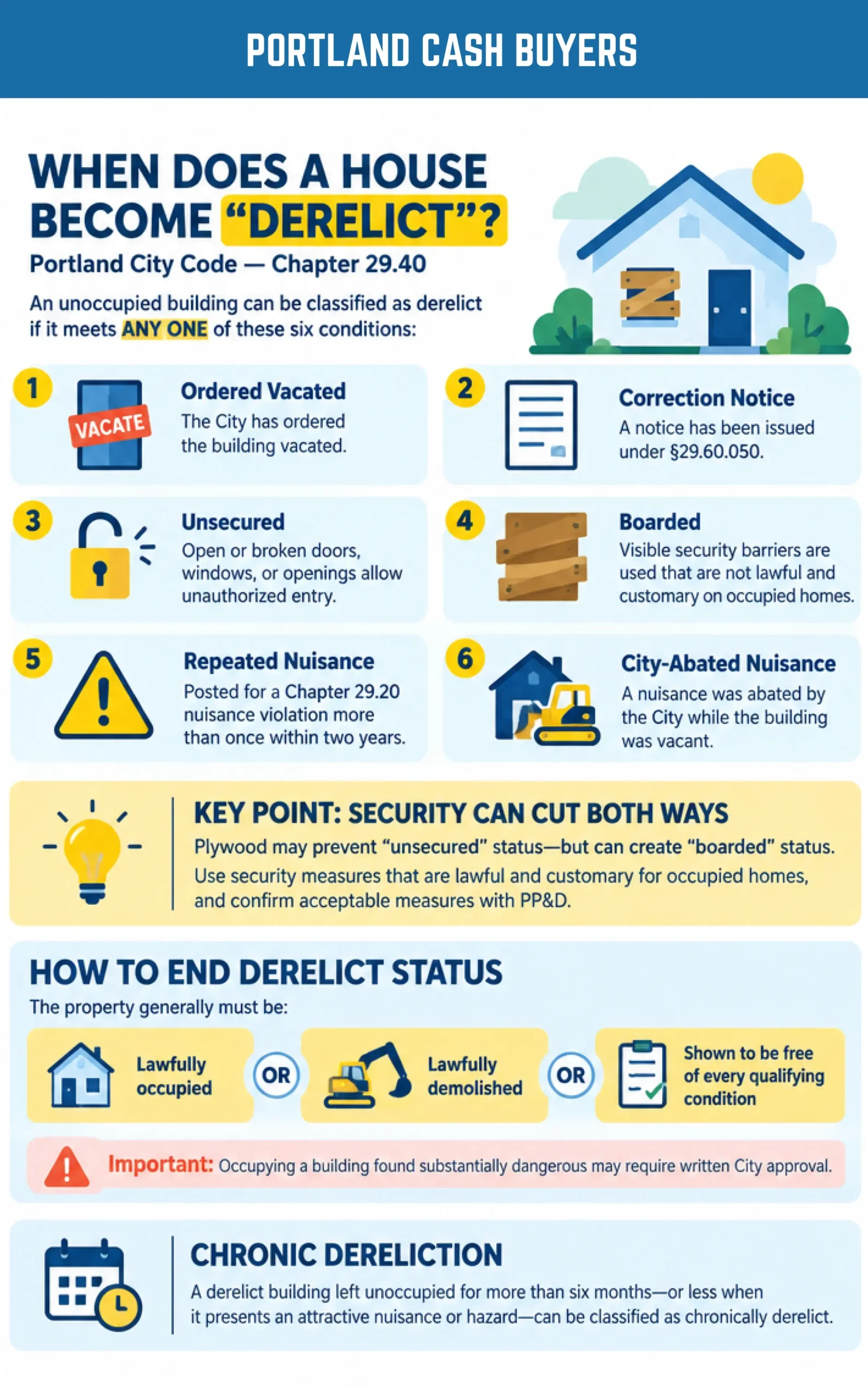
A house becomes a derelict building when it is unoccupied and meets at least one of six conditions listed in Portland City Code 29.40.010. Once the City declares it, the property stays in violation until the house is lawfully occupied, lawfully demolished, or shown to be free of every listed condition.
That last point matters. Moving a tenant or family member in can end derelict status, but only if the occupancy is lawful. Title 29 also makes it unlawful to occupy a structure the City has found substantially dangerous without written approval.
The six conditions that can trigger derelict status
Under 29.40.010, an unoccupied building is derelict if it:
- Has been ordered vacated by the City under Chapter 29.60
- Has been issued a correction notice under Section 29.60.050
- Is unsecured
- Is boarded
- Has been posted for a Chapter 29.20 nuisance violation more than once in any two-year period
- Has, while vacant, had a nuisance abated by the City
Notice how several triggers feed on each other. A correction notice by itself is a trigger. So is a second overgrown-yard or debris posting within two years. A small problem left alone can turn into a derelict designation.
What “unsecured” and “boarded” actually mean under the code
The unsecured building definition in Portland code is short. Section 29.10.020 defines “unsecured” as a structure where doors, windows or other openings are open or broken enough to allow access by unauthorized persons. One broken basement window can qualify.
“Boarded” is the part that catches owners off guard. The code defines it as secured against entry by apparatus that is visible off the premises and is not both lawful and customary to install on occupied structures. In other words, plywood over the windows fixes “unsecured” but creates “boarded.” Both are derelict triggers.
So what do you do? Owners often use security measures that look normal on an occupied house: intact windows, solid locked doors, and screens or grilles that are lawful and customary on lived-in homes. Ask PP&D what it will accept on your property before you spend money.
| Term | Plain-English meaning | Code source |
| Derelict building | An unoccupied building that meets any of the six 29.40.010 conditions | PCC 29.10.020, 29.40.010 |
| Unsecured | Doors, windows or openings are open or broken enough to let people in | PCC 29.10.020 |
| Boarded | Secured with visible barriers you wouldn’t normally see on an occupied house | PCC 29.10.020 |
| Chronic dereliction | A derelict building left unoccupied more than six months, or less if it’s an attractive nuisance or hazard | PCC 29.40.020 |
| Warehousing | Securing a structure against vandalism and entry until it’s back in use | PCC 29.10.020 |
Chronic Dereliction: What Changes After Six Months Vacant
After six months, a derelict house can be treated as a dangerous structure, which opens the door to the City’s strongest tools. Section 29.40.020 lists chronic dereliction among the conditions that make a structure dangerous: a derelict building that stays unoccupied for more than six months. The same section says it can happen sooner if the building is an attractive nuisance or a hazard to the public.
Why does that shift matter? Under 29.40.030, dangerous structures are declared public nuisances. The City may start proceedings for repair, vacation, demolition, or warehousing. A derelict case is mostly about fees. A dangerous-building case can lead to a Code Hearings Officer ordering repair or demolition.
There is one narrow alternative. Under 29.50.070, the City may let an owner warehouse a structure that is suitable because of its historic designation or other significant features. Warehousing can last up to 30 months, with one possible one-year extension. Most ordinary houses won’t qualify, and inspection penalties still apply during the warehousing period.
Long-vacant houses are often heir-owned houses still tied up in probate. If you inherited a house that is sitting empty, the six-month clock keeps running while the estate is sorted out.
The Notice, Correction Order, and Appeals Process
The process starts with a mailed notice and gives you two appeal steps: an administrative review within 15 days, then an appeal to the Code Hearings Officer. Here’s how each piece works.
How the City issues a notice and order (29.60). Under Chapter 29.60, the City mails the notice to the owner’s address in the county assessment and taxation records. It may also post the notice on the property. The notice must describe the violations and warn that penalties, charges, and liens may result. It must give you a response period and explain your appeal rights. The notice counts as served on the date it was mailed, not the date you read it.
If your mailing address with the county is old, fix it now. An error in the owner’s name or address does not void the notice when the notice was also posted on the property.
Open buildings move faster. If an unoccupied structure is open, the City orders the owner to secure the premises immediately. If it isn’t secured within 15 days from the date notice is sent, the City may secure it and bill the owner. Where a hazard exists, the City may secure it right away.
How to appeal a violation to the Code Hearings Officer. Under Chapter 29.80, you first ask PP&D for an administrative review. You must submit a written request within 15 days of the date of the notice. You can present evidence, and the City issues a written decision. If you disagree, you can appeal that decision to the Code Hearings Officer and pay a fee. Under City Code 22.10, an appeal request generally must be filed within 10 business days after the date of the decision. The Hearings Officer then holds a hearing within 30 business days. Further review goes to court by writ of review.
| Step | Typical deadline | Source |
| Secure an open, unoccupied structure | 15 days from notice | PCC 29.60.040 |
| Request administrative review | 15 days from the notice date | PCC 29.80.010 |
| Response period before monthly fees | 30 days from the notice | PCC 29.70.010 |
| Appeal to Code Hearings Officer | 10 business days from the review decision | PCC 22.10.030 |
| Hearing held | Within 30 business days of the request | PCC 22.10.040 |
| Monthly fees double | Violations remain 3 months after the first notice | PCC 29.70.010 |
Appeals work best when the City got the facts wrong. Maybe someone actually lives there, or the window was fixed before the inspection. An appeal is a weaker tool when the condition is real. The Hearings Officer decides each case on its own record, and I can’t predict outcomes.
What Happens If a Violation Goes Unresolved
Unresolved violations turn into monthly fees, then a recorded lien, and in serious cases, City-ordered repair, demolition, receivership or lien foreclosure. Each step is optional for the City, not automatic.
Civil penalties and how they become a municipal lien
Under Section 29.70.010, the City may charge a monthly enforcement fee once three things are true. You got a notice, a response period of 30 days has passed, and the property is still out of compliance. If violations aren’t fixed within three months of the first notice, later fees are twice the scheduled amount. The fees continue until all violations have been corrected, inspected and approved.
The current PP&D Enforcement Fee and Penalty Schedule lists $394 per month for a one- or two-unit property. That rises to $788 per month after three months. Occupying a house after a dangerous-building notice carries its own monthly penalty on the same schedule. Fees change yearly, so check the schedule in force when you read this.
This is how a municipal lien gets attached to vacant property in Portland. The City files a statement, adds a 10 percent revenue charge, and records a property lien in the Docket of City Liens. It bills you monthly. The City may also record notice of the violations with the County Recorder. The City’s Revenue Division describes code enforcement fees as an open revolving lien that carries a fixed 12 percent annual rate on the outstanding balance. The lien stays until it is paid and the City certifies the violations are fixed.
A lien usually shows up on a title commitment when you try to sell or refinance. The title company normally requires it to be paid or resolved before closing. If you’re also behind on the mortgage as well, several debts can stack against the same equity.
There’s some relief after you fix things. PP&D runs a Lien Reduction Review Program for closed enforcement cases. Hard-cost charges aren’t eligible, but other balances may be reviewed. Section 29.60.100 also lets the City grant waivers for undue hardship when an owner applies in writing.
Demolition and housing receivership as last resorts
Demolition and receivership are rare, slow and heavily documented. Under 29.60.080, the City can take a dangerous structure to the Code Hearings Officer. If the owner doesn’t follow an order to repair or demolish, the Hearings Officer may authorize PP&D to do the work. A judge must issue a demolition warrant. Demolition costs plus administrative charges may be assessed as a lien on the land.
Chapter 29.90 uses the Oregon Housing Receivership Act. If residential property violations threaten public health or safety and the owner hasn’t acted, the City may ask a court to appoint a receiver. The City must mail notice to interested parties at least 60 days before filing. Receivers are limited to Home Forward, a City bureau, an urban renewal agency, or a housing nonprofit. A receiver can charge up to 15 percent of abatement costs as a fee, and unpaid costs become a recorded lien.
Separately, the City has used foreclosure on delinquent code liens as a last resort after repeated fines and liens go unpaid. That is different from a lender’s trust-deed foreclosure under Oregon Revised Statutes chapter 86. If you’re facing a lender foreclosure too, talk to an Oregon attorney soon.
If fees and a recorded lien are piling up, you can also sell your vacant Portland property as-is. Recorded liens are usually paid from the sale proceeds at closing through the title company. Confirm how that would work for your lien with the title company or an Oregon attorney.
What To Do If Your Vacant Portland House Already Has an Open Code Case
Start by reading the notice closely, writing down every deadline, and contacting PP&D to confirm exactly what will close the case. Then work through these steps:
- Note the mailing date. Your 15-day review window and 30-day response period count from it.
- Secure the house the right way. Fix broken glass and locks first. Ask whether your security method counts as “boarded.”
- Clear nuisance items. Debris and overgrowth postings can add a derelict trigger.
- Document everything. Take dated photos, keep receipts and save contractor bids.
- Notify the City when you’re done. Under 29.70.010, fees run until you report the fix and pass inspection.
- Decide your long-term plan. Repair and occupy, repair and sell, or sell as-is.
If selling is on the table, compare real numbers first. I’d encourage you to compare a cash offer with listing before choosing. A house with an open case can usually still be sold, and I buy houses in as-is condition. You can see how my as-is sale process works. The title company identifies the liens, and payoff of recorded liens generally happens at closing from the sale proceeds. Whether a specific lien can be cleared that way is something to confirm with the title company or an attorney.
When I buy a house with an open case, I walk through it, show you my math offer, and then you pick the closing date. That math covers comparable sales, condition, repair costs and carrying costs. I take the title in my own name. I don’t assign contracts to other buyers. Oregon’s House Bill 4058 requires residential property wholesalers to register with the Oregon Real Estate Agency. Published summaries describe wholesaling as marketing a property you hold only an equitable interest or option in, for fewer than 90 days, with less than $10,000 invested in improvements. The law also requires written disclosures to sellers before a wholesale contract. Confirm the details on the Oregon Legislature’s enrolled bill and with an Oregon real estate attorney. It’s a fair question to ask anyone who offers to buy your house.
Frequently Asked Questions About Portland Derelict Building Law
Does a vacant house always get flagged as derelict?
No. Under Portland City Code 29.40.010, an unoccupied house is derelict only if it meets one of six conditions. These include being unsecured, being boarded, or receiving a correction notice. A locked, intact, well-kept empty house doesn’t meet the definition. Quinn Irvine of Portland Cash Buyers recommends regular checks so small problems don’t become triggers.
Can I sell a house with an open Title 29 violation or lien?
Yes, in most cases. A buyer’s title company will find recorded City liens, and payoff usually happens at closing from the proceeds. An open case doesn’t disappear with the sale, so the buyer takes on the repairs. Portland Cash Buyers buys houses with code violations, but confirms lien specifics with the title company or an Oregon attorney.
How long does the City give you to fix a violation?
It depends on the notice. Open, unoccupied buildings must be secured within 15 days of notice. Monthly fees can begin after a 30-day response period and double after three months. Your notice states your specific deadlines, so read it closely.
Does Portland require owners to register vacant houses?
No registration requirement or fee appears in Title 29. Portland enforces vacant-house rules through complaints, inspections and the derelict-building conditions instead. Rules change, so confirm with Portland Permitting & Development.
Does Title 29 apply if my house is in Gresham or unincorporated Multnomah County?
No. Title 29 applies inside City of Portland limits. Other cities and unincorporated areas use their own codes, so check with the local building or code enforcement office. For broader selling questions, see the Portland Cash Buyers FAQ.
Your Next Step Under the Portland Vacant Building Code
The Portland vacant building code comes down to conditions, deadlines and follow-through. Keep the house secure, answer any notice within 15 days, and repair when the fix is cheap. If the math says selling a vacant house with an open code case is the better path, I can help. I’ve bought Portland-area homes since 2004, and Portland Cash Buyers is BBB A+ accredited and Google 5-star rated.
Tell me about the house at Get My Cash Offer, and I’ll personally send you a fair, no-obligation cash offer within 24 hours. You can also call or text me at (503) 770-0145 any day from 8 am to 8 pm.