
Selling a house in retirement brings up tax questions that working-age sellers rarely face. For most retirees, the first worry isn’t the price. They want to know what the sale does to everything else. Will Social Security shrink? Will Medicare cost more? Will a tax bill eat the money they planned to live on? Those are fair questions when the house is your largest asset and your income is fixed.
Here is the short answer. No, selling your home will not reduce your Social Security retirement benefit. A large taxable gain can make more of that benefit taxable. It can also raise your Medicare premiums two years later. Most long-time owners avoid both problems through the federal home sale exclusion.
I’m Quinn Irvine, and I’ve been buying Portland-area homes since 2004. I buy houses. I don’t give tax advice. So I’ll explain the rules and point you to the official sources. I’ll also tell you where a CPA should take over. My page on a quick cash home sale for retirement shows how I work with retirees.
A few things most retirees don’t hear until after they sell:
- Social Security’s earnings limit counts only wages and self-employment income. A home sale gain is neither, so it never triggers the earnings test, even if you claimed benefits early.
- Medicare looks back two years. The tax return for the year you sell sets your Part B and Part D premiums two years later, long after the money is in the bank.
- If you moved into a licensed care facility, that time can still count toward the exclusion’s use test. You need at least one year of living in the home in the last five.
- A surviving spouse can still use the $500,000 exclusion if the home sells within two years of the death. Other conditions apply.
- The closing date decides which tax year the sale lands in. On a sale to Portland Cash Buyers, a BBB A+ accredited local buyer, you choose that date.
Does Selling Your House Affect Social Security?
No, selling your house will not reduce your Social Security retirement benefits, because those benefits are not means-tested. However, any taxable gain above the 250,000 exclusion ($ 500,000 (for married couples filing jointly) adds to your income. That can make more of your benefits taxable. Two years later, it can also raise your Medicare Part B and Part D premiums.
Your monthly check is based on your work record. The money in your bank account does not change it. Selling a house turns one asset, the home, into another asset, cash. Social Security does not count that swap against your retirement benefit.
One rule often gets mixed up with this. If you claim before full retirement age and keep working, Social Security can hold back some benefits once your earnings pass a yearly limit. That limit counts wages and self-employment income only. The Social Security Administration’s page on working while receiving benefits says it does not count investment income or capital gains. A home sale gain is not wages.
The real effect is on income tax. Depending on your “combined income,” up to 85% of your benefits can become taxable. Combined income is your adjusted gross income, plus nontaxable interest, plus half of your Social Security benefits. A taxable home sale gain goes into adjusted gross income. An excluded gain does not. Here are the thresholds from the IRS Publication 915 on taxes on Social Security benefits.
| Filing status | Combined income | Share of benefits that may be taxable |
| Individual | Under $25,000 | None |
| Individual | $25,000 to $34,000 | Up to 50% |
| Individual | Over $34,000 | Up to 85% |
| Married filing jointly | Under $32,000 | None |
| Married filing jointly | $32,000 to $44,000 | Up to 50% |
| Married filing jointly | Over $44,000 | Up to 85% |
Notice what the table means for a home seller. If your whole gain is excluded, none of it enters combined income. Your benefit taxes stay the same. If part of the gain is taxable, it can push you into the 85% tier for that one year. That’s a one-year effect. It does not carry into the next year’s return unless your other income stays high.
Will Selling Your Home Raise Your Medicare Premiums?
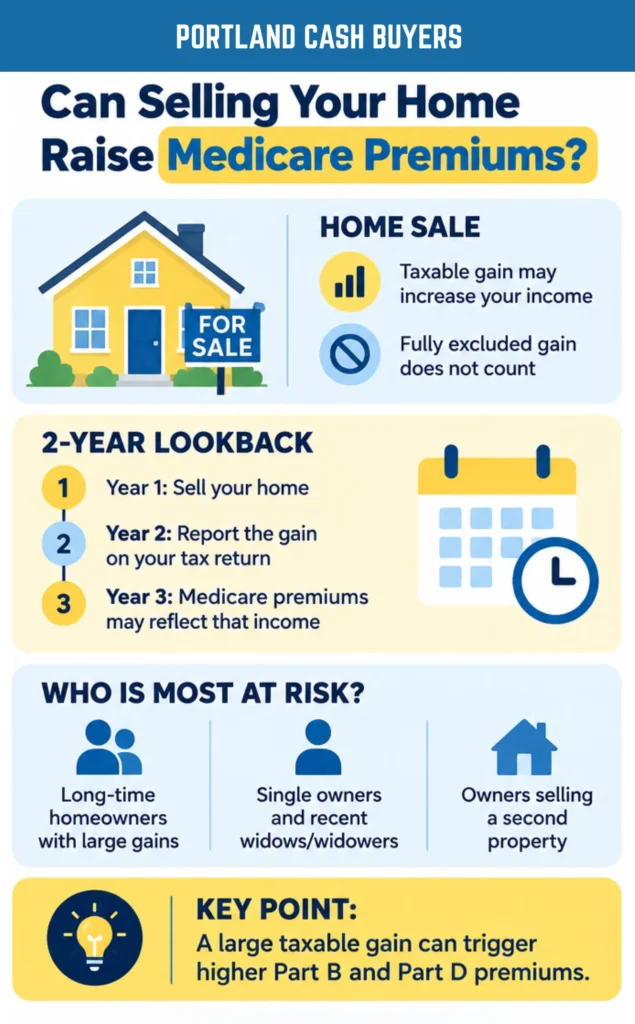
It can, but only if the sale creates a taxable gain big enough to push your income over Medicare’s income thresholds, and the increase shows up two years after the sale. A fully excluded gain does not count toward those thresholds.
Most people on Medicare pay the standard Part B premium. Higher-income beneficiaries pay an extra charge called the income-related monthly adjustment amount, or IRMAA. It applies to Part B and to Part D drug coverage. Social Security decides who pays it using modified adjusted gross income. That is your adjusted gross income plus tax-exempt interest.
How IRMAA and the Two-Year Lookback Work
Social Security sets your premiums from the latest tax return the IRS sends it, which is usually from two years back. A home sold this year shows up on next spring’s tax return. That return then drives your premiums the year after.
| Step | When | What happens |
| Sale closes | Year 1 | Any taxable gain is earned |
| Tax return filed | Spring of Year 2 | The gain is reported in modified adjusted gross income |
| Premiums set | Year 3 | Social Security uses that return to set Part B and Part D premiums |
| Premiums reset | Year 4 | If your income returns to normal, premiums usually follow |
The income brackets change every year, so I won’t print them here. Social Security keeps the current ones on its page about Medicare premium rules for higher-income beneficiaries. Check that page for the year your sale will count. If your income drops after certain life-changing events, you can ask for a new decision with Form SSA-44. The listed events include marriage, divorce, the death of a spouse, and stopping or cutting back work. A one-time gain from selling your house is generally not on that list. Plan for the surcharge instead of counting on an appeal.
Who is most likely to see IRMAA from a home sale? Long-time owners with large gains. If you bought decades ago, your gain may be bigger than the exclusion. Single owners and recent widows or widowers face a lower exclusion and lower brackets. Owners selling a second property, such as a rental, get no home sale exclusion on it at all.
Do Seniors Pay Capital Gains When Selling a Home?
Most do not, because the federal home sale exclusion removes up to $250,000 of gain for a single filer and up to $500,000 for married couples filing jointly, at any age. Seniors owe tax only on gain above that amount, or on a home that doesn’t qualify.
Capital Gains on a Home Sale for Seniors: The Exclusion in Brief
The rules come from IRS Topic 701 on selling your home. You must have owned the home and lived in it as your main home. The test is at least two of the five years before the sale. You also generally can’t have used the exclusion on another home in the two years before. A married couple gets the full $500,000 when either spouse meets the ownership test, both meet the use test, and neither used the exclusion in the prior two years.
Your gain is not the sale price. It is the amount realized minus your adjusted basis. The amount realized is the price minus selling expenses. Your adjusted basis is what you paid plus qualifying improvements. Receipts for a new roof, an addition, or a remodel matter here. IRS Publication 523 has a worksheet for each piece.
Here is an example scenario with round numbers. It is not a quote, and it is not your house.
| Line | Single filer | Married filing jointly |
| Sale price | $600,000 | $600,000 |
| Selling expenses | -$10,000 | -$10,000 |
| Amount realized | $590,000 | $590,000 |
| Adjusted basis (purchase plus improvements) | -$190,000 | -$190,000 |
| Gain | $400,000 | $400,000 |
| Home sale exclusion | -$250,000 | -$400,000 (up to $500,000 allowed) |
| Taxable gain | $150,000 | $0 |
Same house, same gain. The married couple reports no taxable gain. The single owner reports $150,000. That $150,000 is the number that can change Social Security taxes and Medicare premiums. Two rules matter more in retirement than at any other age.
First, a surviving spouse can use the $500,000 limit if the home sells within two years of the spouse’s death and the couple met the requirements just before the death. Second, if you can’t care for yourself, time in a licensed care facility can count as living at home. You need at least one year of actual use in the five years before the sale. Both rules are in Publication 523. Ask a tax professional to confirm they fit your facts.
What Happened to the Over-55 Exemption
It no longer exists. Before 1997, homeowners 55 and older could take a one-time exclusion of up to $125,000 of gain. The Taxpayer Relief Act of 1997 replaced it with today’s exclusion. The new rule has no age requirement. You can use it more than once, generally once every two years at most. The same law ended the old rule that let sellers defer gain by buying a pricier home. Some retirees still plan around those older rules. If anyone tells you a new purchase shelters your gain, ask them to show you the current IRS rule.
Oregon Taxes on a Home Sale for Retirees
Oregon generally follows the federal home sale exclusion, so a gain that is fully excluded on your federal return is usually not taxed by Oregon either. Any taxable gain is taxed at Oregon’s regular income tax rates, because Oregon does not give capital gains a lower rate.
Oregon starts its income tax from your federal figures. That’s why the federal exclusion usually carries through. What changes is the rate on the taxable part. Federally, a long-term gain gets capital gains rates. In Oregon, the same gain is taxed like pension or wage income. The Oregon Department of Revenue’s individual tax pages list current rates and forms.
Portland-area sellers have one more layer to check. The Metro Supportive Housing Services tax and the Multnomah County Preschool for All tax are local income taxes. Both apply only above high-income thresholds. A one-time taxable gain can push a retiree over those lines for a single year. The City of Portland Revenue Division runs both programs and explains who owes them.
| Question | Federal | Oregon and Portland area |
| Home sale exclusion | Up to $250,000 single, $500,000 joint | Generally follows the federal exclusion |
| Rate on a taxable long-term gain | Capital gains rates | Regular state income tax rates |
| Local income taxes | None | Metro and Multnomah County taxes may apply above high-income thresholds |
If your home is in Clark County, Washington, Oregon’s rules don’t apply to that sale. Ask a Washington tax professional how your state treats it. Wherever you live, book a short meeting with a CPA before you set a closing date. Bring your purchase records and improvement receipts.
SSI and Medicaid: When a Home Sale Can Affect Eligibility
Yes, a home sale can affect SSI and Medicaid, because both programs have resource limits and your home stops being an exempt asset once it turns into cash. This is the part of a retirement sale where the order of steps matters most.
While you live in your home, SSI doesn’t count it as a resource. After you sell, the proceeds generally do count. There is one exception. Under Social Security’s home replacement rule, proceeds stay excluded if you plan to buy another home and do so within three full calendar months of getting the money. If that window passes, the cash can count against you. Medicaid is more complex, especially for long-term care. Eligibility depends on Oregon’s rules, your spouse’s situation, and how the money gets used. For long-term care, giving the house or the proceeds to family can trigger a penalty under Medicaid’s look-back rules. Oregon can also seek repayment from an estate for some Medicaid costs. Medicare Savings Programs and Extra Help with drug costs look at resources too.
If you receive SSI or Medicaid, or expect to need long-term care soon, talk to an Oregon elder law attorney before you sign anything with anyone, me included. A good attorney can tell you whether to sell, when, and what to do with the proceeds. If care bills are already arriving, my post on selling to pay medical bills walks through that situation. If that’s your situation, my post on selling to pay medical bills walks through it.
Sell Now or Leave the House to Your Kids?
Leaving the house to your kids can save them capital gains tax, because heirs generally receive a stepped-up basis, but you keep carrying the costs and the house stays tied up until it passes through your estate. Selling now gives you the cash while you’re here to use it. The right answer depends on your gain, your health, your income needs, and your heirs.
How Stepped-Up Basis Works for Heirs
When someone inherits a home, the IRS generally sets the heir’s basis at the home’s fair market value on the date of death. Decades of appreciation drop out of the tax math. If your kids sell soon after inheriting, their taxable gain may be small or zero. I go deeper in my post on stepped-up basis for heirs in Oregon.
There are limits. When spouses own a home jointly, generally only the deceased spouse’s half gets the step-up. Oregon is not a community property state, so the special full step-up some states allow doesn’t apply here. Gifting the house to your kids while you’re alive works differently. A gift usually carries your original basis to them, which means they can inherit your whole gain.
| Factor | Sell now | Leave it to heirs |
| Tax on the gain | Excluded up to $250,000 or $500,000; the rest is taxable to you | Heirs’ basis generally steps up to value at death |
| Medicare and Social Security | Possible one-year effect if part of the gain is taxable | No effect from the house |
| Upkeep, insurance, property taxes | End at closing | Stay with you, then the estate |
| Cash for your own care | Available now | Only through a loan or a later sale |
| Work left for heirs | None for the house | Probate or trust steps, cleanout, repairs, and a sale |
Heirs also inherit the work. A personal representative may have to handle probate, clear out a lifetime of belongings, and agree with siblings on a price. Christina C. sold her late mother’s home with her brothers. She wrote that I came out the day they called, walked through the house, and made an offer the next day. She also said I gave them extra time when they needed it. That is the kind of job a house left behind creates, so weigh it honestly. If your family may end up there, see my notes on selling an inherited house and on what happens when several heirs share one house.
How to Time Your Sale to Limit the Tax and Medicare Impact
The most useful timing tool is the closing date, because it decides which tax year holds the gain and which year’s Medicare premiums it touches. Moving a closing from late December to early January moves the whole gain into a different tax year.
| Timing move | Why it can help | Who it fits |
| Close in a year with less other income | A taxable gain stacks on top of other income, so less other income can mean a lower bracket | Retirees with a light withdrawal year |
| Don’t stack the sale with a large IRA withdrawal or Roth conversion | Two big items in one year can cross an IRMAA bracket that either alone would not | Anyone planning a conversion |
| Sell before the two-of-five-year window closes | After three years living elsewhere, the use test generally fails | Owners who moved in with family |
| Sell within two years of a spouse’s death | Keeps the $500,000 surviving spouse limit available | Recently widowed owners |
| Think ahead in your early 60s | Medicare starts at 65 and looks back two years, so a sale at 63 can shape your first premiums | Owners nearing Medicare |
A traditional listing makes the date hard to control. Your closing depends on the buyer’s loan, an appraisal contingency, and the inspection. A December target can slide into January without your say. When you sell to me, you pick the closing date. My typical close is 7 to 14 days from an accepted offer. I can also wait longer when a later date fits your tax plan. Every closing runs through a licensed and insured title company. If you need to stay after closing while you set up the next place, I offer a leaseback.
If you’re downsizing to a smaller place or moving closer to family, the right date usually matters more than speed.
A Cash Sale Controls the Date, Not the Tax Bill
A cash sale does not lower your tax rate or your exclusion; it only gives you control over when the sale happens and what you net after costs. I won’t pitch it to you as a tax strategy.
The tax math uses your amount realized. A lower price means a smaller gain, but it also means less money. That is not a tax win. My cash offer will be lower than a retail price. What matters is what you net after agent commissions, repairs, seller closing costs, and months of carrying costs. I pay all closing costs and charge no fees or commissions. I show you the comparable sales and the repair estimate behind every number. My post on how a cash offer compares with listing lays out that comparison side by side.
Here is the honest part. If your house is in good shape, you have a few months, and the market is strong, list it. You’ll likely net more, and you can still plan the tax year with a CPA. A cash sale is the right tool for speed and simplicity, not for topping the market.
| Your situation | Better fit |
| Well-kept home, flexible timeline, strong market | Listing |
| You need a specific closing date for tax or Medicare planning | Cash sale, or a listing with a CPA watching the calendar |
| The home needs major repairs or a full cleanout | Cash sale |
| You want to stay a while after closing | Cash sale with a leaseback |
| You want the highest price and can wait | Listing |
Lindsay L. told me she was nervous selling without a lawyer or realtor. Afterward, she wrote that everything played out the way I said it would, with no bad surprises. That’s the standard I hold myself to. We are BBB A+ accredited and Google 5-star rated. You can read what sellers say in their own words, or learn who I am before you call.

Frequently Asked Questions About Selling a House in Retirement
Is there still an over-55 home sale exemption?
No. The once-in-a-lifetime over-55 exclusion ended in 1997. Today’s home sale exclusion replaced it and applies at any age. You can exclude up to $250,000 of gain, or $500,000 for married couples filing jointly, if you owned the home and lived in it as your main home for at least two of the five years before the sale. IRS Publication 523 has the full rules.
Can I avoid capital gains by buying another house?
Not on a primary residence. The old rollover rule ended in 1997. Like-kind exchanges under Section 1031 apply only to investment or business property, not the home you live in. For a main home, the exclusion is the main protection. If you also own a rental, an exchange may apply to that property, so ask a tax professional before you sell it.
Does selling a house affect SSI or Medicaid?
It can. Both programs have resource limits. Your home is exempt while you live in it, but sale proceeds generally count unless you use them to buy another home within three full calendar months. Medicaid long-term care rules add transfer penalties and estate recovery. Talk to an Oregon elder law attorney before selling if you receive either benefit or expect to need care soon.
Do I pay Oregon tax on the sale of my home?
Often no. Oregon generally follows the federal home sale exclusion, so a fully excluded gain usually isn’t taxed by Oregon either. Any taxable portion is taxed at Oregon’s regular income tax rates, with no lower capital gains rate. Portland-area residents with high income in the sale year may also owe Metro and Multnomah County income taxes. Confirm your numbers with a CPA.
Can I stay in my home for a while after selling to Portland Cash Buyers?
Yes. We offer a leaseback, which lets a seller stay in the home after closing while finding the next place. The seller also picks the closing date, short or long. That gives retirees room to line up a new home, a move-in date at a care community, or a tax-year plan before handing over the keys.
Will a cash sale show up on my tax return?
It can, the same as any sale. The title company may issue Form 1099-S. According to IRS Topic 701, if you receive one, you must report the sale even when the whole gain is excluded. A cash price doesn’t change how the gain is figured. It is still the amount realized minus your adjusted basis. For more on how I buy, see my answers to common questions.
Selling Your House in Retirement Without Tax Surprises
Selling your house in retirement doesn’t cut your Social Security check. The taxes to watch are on any gain above the exclusion, plus the Medicare premium bump that can arrive two years later. For most long-time owners, the exclusion covers the gain. For the rest, the date of the sale is the lever that matters. Bring your numbers to a CPA. Bring in an elder law attorney if SSI or Medicaid is part of your life.
If you want to see what a cash sale would net you, and pick a closing date that fits your plan, call or text me at (503) 770-0145. I answer seven days a week, 8 am to 8 pm. Get your cash offer within 24 hours, from me personally, with the math walked through.