
You spent decades paying for your house. Now you are selling it, or you already have, and one question sits on top of the pile: what to do with home sale proceeds in retirement so the money lasts. I’m Quinn Irvine, and I’ve been buying homes in the Portland area since 2004. I’m not a financial advisor, so I won’t tell you how to invest. If you’re still deciding whether to sell at all, my page on selling your home for cash to fund retirement covers that side. Most retirees divide home sale proceeds by purpose. They keep an emergency reserve in insured savings, pay off high-interest debt, and set aside money for the next home or several years of rent. The rest gets invested for income or growth, based on how long it needs to last. A fee-only fiduciary advisor can help you match that mix to your life.
Here are a few things most guides on this topic leave out:
- Your plan starts with your net number, not your sale price. The mortgage payoff, selling costs, and any tax on the gain come out first.
- The date the cash lands matters almost as much as the amount. A fixed closing date lets you book movers, sign a lease, or meet an advisor without guessing.
- A large taxable gain can raise your Medicare premiums later. Social Security bases the income-related Medicare premium adjustment on your tax return from two years earlier.
- Bank insurance has limits per depositor, per bank, and per ownership category. One big check parked in one account may not be fully covered.
- Selling does not have to mean moving out on closing day. A leaseback lets you stay for a set time after the sale while you find your next place.
What Should a Retiree Do With Proceeds From a Home Sale?
A retiree should give every dollar of home sale proceeds a job before spending or investing any of it. That sounds simple. In practice, it means sorting the money into buckets by when you will need it. Money you need in the next year or two belongs somewhere safe and easy to reach. Money you won’t touch for ten years can take on more risk in exchange for growth. The middle bucket sits in between. Advisors use different names for this, but the idea holds up across almost every approach.
| Bucket | What it usually covers | Where people often keep it |
| Now (0 to 2 years) | Emergency reserve, moving costs, rent or a down payment, any tax due | Insured savings, CDs, short-term Treasury bills |
| Soon (3 to 9 years) | Planned high costs, a car, home repairs at the next place, care costs | A mix of short and intermediate bonds or CDs |
| Later (10+ years) | Long-term growth, inflation protection, money for heirs | A diversified investment portfolio |
There is no prize for deciding fast. Plenty of retirees park the full amount in insured savings for a few months while they think. That is a reasonable first move. The mistake is letting “a few months” quietly turn into ten years while inflation eats the balance.
Step Zero: Know Your Real Net Proceeds
Your real net proceeds are your sale price minus your mortgage payoff, any liens, your selling costs, and any tax you owe on the gain. Everything else in this article depends on that one number. People who plan around the sale price instead tend to come up short.
Here is a simple worksheet you can fill in. The right-hand column is an example scenario with round numbers. It is not a quote, not an offer, and not a prediction for your home.
| Line item | Where the number comes from | Example scenario only |
| Sale price | Your accepted offer or contract | $400,000 |
| Mortgage and home equity payoff | A payoff statement your lender sends to the title company | – $90,000 |
| Other liens or judgments | The title commitment from the title company | – $0 |
| Agent commission | Your listing agreement, if you list. None in a direct cash sale. | – $0 (cash sale) |
| Seller closing costs | Your settlement statement. In my cash purchases, I pay them. | – $0 (cash sale) |
| Repairs before sale | Contractor bids, or inspection requests from a buyer | – $0 (sold as-is) |
| Federal tax on the gain | Your tax professional, using IRS Topic 701 | $0 (assumes gain within the exclusion) |
| Your own costs after closing | Movers, deposits, short-term housing | – $5,000 (your estimate) |
| Money you can plan with | Add it up | $305,000 |
A cash offer from me will be lower than what a fully fixed-up house might list for. I’ll say that plainly. The gap that matters is what you net after commissions, repairs, and months of carrying costs. If you want to see both paths side by side, read my breakdown of cash offer vs. listing: what you net.
Mortgage payoff, selling costs, and taxes on home sale proceeds
Your mortgage payoff is not the balance on your last statement. It includes interest through the payoff date, plus any fees. The licensed title company orders the exact figure and pays the lender from escrow at closing. The same goes for any lien that shows up on the title commitment. You never write those checks yourself.
Taxes are where retirees most often guess wrong. Under IRS Topic 701 on the sale of your home, you may exclude up to $250,000 of gain from income, or up to $500,000 on a joint return, if you meet the ownership and use tests. In general, that means you owned and lived in the home as your main home for at least two of the five years before the sale. Gain above that amount may be taxable. Your state return may be affected too. A CPA or enrolled agent can run your numbers before you sell, which is the cheapest time to find a surprise.
One more tax point. If you inherited the property rather than lived in it, different rules apply. My post on capital gains on an inherited house in Oregon walks through the basics.
Why a fixed closing date helps you plan
A fixed closing date turns your net number into a real plan with a real start date. When you list a home, the buyer usually has a financing contingency and an appraisal contingency. If their lender says no or the appraisal comes in short, the date moves or the deal ends. You can’t book movers or sign a lease against a maybe.
In a direct sale to me, there is no buyer financing contingency. The deal can’t fall apart because a lender declined. My typical close runs 7 to 14 days. I have closed in as little as 7, and my fastest on record is 3. You pick the date, and it can be longer if you need it. Christina C., who sold her late mother’s home with her brothers, wrote that I gave them extra time when they needed it and the closing went smoothly.
Know your number before you decide. If you’d like to talk it through, call or text me at (503) 770-0145, or reach me directly here. I’ll walk you through how I got to the offer, line by line.
7 Smart Ways Retirees Use Home Sale Proceeds
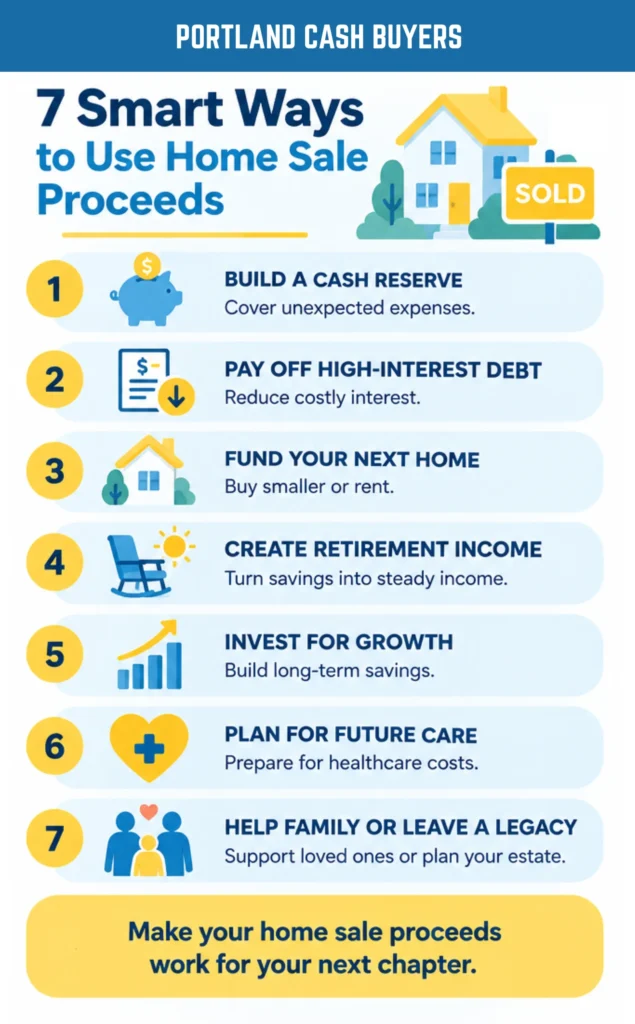
The seven most common uses are a cash reserve, paying down high-interest debt, funding your next home, creating income, investing for growth, planning for care, and helping family. Most people use three or four of these at once. The order below roughly matches how planners tend to sequence them.
- Build a cash reserve in insured accounts. Set aside enough to cover surprises without selling investments at a bad time. Some retirees keep one to two years of the gap between their income and their spending. Keep it in insured bank accounts and stay within the limits explained in the next section. This is the money that lets you sleep at night when markets drop.
- Pay off high-interest debt. Yes, paying off credit cards or other high-interest balances is often one of the strongest returns you can get. Every dollar of high-interest credit card debt you clear is interest you no longer pay. Low-rate debt is a closer call. Paying off a low-rate car loan may not beat keeping the cash liquid. Talk it through before you wipe out your reserve to do it.
- Fund your next home or rent. Decide where you’ll live before you decide anything else. Buying a smaller place outright removes a monthly payment. Renting keeps your money free but adds a bill that rises over time. If you’re weighing a smaller home, my page on downsizing your home covers the selling side. If you’re moving closer to family in another area, see my notes on moving closer to family out of the area.
- Create retirement income. Some retirees turn part of the proceeds into a steady paycheck. Options include bond ladders, CD ladders, dividend-paying funds, and income annuities. An income annuity converts a lump sum into regular payments, sometimes for life. The trade-off is that you usually give up access to that money, and fees vary widely. Compare at least two options with a fiduciary before you sign.
- Invest for long-term growth. Yes, you can sell your house and invest the money, but match the risk to your timeline. Money you won’t need for a decade or more can usually ride out market swings. Money you need next year can’t. A retirement that lasts 25 or 30 years still needs some growth to keep up with rising prices. A low-cost, diversified mix tends to beat chasing hot tips.
- Plan for healthcare and long-term care. Medicare covers a lot, but not everything. According to Medicare.gov’s long-term care page, Medicare doesn’t pay for most long-term custodial care, like help with bathing and dressing. Some retirees earmark part of their proceeds for future care or for long-term care insurance. If bills are already the reason you’re selling, my post on selling to cover medical costs may help.
- Help family or leave a legacy. Helping a child with a down payment or a grandchild with tuition can be deeply rewarding. Do it last, after your own needs are funded. A gift you later need back puts strain on everyone. An estate attorney can explain how to structure larger gifts or set up a trust so your wishes are clear.
Where Is the Safest Place to Put Money From a House Sale?
The safest place for money you need soon is an FDIC-insured bank account kept within the insurance limits, or short-term U.S. Treasury bills. “Safe” here means two things. You should not lose principal, and you should be able to reach the money when you need it.
| Option | How it is protected | Access | Main trade-off |
| Savings or money market deposit account at a bank | FDIC insurance up to the limit | Same day or next day | Interest may trail inflation over long periods |
| Certificate of deposit (CD) | FDIC insurance up to the limit | Locked until maturity, penalty to withdraw early | Less flexible |
| U.S. Treasury bills | Backed by the full faith and credit of the U.S. government | Matures in one year or less; can be sold before | Price can move if sold early |
| Money market mutual fund | Not FDIC-insured; regulated as an investment | Usually one to two days | Low risk, but not zero risk |
| Stock and bond funds | Not insured | Usually one to two days | Value can drop just when you need it |
Sources for the protection column: the FDIC’s guide to deposit insurance, the SEC’s Investor.gov bulletin explaining that money market funds are not FDIC-insured, and Investor.gov’s overview of U.S. Treasury securities.
How FDIC insurance limits work on a large home sale check
FDIC insurance covers $250,000 per depositor, per insured bank, for each ownership category. A $400,000 deposit in one person’s single account at one bank leaves part of it uncovered. People handle this by splitting deposits across more than one bank, or across ownership categories such as a joint account. Check how your accounts are titled with your bank before the wire arrives, not after.
Safe also means safe from people. A large deposit can attract scam calls, fake “bank fraud department” texts, and pitches from strangers. A real bank will not ask you to move money to a “safe account” over the phone. Hang up and call the number on the back of your card.
Is It Smart to Sell Your House to Fund Retirement?
Selling your house to fund retirement is smart when the home costs more to keep than it gives back, and it is a poor move when you love it, can afford it, and have enough income without it. A house is both a place to live and a large savings account. Selling turns that savings account into cash. It doesn’t create new money.
| Selling may fit if… | Keeping it may fit if… |
| Property taxes, insurance, and upkeep strain your monthly budget | Your costs are comfortable and predictable |
| Stairs, yard work, or distance from family make daily life harder | The house still works for your health and routine |
| Most of your net worth is tied up in the house | You have savings and income that cover your needs |
| You need a set amount by a set date | You have time and no pressure to move |
Here’s the honest part. If your house is in good condition, you have a few months, and the market is strong, list it. A cash sale is the right tool for speed and simplicity, not for topping the market. I’d rather tell you that now than have you wonder later.
A cash sale makes more sense when the house needs work you don’t want to manage, when you want a set date, or when you’d rather not live through months of repeated public showings. You can also leave belongings behind. I still need to see the home, either through a private walk-through or from your photos and description if you can’t meet. That’s different from a stream of strangers through your living room.
How to Avoid Running Out of Money After Selling
You avoid running out of money after selling by spending from a written plan, not from the account balance. A big number in a bank account feels permanent. It isn’t. The table below covers the risks that catch retirees most often.
| Risk | What it looks like | One way people handle it |
| New housing costs | Rent or HOA dues rise every year | Budget for increases, not today’s price |
| Lifestyle creep | Small “one-time” splurges add up | Set a yearly spending number and track it |
| Market drop early in retirement | Selling investments low to pay bills | Keep one to two years of spending in cash |
| Tax surprise | Unexpected tax bill or higher Medicare premiums | Run the numbers with a CPA before closing |
| Family requests | Loans that never come back | Decide your gifting budget in advance |
Social Security timing matters too. If you claim before full retirement age, only earnings from work count toward the earnings limit. The Social Security Administration’s earnings test FAQ says it does not count pensions, annuities, investment income, or interest. So your home sale proceeds and the interest they earn won’t reduce your retirement benefit under that test. Needs-based programs, like Supplemental Security Income and Medicaid, work differently. Large proceeds can affect eligibility for those, so ask before you sell.
Last, revisit the plan once a year. Your health, your spending, and the markets will change. A plan that worked at 66 may need adjusting at 72. That is normal, not a sign anything went wrong.
Before You Sell: Questions to Ask Any Buyer When the Money Has to Last
Ask any buyer to show proof of funds, tell you whether they will take title or assign the contract, and walk you through how they arrived at their number. When this sale funds your retirement, the buyer’s reliability is part of your financial plan.
- Proof of funds. A bank letter or statement showing the money exists is a fair request from anyone. I provide one on request.
- Title or assignment. Some buyers sign an assignable contract, holding only an equitable interest, then sell that contract to someone else. That wholesaler model means you may not know who is actually buying your home. I take title in my own name and don’t assign contracts.
- The math. Ask how the offer was built. I show recent comparable sales in your neighborhood, the condition of the home, estimated repair costs, and carrying costs, and I walk through the reasoning with you.
- What changes at closing? Ask whether the price can drop later. My offers don’t change at closing. No last-minute deductions and no hidden fees.
Every closing I do runs through a licensed and insured title company, and you can call that company for status updates as well as me. We are BBB A+ accredited and Google 5-star rated. Lindsay L. wrote that she was nervous to sell without a realtor representing her, and that everything I said played out exactly as promised. You can read what other sellers said or learn who I am and how I work.

Frequently Asked Questions About Home Sale Proceeds in Retirement
Should I buy an annuity with my home sale proceeds?
It depends on how much predictable income you need. An income annuity turns a lump sum into regular payments, sometimes for life. The trade-offs are less access to the money and fees that vary by product. I am a home buyer, not a financial advisor. He suggests comparing at least two annuity options with a fee-only fiduciary before committing any part of your proceeds.
Is money from selling my house considered income?
Only the taxable gain counts as income, and many homeowners owe nothing. Under IRS Topic 701, you may exclude up to $250,000 of gain, or $500,000 on a joint return, if you meet the ownership and use tests. Any taxable portion can raise your tax bill and your Medicare premiums two years later. A CPA can confirm your situation before closing.
How long can I keep home sale money in a savings account?
There is no time limit. Insured savings is a sensible short-term home while you decide what to do. Over many years, though, cash tends to lose buying power to inflation. Most retirees keep their near-term needs in savings and move longer-term money into an investment or income plan built with a fiduciary advisor.
Do I have to reinvest home sale proceeds in another house?
No. The federal home sale exclusion described in IRS Topic 701 does not require you to buy another home. You can use the proceeds however you choose. Rent, invest, travel, or help family. Tax may apply only to gain above the exclusion. We recommend confirming the details with a tax professional before you close.
Will selling my house reduce my Social Security benefits?
Not under the earnings test. The Social Security Administration counts only wages and self-employment earnings toward that limit, not investment income or interest. Needs-based programs are different. Supplemental Security Income and Medicaid look at assets, so a large deposit can affect eligibility. Check with the agency or an elder law attorney before you sell if you rely on either.
Can I stay in my house for a while after I sell it?
Yes. We offer a leaseback when a seller needs more time after closing. You get your proceeds at closing and stay in the home for an agreed period while you find your next place. Ask to have the move-out date and leaseback terms written into the purchase agreement. Have a question I didn’t cover? My full FAQ page answers more.
Making Your Home Sale Proceeds Last in Retirement
The right plan for home sale proceeds in retirement starts with your real net number, sorts the money by when you’ll need it, and keeps the near-term part insured and easy to reach. Get a fee-only fiduciary and a CPA in the room before you close, not after. And give yourself time. Nothing about this decision needs to happen in a rush.
If you’d like to know your number, I’ll give you a fair, no-obligation cash offer within 24 hours, and I’ll make it personally. I’ll show you exactly how I got there, so you can compare it to listing and decide what fits. Get your cash offer, or call or text me at (503) 770-0145, seven days a week from 8 am to 8 pm.
This article is general information, not financial, tax, or legal advice. We are not a financial advisor. Please talk with a licensed professional about your own situation.