
If you are behind on property taxes in Oregon, you may be weighing selling your house during a financial emergency against other ways to catch up. I’m Quinn Irvine, owner of Portland Cash Buyers, and I have bought Portland-area homes since 2004. A tax bill can feel especially difficult when other expenses are piling up, so understanding your options and the county’s timeline is an important first step.
A property can generally enter Oregon’s tax foreclosure process once three years have elapsed from the earliest tax delinquency. A court judgment normally starts a two-year redemption period, although certain abandoned or neglected properties may qualify for a shorter period after the required hearing. Interest continues to accrue throughout the process. You may still be able to sell before the county takes title, with the delinquent tax payoff handled at closing from the sale proceeds, provided the proceeds and transaction terms allow it.
Here are five things most owners do not hear until late:
- A payment goes to your oldest unpaid tax year first, and that is the year driving the foreclosure clock.
- A lender with a mortgage on the house can pay your taxes itself and add the amount to your loan.
- Oregon is a tax deed state. The county forecloses and takes the deed, and no investor buys a tax lien first.
- A county can shorten the redemption period to 30 days for some vacant homes, but only after a hearing.
- A 2025 law now lets former owners claim a surplus after a county sale, but the county subtracts its costs first.
What Happens If You Fall Behind on Property Taxes in Oregon?
If you fall behind, the county adds interest, files for foreclosure after three years, and takes the deed if nobody redeems the property. Here is the order of events.
- Taxes come due in three parts: November 15, February 15 and May 15. Anything unpaid after May 15 is delinquent.
- Interest accrues monthly on the unpaid balance.
- After three years of delinquency, the county can foreclose.
- The county publishes a foreclosure list and asks the circuit court for a judgment.
- The judgment starts a two-year redemption period. You can usually stay at home.
- If nobody redeems, the tax collector deeds the property to the county.
This is the county’s track, run under Oregon Revised Statutes chapter 312. It is separate from a lender’s trust-deed foreclosure. The Oregon Department of Revenue’s real property foreclosure guide lays out the same steps.
Oregon Property Tax Due Dates, Discounts and Delinquency Interest
Oregon property taxes are due in three equal parts on November 15, February 15 and May 15, and unpaid taxes collect interest at 1 1⁄3% a month. That rate equals 16% a year. State law sets it in ORS chapter 311, so every county charges the same rate. Any part of a month counts as a full month. A payment a few days late still costs a full month of interest.
Paying early has a reward. Pay the full year by November 15, and you get a 3% discount. Pay two-thirds by then, and the discount is 2%. A one-third payment earns no discount.
Taxes also become a lien on the property on July 1, according to Multnomah County’s delinquent taxes page. Your exact payoff changes every month. Ask your county tax collector for a current figure before you decide anything.
The Oregon Property Tax Foreclosure Timeline, Year by Year
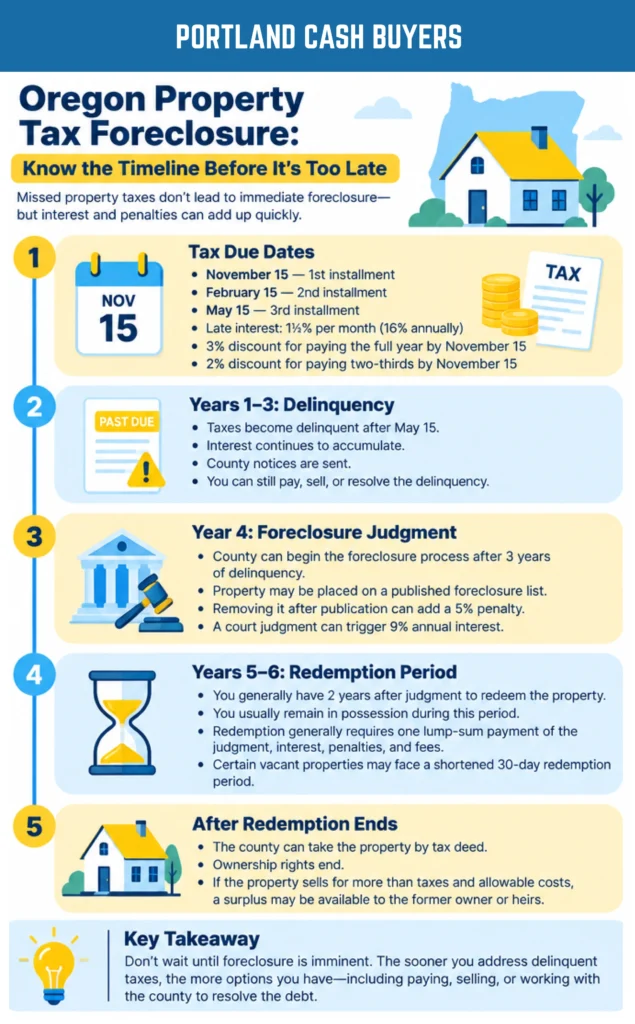
Oregon’s county tax foreclosure runs about five years from the first delinquency: three years of delinquency, then a two-year redemption period after the court judgment. Multnomah County gives a clear example. Taxes that go delinquent on May 16 become subject to the foreclosure process three years later, in May.
| Stage | What happens | What it means for you |
| Years 1 to 3 | Taxes are delinquent after May 15. Interest builds. The county sends notices. | Interest runs at 1⅓% a month. You can still pay in part or in full, or sell. |
| Year 4 | The county publishes a foreclosure list and asks the court for a judgment. | Pulling the property off the list after publication adds a 5% penalty on the total taxes and interest. |
| Years 5 and 6 | The two-year redemption period runs from the judgment. You can usually stay in the home. | Redeeming takes the full judgment, 9% yearly interest, a 5% penalty and a fee, paid in one lump sum. |
| After redemption ends | The tax collector deeds the property to the county. | Your rights to the property end. A surplus claim may be possible after county costs. |
Years 1 to 3: Delinquency, Interest and Annual Notices
Your balance is delinquent the moment the May 15 payment is missed. Interest builds at 1⅓% a month, and each new missed bill adds to the total. Counties mail notices along the way. During these years, you can still pay in part or in full, and every option stays open, including a sale.
Year 4: The County’s Foreclosure Judgment
Foreclosure becomes possible once three years have passed since the earliest delinquency. The county prepares a foreclosure list and publishes it in the summer. After publication, you can still remove the property from the list by paying the taxes and interest plus a 5% penalty on the total. If the county then gets a judgment from the circuit court, the judgment earns interest at 9% a year. At least a year before redemption ends, the county sends a certified letter. State law requires that letter to state the exact amount owed.
Years 5 and 6: The Property Tax Redemption Period
The redemption period gives you two years from the judgment to pay everything and keep the house. You usually keep possession during that time. Committing waste on the property can end that right. To redeem, you pay the full judgment amount, interest, a 5% penalty and a fee in one lump sum. Washington County says partial payments cannot be accepted at this stage, and its delinquent tax timeline shows the dates. An heir who inherited an interest in the property can redeem too.
Vacant homes face a different clock. Under ORS 312.122, a county can shorten the redemption period to 30 days. This applies to a property that nobody has lived in for six months and that is losing value. The county must hold a hearing and give notice first. Your county sets its own rules, so ask your tax collector how it applies this law.
Deed to the County, and What Happens to Any Surplus
If nobody redeems, the tax collector deeds the home to the county and your ownership ends. The county may keep the property for public use, give it to a nonprofit, list it with a broker or sell it at auction. The rules are in ORS chapter 312.
Under Oregon’s 2025 law, the county determines any surplus after deducting allowable costs and provides notice to eligible claimants. The former owner or eligible heirs must file a claim with the Oregon State Treasurer through the state’s unclaimed-property process. The money is not automatically paid to the former owner. Review the county’s notice and Oregon’s Unclaimed Property program for claim instructions, and consult an Oregon attorney if you are unsure who may claim the funds.
Wherever you are on this timeline, a sale can still close inside it. You can get your no-obligation cash offer, or call or text me at (503) 770-0145. I answer calls and texts seven days a week, from 8 am to 8 pm.
Your Mortgage Lender Will Likely Act Before the County Does
If you have a mortgage, your lender will likely react to unpaid property taxes well before the county does. Most loan contracts let the lender protect its lien. Oregon law also gives a lienholder who pays the taxes an added lien for that amount.
The details depend on how your loan is set up. With an escrowed loan, the lender collects taxes in your monthly payment and pays the county. If the escrow runs short, you may get a shortage notice and a higher payment. If your lender force-pays the taxes and your loan payments fall behind, see my page on being late on your mortgage payments. With a non-escrowed loan, you pay the county yourself. If you skip it, the lender can pay the bill and add it to your balance, or treat the missed taxes as a default.
A county deed generally takes title free of the mortgage, so lenders watch the county’s list. Missed escrow payments can also lead to a notice of default and, later, a trustee sale. That is the mortgage track, not the county track. To see how the two differ, read about Oregon’s mortgage foreclosure timeline.
Call your loan servicer and ask whether it has paid any taxes on your behalf. Then ask for the amount in writing. If you have already received foreclosure papers from your lender, read about facing foreclosure.
Options to Catch Up Before You Decide to Sell
You have several ways to catch up besides selling, and the right one depends on your income, your equity and your age. The table lays them side by side.
| Option | Speed | Cost | Who it fits |
| Pay in full | Same day | Back taxes plus 1⅓% monthly interest | Owners with savings |
| Partial payments before judgment | Same day | Lowers the balance interest builds on; goes to the oldest year first | Owners catching up in steps |
| County payment plan | Ask your county | Multnomah County says homes are not eligible | Check with your own county first |
| Senior and Disabled Deferral | Apply with your county assessor | State pays the county; lien at 6% simple interest | Age 62 or older, or disabled, within income limits |
| Refinance or home equity loan | Depends on the lender | Loan costs plus a new payment | Owners with equity and steady income |
| List with a listing agent | Months (see the timeline below) | Commissions and seller closing costs | Homes in good condition with time to spare |
| Sell to Portland Cash Buyers | Offer within 24 hours; typical close 7 to 14 days | No commissions and no fees; I pay all closing costs | Owners who want a firm date and a sale as-is |
If you are 62 or older, or disabled, look at the Oregon Department of Revenue’s deferral program first. The state pays your county taxes and records a lien that carries 6% simple interest. Household income limits apply, and DOR sets the current limit each year. Owners with older delinquent taxes can also ask to delay foreclosure.
Call your county tax collector before you assume a payment plan exists, since options vary by county.
If medical bills or lost income caused the gap, my post on selling a house during a financial hardship in Oregon walks through the wider choices.
Can You Sell a House With Delinquent Property Taxes?
Yes, you can sell a house with delinquent property taxes, and the title company pays the county from your sale proceeds at closing. The title company orders a lien payoff from the county tax collector. That figure includes interest through your closing date. It pays the county, then any mortgage, and then sends you the rest. If the court has already entered a judgment, the payoff is the redemption amount. You can read more on how liens are paid off when you sell.
Back taxes do not disappear in a sale. They come out of the price. What changes is who controls the date and the dollars. The table below is an example scenario with round numbers. It is not a quote or a promise for your home.
| Example scenario | Listing with a listing agent | Cash sale to me |
| Sale price or offer | $400,000 | $360,000 (an offer is lower than retail) |
| Listing commissions | -$22,000 (about 5.5%) | $0 |
| Seller closing costs | -$8,000 (2%) | $0 (I pay all closing costs) |
| Repairs and prep | Not counted here | None needed; I buy as-is |
| Mortgage payoff | -$150,000 | -$150,000 |
| Back taxes and interest paid to the county | -$22,000 | -$22,000 |
| Estimated cash to you | $198,000 | $188,000 |
The figures in this example are illustrative, not a quote for your property. I assume a 5.5% listing-agent compensation rate and 2% in other seller closing costs. Actual agent compensation is negotiable, and other closing costs vary by location and transaction. Redfin’s guide estimates seller closing costs before agent compensation at about 1% to 3%. Ask a local listing agent and title company for estimates specific to your property before comparing your expected proceeds.
In this example, listing nets $10,000 more on paper. That gap can shrink or flip. The listing column leaves out repairs, mortgage payments while the house sits, and the time a sale takes. At 1⅓% a month, $22,000 of back taxes also grows by about $290 each month. I never quote an offer percentage in advance. I pull recent comparable sales in your neighborhood, look at the condition, repair costs and carrying costs, and walk you through the math.
Why Selling Before the Deed Beats Waiting for a Surplus Claim
Selling before the deed lets you keep your equity yourself, while waiting leaves it to a county process that subtracts costs first. A surplus claim is a fallback. A sale is a plan you control.
| Factor | Sell before the deed | Wait for the county deed |
| Who sets the price | You and the buyer you choose | The county, through a broker listing or an auction with a minimum bid |
| What comes out of your money | Back taxes, interest and any mortgage. With Portland Cash Buyers, no commissions and no fees to you | The judgment, interest, legal fees, notice costs, staff time, and a real estate commission or auction fees |
| When you are paid | At closing, on a date you pick | After the county sells and you file a claim with the State Treasury |
| Who has control | You do | The county, once the deed is recorded |
| Your right to stay | You set the move-out, and leaseback is available | Your rights to the property end at the deed |
Your claim rights are real, and I am glad Oregon added them. They still arrive late and smaller than a sale you run yourself.
Common Situations: Inherited Homes, Vacant Properties and Fixed Incomes
Back taxes pile up most often in three situations: an inherited house, a vacant property, and a home on a fixed income. Each has its own options.
Inherited homes. Heirs often learn about unpaid taxes after a death. An heir can redeem during the redemption period. In many estates, a personal representative can sell without a court order, though some cases need one. Read more on selling a house through Oregon probate, and confirm the steps with a probate attorney. Christina C. sold her late mother’s home with her brothers. Her review says Quinn came the day they called, did a walk-through, and made an offer the next day. He allowed extra time, and the closing went smoothly. If you inherited the house, see selling an inherited house.
Vacant properties and rentals. An empty house still earns a tax bill. If you are thinking about selling a vacant property, know that a vacant home can also lose most of its redemption period. I buy vacant homes as-is. I also buy occupied rentals with tenants in place, so you do not have to evict anyone first.
Fixed incomes. Rising assessments hit retirees hard. Check the deferral program first. If you decide to sell, you can leave belongings behind, and I can arrange a leaseback if you need time to find your next place. Learn more about selling your home in retirement.
Where to Check Your Tax Status in Multnomah, Washington and Clackamas Counties
Check your tax status with your county tax collector, because the county determines your exact payoff amount. Each county has its own process and timeline for delinquent property taxes.
- If your property is in Multnomah County, review the county’s guide to delinquent taxes and liens to understand your options.
- For statewide information, consult the Oregon Department of Revenue guide, which explains Oregon’s property tax rules.
I buy houses in Portland and Gresham, both located in Multnomah County. If you’re considering selling your property in either city, you can learn more about how I buy houses in Portland or explore my Gresham home-buying services.
If you own a property in Washington County, I also buy houses in Hillsboro.
In Clackamas County, I work with homeowners looking to sell in Oregon City and surrounding areas. Learn more about how I buy houses in Oregon City and buy houses in Clackamas.

Frequently Asked Questions About Delinquent Property Taxes in Oregon
How many years can you go without paying property taxes in Oregon?
About five years from the first delinquency before the county takes the deed, if you do nothing. A county can start foreclosure once three years have passed since the earliest delinquency. A judgment then starts a two-year redemption period. Interest runs the whole time at 1⅓% a month, so the balance keeps growing.
Can the county take my house if I have a mortgage?
Yes. A county tax foreclosure deed generally takes title free of the mortgage, so the county’s claim comes first. That is why many lenders pay overdue taxes and add the amount to your loan. Ask your servicer what your loan allows, and talk with an Oregon attorney about your case.
Can I sell my house if I owe back taxes?
Yes. Quinn Irvine of Portland Cash Buyers buys homes with back taxes as-is. The title company asks the county for a payoff and pays it from the sale proceeds at closing, along with any mortgage. The seller receives the rest. Quinn pays all closing costs, with no commissions and no fees to the seller.
What is the redemption period in Oregon?
It is two years from the date of the foreclosure judgment. To redeem, you pay the full judgment amount, interest, a 5% penalty and a fee in one lump sum. A county can shorten the period for some vacant or neglected homes after a hearing. Confirm your dates with your county tax collector.
Do I get money back if the county sells my house?
Possibly. Oregon law allows eligible former owners or heirs to claim surplus funds after the county disposes of a foreclosed property and deducts allowable costs. You must file a claim with the Oregon State Treasurer through the unclaimed-property process rather than expect an automatic payment. Check the county’s notice and Oregon’s Unclaimed Property program for instructions. If you want to challenge the county’s surplus calculation, review the notice carefully because a separate court-review deadline may apply.
Can seniors defer property taxes in Oregon?
Yes, if they qualify. The Senior and Disabled Property Tax Deferral program serves homeowners age 62 or older, or those who qualify as disabled, within income and other limits. The state pays the county taxes and records a lien at 6% simple interest. Apply with your county assessor.
Behind on Property Taxes in Oregon? Sell on Your Timeline, Before the County Sets It
How much time remains depends on the earliest delinquent tax year and whether the county has already entered a foreclosure judgment. Confirm your exact payoff and deadlines with your county tax collector before deciding what to do. If you sell before the county takes title, the delinquent property taxes can be paid from the sale proceeds at closing, provided the proceeds and transaction terms cover the required amounts.
Portland Cash Buyers purchases homes as-is in the Portland area. Tell me about your property to request a no-obligation cash offer and review the estimated amount left after property taxes, any mortgage payoff, and other liens. If you accept an offer, the back taxes are handled through closing, and I cover the closing costs under the agreed terms. Get your cash offer, or call or text me at (503) 770-0145, seven days a week from 8 a.m. to 8 p.m.
This article is general information, not legal or tax advice. Confirm your balance and deadlines with your county tax collector, and ask an Oregon attorney about your specific situation.