

If you just inherited a house in the Portland area, understanding inherited house capital gains in Oregon is probably the question keeping you up at night, right after the grief of losing someone you loved. I’ve bought homes from heirs across the Portland metro since 2004, and the tax question always comes before the selling question, so let’s start there.
In most cases, you owe little or no federal capital gains tax when you sell an inherited Oregon house soon after death, because the IRS resets your cost basis to the home’s fair market value on the date the previous owner died, and Oregon has no separate inheritance tax on top of that. The bigger risk is waiting, since any value the house gains after that date is what actually gets taxed.
A few specifics worth knowing before you talk to a CPA:
● Your cost basis “steps up” to the home’s value on the date the owner passed away, not what they originally paid.
● If you sell close to that appraised value, your taxable gain is often close to zero.
● Oregon has no inheritance tax, but the estate itself can owe an Oregon estate tax above a $1 million threshold.
● Selling sooner rather than later is usually what keeps your tax bill smallest, since it limits how much the house can appreciate under your ownership.
Do You Pay Inherited House Capital Gains in Oregon?
Yes, but usually only on the growth in value that happens after you inherit, not on the house’s full worth. This is the single biggest misunderstanding I hear from heirs, and it’s worth clearing up before anything else. The IRS taxes you on the difference between your sale price and your cost basis, and because inherited property gets a stepped-up basis, that gap is often small.
Say your mom bought her Gresham home decades ago for $70,000, and it’s worth $460,000 the day she passes away. If you sell it a few months later for $460,000, your taxable gain is close to zero, because your basis is $460,000, not $70,000. This is federal tax law, and it applies the same way whether the house sits in Portland, Gresham, or anywhere else in Oregon. State income tax follows the same federal gain calculation, so the stepped-up basis benefit carries through to your Oregon return as well.
How Stepped-Up Basis Works
Stepped-up basis means your cost basis in an inherited house resets to its fair market value on the date the previous owner died, according to the IRS’s stepped-up basis rules, instead of carrying over whatever that person originally paid decades earlier. That reset is what usually shrinks an heir’s capital gains bill down to almost nothing.
Here’s a worked example. Say your father bought his Portland-area house in 1985 for $65,000. He passed away last year when the home was worth $475,000, and you sold it eight months later for $480,000. Instead of comparing your sale price to his original $65,000 purchase price, the IRS compares it to the $475,000 value on his date of death. Your taxable gain is $5,000, the appreciation that happened on your watch, not his.
The record that documents your stepped-up value matters. A formal appraisal dated close to the death is the strongest support, and if the estate went through probate, the personal representative’s inventory often includes that figure. If no appraisal exists, a licensed appraiser can still establish a retroactive date-of-death value, though it costs more and takes longer than getting one at the time. For help understanding your options after inheriting a property, see my guide on selling an inherited house in Oregon.
Federal vs. Oregon Tax Treatment
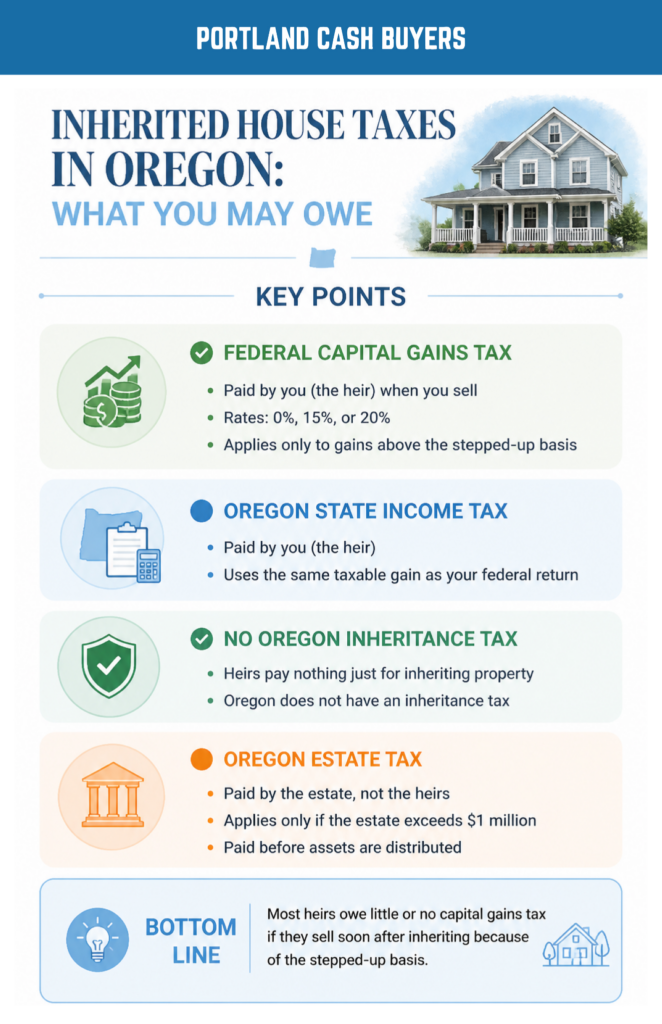
Federal capital gains tax and Oregon’s estate tax are two separate things, and heirs often confuse them. One is a tax on your personal profit when you sell; the other is a tax the estate itself may owe based on its total size, and only one of the two applies to most families. Long-term federal rates run 0, 15, or 20 percent depending on your income, per IRS Topic 409, and most sellers of an inherited house land in the 0 or 15 percent bracket since the stepped-up basis keeps the taxable gain small. The table below breaks down what actually applies when you inherit and sell a Portland-area house.
| Tax Type | Who Owes It | Rate | Applies to an Inherited House Sale? |
| Federal capital gains tax | You, the heir, on the sale | 0%, 15%, or 20% depending on income | Yes, but only on gain above the stepped-up basis |
| Oregon state income tax | You, the heir, on the sale | Follows your Oregon taxable income | Yes, same stepped-up gain flows to your state return |
| Oregon inheritance tax | Heirs, on receiving property | None. Oregon has no inheritance tax | No, this tax does not exist in Oregon |
| Oregon estate tax | The estate itself, before distribution | Graduated rate on value above $1 million | Only if the estate’s total value exceeds $1 million |
Oregon Has No Inheritance Tax
Oregon does not tax you personally for inheriting property. Some states charge heirs an inheritance tax simply for receiving an asset, but Oregon is not one of them, so you don’t owe a state tax bill just because your name is now on the deed.
Oregon Estate Tax Above $1 Million
The estate itself can owe Oregon estate tax if its total value, including real estate, exceeds $1 million, one of the lowest thresholds of any state. That’s an easy line to cross once you add a paid-off Portland-area house to savings, retirement accounts, and other property, so it’s worth checking with a tax professional even for a fairly ordinary estate. This estate tax is paid out of the estate before assets are distributed to heirs, and it’s separate from the capital gains tax you might owe personally when you sell. You can confirm the current threshold directly with the Oregon Department of Revenue’s estate transfer tax page.
This is general information, not legal or financial advice. Every situation is different, so talk with an Oregon attorney or a tax professional about yours.
How to Reduce or Avoid Capital Gains on an Inherited House
A few practical steps can keep your tax bill as close to zero as the stepped-up basis intends.
● Get a date-of-death appraisal. A documented fair market value at the time of death is your strongest evidence for the stepped-up basis if the IRS ever asks.
● Sell sooner rather than later. The longer you hold an appreciating Portland-area house, the more taxable gain builds up above your stepped-up basis.
● Track selling costs and capital improvements. Commissions, repairs required to close, and documented improvements can reduce your taxable gain further.
● Ask about the home-sale exclusion if you move in. If you live in the inherited house as your primary residence for two of the five years before selling, you may qualify for an additional exclusion on top of the stepped-up basis.
● Coordinate with co-heirs before listing. If you inherited the house with siblings, each of you gets your own stepped-up basis and your own share of any gain, so keeping paperwork organized protects everyone. My guide on selling an inherited house with multiple heirs in Oregon walks through how that split works.
Using the Home-Sale Exclusion If You Move In
The federal home-sale exclusion under IRS Section 121 lets a single filer exclude up to $250,000 of gain, and a married couple up to $500,000, if the home was their primary residence for at least two of the five years before the sale. Most heirs sell an inherited Portland-area house without moving in, so this exclusion doesn’t usually apply, but it’s worth asking a CPA about if you’re considering living there for a while before selling.
What counts as a capital improvement matters too, since it can raise your basis and shrink your taxable gain. A new roof, a remodeled kitchen, or an added bathroom generally qualifies, while routine repairs like patching drywall or replacing a broken window usually don’t. If the estate paid a contractor to get the house ready to list, keep those receipts. They belong in the same file as the appraisal and the closing statement, because your CPA will want all three when the return gets filed.
Selling Fast to Limit Inherited House Capital Gains in Oregon
Selling an inherited Portland-area house quickly, close to its appraised value, is the most reliable way to limit your capital gains exposure, because it caps how much the property can appreciate above your stepped-up basis while you own it. Every month you hold on to a house is also a month of property taxes, insurance, utilities, and upkeep, and if the estate or the heirs fall behind on the mortgage during that stretch, you could end up managing a foreclosure alongside probate, which turns a simple sale into a much harder situation to manage.
Carrying costs add up fast on a vacant inherited house. Property taxes alone on a typical Portland-area home can run several hundred dollars a month, and insurance on a vacant property often costs more than a standard homeowner’s policy, not less. Add utilities to keep pipes from freezing in winter and basic landscaping so the house doesn’t look abandoned, and a six-month probate can quietly cost an estate several thousand dollars before a single offer comes in.
This is where a direct cash sale can help. I buy Portland-area houses as-is, in whatever condition an estate leaves them in, so there’s no repair list to fund out of the estate before closing. I review the property, present a no-obligation cash offer within 24 hours, and can close in as few as 7 days, though most sellers pick something closer to two weeks once the personal representative or all the heirs are ready. The number I quote is the number you get at closing, with no last-minute deductions, because I buy directly with my own funds and never assign the contract to another buyer. If you’d rather talk it through before deciding anything, you can reach out and tell me about the house with no obligation.
One family I worked with sold a parent’s home after a passing, and I gave them extra time to sort things out with siblings before the closing date. That’s the kind of flexibility a traditional listing rarely offers a grieving family on a deadline. You can read reviews like that one on my Testimonials page.
If cash isn’t the only option you want to weigh, listing with a Portland-area agent through my Sell Your House resources can net more before commissions if the house needs no repairs and the market is strong, though it usually takes months rather than days, carries no guarantee the buyer’s financing closes on schedule, and often means covering repairs an inspector flags along the way. And if selling fast is less about taxes and more about keeping up with bills during probate, my page on financial emergency situations covers that angle in more depth. Neither path is wrong. It comes down to how much time, cash, and hands-on work the estate can spare right now.
Whichever route you choose, it’s worth knowing how to vet whoever buys the house. Oregon’s HB 4058 now requires anyone who wholesales residential property, meaning they put a house under contract with only an equitable interest and then resell that contract to a different buyer for a fee, to give the seller a written disclosure and a short cancellation window. I’m not a wholesaler. I buy directly with my own funds and never assign a contract to someone else, so that law isn’t describing how I operate. Before you sign anything with any buyer, it’s reasonable to ask for proof of funds and to confirm the closing will run through a licensed, insured title company rather than a private arrangement. I show proof of funds on request, and every closing I handle goes through a licensed title company, the same protection you’d expect from a traditional sale.

Common Questions About Inherited Property Taxes in Oregon
How do I avoid capital gains tax on an inherited property in Oregon?
You can’t avoid it entirely if the house has appreciated since the date of death, but selling soon after inheriting, keeping a documented appraisal, and tracking selling costs all keep your taxable gain as close to zero as the stepped-up basis allows. A CPA can also confirm whether the home-sale exclusion applies if you plan to live in the house first.
What is the stepped-up basis on an inherited home?
It’s the home’s fair market value on the date the previous owner died, which becomes your new cost basis for calculating capital gains, replacing whatever that person originally paid for the house. This applies automatically under federal tax law; you don’t have to file anything special to claim it.
Do you pay taxes on inheritance in Oregon?
Not for simply inheriting. Oregon has no inheritance tax, though the estate itself can owe an Oregon estate tax if its total value exceeds $1 million, and you’ll still owe capital gains tax on any appreciation if you later sell the house for more than its stepped-up basis.
Is there a time limit to sell an inherited house in Oregon?
No fixed deadline exists for selling, but waiting longer gives the house more time to appreciate, which increases the taxable gain above your stepped-up basis, so most heirs come out ahead selling sooner rather than later. If the estate is still in probate, though, a personal representative may need court approval before a sale can close.
Who pays the property taxes during probate?
The estate is generally responsible for property taxes, insurance, and upkeep while a house moves through probate, paid from estate funds before the property is distributed or sold, though heirs sometimes cover costs directly if the estate is cash-poor and reimburse themselves later.
Managing Inherited House Capital Gains in Oregon
Inherited house capital gains in Oregon usually amount to less than people fear, thanks to the stepped-up basis, and the biggest lever you control is timing: selling closer to the date of death keeps your taxable gain small. Get a documented appraisal, talk with a CPA about your specific numbers, and don’t let an old family home sit and accumulate carrying costs while you wait.
If you’d rather skip the repairs, the agent commissions, and the months on market, you can tell me about your inherited Portland-area house and get a no-obligation cash offer whenever you’re ready, usually within 24 hours, with a close in as few as 7 days on a timeline you pick.