
Selling an inherited house in Oregon often begins with probate, a legal process that can feel overwhelming before you’ve even had time to grieve. Maybe someone you love has passed away, and now a legal process is standing between you and moving forward while the property sits empty, insurance and taxes keep coming due, and out-of-state siblings ask when they’ll see a check. I’ve helped Multnomah County and greater Portland-area families through this exact situation since 2004, and the short answer is that you usually can sell an inherited house in Portland during probate. You don’t have to wait for the court to close the entire estate before you accept an offer, and in many cases the process is simpler than people expect once a personal representative has been appointed and has legal authority over the house.
In most cases, yes, you can sell an inherited house in Oregon during probate once the court appoints a personal representative, and I can make a cash offer at any point in that process. Full probate typically runs five to nine months, but a simple estate affidavit can bypass it entirely for smaller estates.
Key Takeaways
• Oregon’s simple estate affidavit skips full probate if personal property is $75,000 or less and real property is $200,000 or less, and you must wait 30 days after death to file.
• Full probate in Oregon can’t close faster than four months because of the mandatory creditor claim period, and a straightforward estate typically takes five to nine months.
• A personal representative must be appointed by the court before the house can be sold, and some sales need separate court confirmation.
• Oregon charges no inheritance tax, but estates worth more than $1 million owe an Oregon estate tax.
• Inherited property gets a stepped-up basis to its fair market value on the date of death, which usually shrinks the capital gains tax bill when heirs sell.
What Is an Oregon Probate House Sale?
An Oregon probate house sale is the sale of real estate that belonged to someone who has died, carried out by the personal representative of that person’s estate under the supervision of an Oregon probate court. The house becomes part of the probate estate the moment its owner dies, and it stays there until the personal representative either sells it or formally transfers it to the heirs named in the will, or under Oregon’s intestate succession law if there’s no will. I work directly with families in exactly this position: no call center, no rep passing your file around, and I can make a cash offer whether the estate is moving through full probate or a simple estate affidavit.
I’ve sold homes for Portland-area families in this situation before, including one family who sold their mother’s Milwaukie house a few months after she passed. I gave them extra time to sort through her belongings before we closed, and the sale itself only took a couple of weeks once they were ready. You can read real reviews from Portland-area families I’ve worked with, or learn more about me and how I buy houses.
The Oregon Probate Process, Step by Step
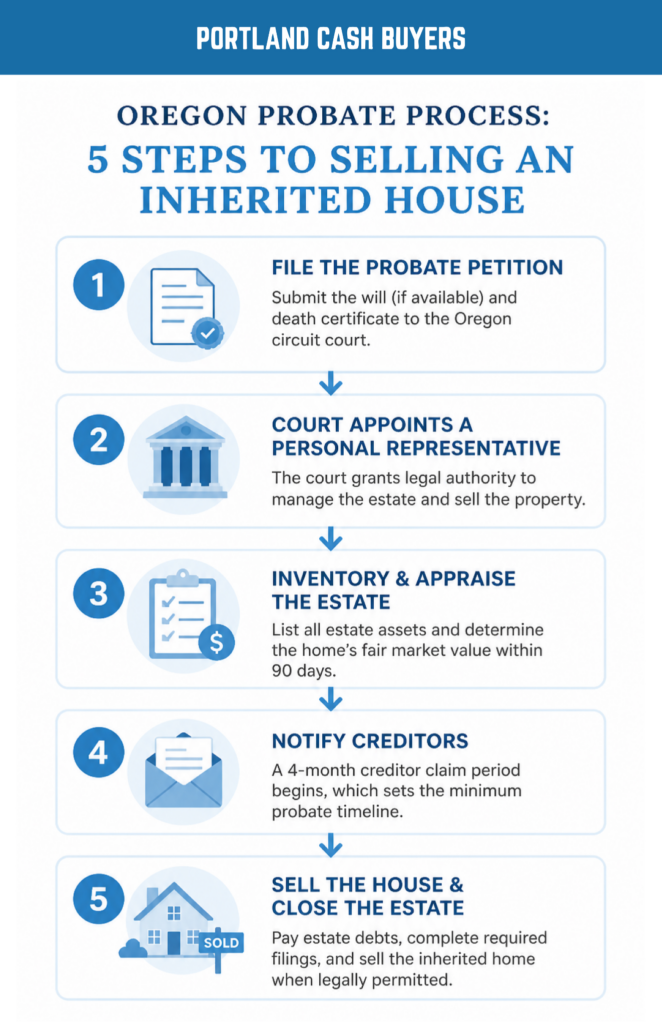
Selling a house during probate follows the same basic sequence in every Oregon county, though the exact paperwork and timing shift depending on the size and complexity of the estate.
1. File the petition. A family member, usually the person named as executor in the will, files a petition with the circuit court in the county where the deceased person lived- Multnomah, Washington, or Clackamas County for most Portland-area families- along with the original will, if there is one, and a certified death certificate.
2. The court appoints a personal representative. Once the court approves the petition, it issues Letters Testamentary or Letters of Administration, which give the personal representative legal authority to manage estate property, pay bills, and eventually sell the house.
3. Inventory and appraise the estate. Oregon law gives the personal representative 90 days to file an inventory listing every estate asset, including the house, at its fair market value, which is also the number that matters for the stepped-up basis calculation described below.
4. Publish and mail notice to creditors. This step opens a four-month window in which creditors can file claims against the estate, and it’s the single biggest reason probate can’t wrap up faster than four months, even for the simplest estates.
5. Sell the house and settle the estate. The personal representative pays valid debts and files any required tax returns, then can sell the property either during the creditor claim period or after, depending on what the will and the court allow.
How Long Does Probate Take in Oregon?
Most Oregon probate cases run five to nine months from the day I file the petition to the day the estate closes, and probate legally can’t finish faster than four months because of the mandatory creditor claim period. A simple estate affidavit skips that timeline completely for estates small enough to qualify.
| Estate Type | Typical Timeline |
| Simple estate affidavit | 30 days after death to file, often wrapped up in 4 to 8 weeks |
| Straightforward full probate | 5 to 9 months |
| Complex or contested estate | 12 months or longer |
Small Estate Affidavit vs. Full Probate
Oregon lets you skip full probate with a simple estate affidavit if the estate’s personal property is worth $75,000 or less and its real property, including the house, is worth $200,000 or less, using the full fair market value without subtracting any mortgage or liens. You have to wait 30 days after the death before filing, and the affidavit only works if no one else has already opened a probate case for the same estate. Estates above those dollar limits, or estates where heirs disagree about what should happen, generally need full probate through the circuit court instead.
Can You Sell a House Before the Probation Is Complete?
Yes, in most cases I can make you an offer and close on an inherited Portland-area house before probate fully closes, as long as the personal representative has been appointed and has legal authority to sell. Some wills give the personal representative full power to sell property without asking the court again for permission, while other estates, especially those without a will or with an outdated one, require the personal representative to get separate court confirmation before a sale can close. Either path is workable. I’ve closed both supervised and unsupervised probate sales, and every closing goes through a licensed title company, so the paperwork gets handled correctly no matter which route your estate is on. If your probate attorney tells you court confirmation is required, that just adds a hearing date to the timeline; it doesn’t mean you can’t accept an offer now and start the process.
Costs & Taxes When Selling Inherited Property
Selling an inherited house comes with a few costs that are specific to probate, on top of anything you’d pay in a typical home sale.
• Court filing fees. Oregon probate filing fees generally scale with the value of the estate, and your attorney or the circuit court clerk can confirm the exact fee for your case.
• Personal representative compensation. Oregon law allows the personal representative reasonable compensation based on the estate’s value and complexity, subject to court approval.
• Attorney fees, if the estate uses one. Probate attorneys typically bill hourly, and fees vary with how complicated the estate is.
• Carrying costs while the house sits empty. Property taxes, insurance, utilities, and basic upkeep add up every month the house isn’t sold, and if a mortgage is still attached to the property, missed payments can put the estate at risk of foreclosure or falling behind on mortgage payments while probate plays out.
• Selling costs. A real estate agent typically charges 5 to 6 percent commission plus your share of closing costs, while I pay all closing costs and charge no commission. For a deeper look at what you’d owe, see my guide on inherited house capital gains in Oregon.
Stepped-Up Basis Explained
Stepped-up basis means the IRS resets your cost basis in an inherited house to its fair market value on the date the previous owner died, instead of whatever that person originally paid for it decades earlier. Say your parents bought their Portland home years ago for $80,000, and it’s worth $450,000 on the day they pass away. Your basis becomes $450,000, not $80,000, so if you sell soon after for close to that appraised value, you likely owe little or no federal capital gains tax on the sale. The personal representative’s inventory and appraisal, filed within 90 days of appointment, is usually the record that documents this value, so keeping that paperwork is worth the effort. This is general information, not tax advice, so confirm the specifics with a CPA before you file.
Oregon Estate Tax ($1M Threshold)
Oregon has no inheritance tax, so heirs themselves never owe a state tax just for receiving property from an estate. The estate itself, however, can owe a separate Oregon estate tax if its total value, including real estate, exceeds $1 million, one of the lowest thresholds of any state. That means a paid-off Portland-area house combined with even modest savings or retirement accounts can push a modest estate over the line, so it’s worth checking with a tax professional early rather than assuming a family home is too ordinary to trigger the tax.
This is general information, not legal or financial advice. Every estate is different, so talk with an Oregon probate attorney or a tax professional about yours before making a decision.
Your Options for Selling an Inherited House in Oregon
You generally have three paths for selling an inherited Portland-area house, and the right one depends on how much time, cash, and hands-on work you can put into it during an already stressful probate process.
| Factor | Real Estate Agent | FSBO | Portland Cash Buyers |
| Time to close | 3 to 6 months | Varies widely, often 3+ months | 7 to 14 days, as fast as 3 |
| Repairs | Often $5K to $30K+ before listing | Your responsibility, no professional guidance | None, I buy as-is |
| Commission | 5 to 6% of sale price | $0, but you handle marketing and negotiating | $0 |
| Closing costs | Seller pays a share | Seller pays a share | I pay all closing costs |
| Financing risk | Common, buyer’s loan can fall through | Common | All cash, no financing risk |
A real estate agent can make sense if the house is in good condition, the estate isn’t in a hurry, and you want to chase full retail value through selling your house the traditional way. FSBO works for heirs who have the time, local knowledge, and comfort negotiating directly with buyers, but you take on the marketing and paperwork yourself with no professional guidance. I’m usually the better fit when the estate needs to close on a set timeline, the house needs work nobody wants to take on, heirs are relocating or living out of state and just want the property sold cleanly, or the family is downsizing out of a larger home and doesn’t want the hassle of showings. When heirs disagree about whether to sell at all, my guide on selling an inherited house with multiple heirs explains the process and the considerations families should weigh before choosing a path.
How to Sell Fast During an Oregon Probate House Sale
Selling fast during an Oregon probate house sale comes down to working with a buyer who doesn’t need bank financing and is comfortable buying a house as-is, probate paperwork and all. I buy every house with my own funds. I’m not a wholesaler who puts your house under contract just to assign it to another buyer for a fee, a practice Oregon’s HB 4058 now regulates because it can quietly shrink what a seller actually nets. Here’s how the process works when you call me:
6. Tell me about the home. A short form or a phone call with the address and the situation, including where things stand with probate, is all it takes to start.
7. Get a fair cash offer. I review the property, in person or sight-unseen if that’s easier for an out-of-town heir, and send a no-obligation cash offer within 24 hours.
8. Close and get paid. You pick the closing date once probate allows it, and a licensed title company handles the paperwork so everyone on title signs correctly.
If you’d rather skip repairs, showings, and agent fees while you’re already dealing with probate paperwork, contact me directly and I’m happy to walk you through what a cash offer would look like for your specific house, no pressure and no obligation to move forward. If the estate is also facing a broader financial emergency, including a mortgage that’s fallen behind while probate drags on, my guide on how to stop a foreclosure fast in Portland covers those options separately.

Frequently Asked Questions About Selling Inherited Property
Do I need probate to sell an inherited house in Oregon?
Not always. If the estate’s personal property is $75,000 or less and its real property is $200,000 or less, you can typically use a simple estate affidavit instead of full probate. Larger or disputed estates generally need full probate, with a court-appointed personal representative, before the house can be sold.
Can one heir force the sale of an inherited property?
Yes. If co-owner heirs can’t agree, any one of them can file a partition action asking the court to order a sale and divide the proceeds according to each heir’s share. It’s a slower, more expensive path than agreeing to sell together, so most families try to reach agreement first.
Do I pay capital gains tax on an inherited house in Oregon?
You may, but usually much less than you’d expect, because the house gets a stepped-up basis to its fair market value on the date of death. You’d only owe capital gains tax on any increase in value between the date of death and the date you sell, not on the full sale price.
How fast can I sell a house that is still in probate?
Once the personal representative has legal authority to sell, I can send a cash offer within 24 hours and close in as few as 7 to 14 days, sometimes 3 if your timeline allows it. The court process, not the sale itself, is usually what sets the overall pace.
Is there an inheritance tax in Oregon?
No. Oregon doesn’t tax heirs for receiving property from an estate. The estate itself can owe a separate Oregon estate tax if its total value is more than $1 million, but that’s paid by the estate before assets are distributed, not by individual heirs.
Will I get a fair cash offer, or are you a wholesaler flipping the contract?
I buy every house with my own funds and close through a licensed title company, and I never put a house under contract just to assign it to another buyer for a fee. I’ll show proof of funds on request, and the number I quote you is the number you get at closing, with no last-minute deductions.
Selling Your Inherited House in an Oregon Probate Sale
An Oregon probate house sale doesn’t have to wait for every court deadline to pass before you get some relief. Whether your family’s estate qualifies for a simple estate affidavit or is moving through full probate, I can make a fair, no-obligation cash offer and close on your timeline instead of a stranger’s. I’ve helped families across Portland, Gresham, Beaverton, and the surrounding metro area sell inherited houses since 2004, more than 1,000 Portland-area families in total, always working directly with you and never as a wholesaler passing your contract off to someone else.
I’ll give you a fair cash offer within 24 hours and can close in as few as 7 days once probate allows it, with no fees, no repairs, and no last-minute deductions from the number I quote you. Get your no-obligation cash offer and find out what your inherited house could sell for.