
Selling your home to pay medical bills can be one of the fastest ways to turn home equity into cash when healthcare costs become overwhelming. If you’re facing broader financial challenges beyond medical expenses, our guide on selling your Portland home during a financial emergency explains additional options available to Oregon homeowners. I am Quinn Irvine, founder of Portland Cash Buyers, and I have bought Portland-area homes directly with my own funds since 2004. Medical debt is one of the most common reasons homeowners call me, and it is rarely the result of one bad decision. More often, it begins with an unexpected diagnosis followed by bills that continue arriving long after the medical emergency has passed.
Selling your house to pay medical bills makes sense when the debt is larger than a payment plan can realistically absorb and your equity is sitting unused. A cash sale converts that equity into money in as few as seven days, without repairs, agent commissions, or a bank appraisal standing in the way, though it is worth ruling out payment plans and financial assistance first.
- Payment plans, hospital charity care, and bill negotiation are worth trying before you sell, since many providers will reduce a balance simply because you asked.
- A cash sale can put your equity in hand in as little as seven days, versus three to six months for a traditional listing.
- Selling as-is means no repairs, no staging, and no bank financing contingency to worry about while you are managing a health crisis.
- I’ve helped more than 1,000 Portland-area families since 2004, and I close through a licensed, insured title company every time.
- The offer I quote is the number you get at closing. I pay all closing costs, and there are no commissions or fees taken out along the way.
This guide walks through your realistic options in the order I would want a family member to hear them: alternatives to try first, how much cash you could actually free up, how fast each path moves, and how selling as-is works when your time and energy belong somewhere other than a home renovation. If your situation is more than just medical debt, my page on financial emergencies covers the full picture of urgent home sales in the Portland metro.
Selling Your House to Pay Medical Bills: Is It the Right Move?
Selling makes sense once your medical debt is large enough that a payment plan would stretch on for years and you have meaningful equity sitting in the house. It is not the first move for a $3,000 balance you could pay off in six months. It becomes the practical move when the debt runs into five figures, collections calls have started, or the stress of managing multiple bills is taking a toll on your recovery.
I think of it as a math problem with a human cost attached. If your equity could clear the debt and still leave you with a cushion, selling stops the bleeding immediately instead of over years of minimum payments and accruing interest. If the debt is small relative to your equity, a payment plan or a personal loan against a portion of that equity might make more sense, and I would tell you that honestly rather than push you toward a sale you do not need.
One theme comes up often in the calls I get: a family selling a parent’s home after a passing, where medical costs from a final illness had piled up alongside the estate. Christina C., one of my past clients, needed extra time to sort through the situation before closing, and I built the timeline around what her family actually needed rather than a fixed deadline.
Alternatives to Consider First
Alternatives worth trying before you sell include hospital financial assistance, a structured payment plan, and direct negotiation on the bill itself. Every one of these can shrink or slow the debt without touching your home, and they cost nothing but a phone call.
Payment Plans and Charity Care First
- Ask the hospital billing office about an interest-free payment plan.Many Oregon hospitals offer one, and it rarely shows up unless you ask directly.
- Nonprofit hospitals are required to offer financial assistance or charity care programs based on income. Oregon Health Authority publishes information on coverage options through the Oregon Health Plan for households that may now qualify.
- If you are uninsured or underinsured, ask whether the provider will apply a self-pay or cash-pay discount, which can cut a bill substantially before any negotiation even starts.
Negotiating the Bill Down
Medical bills are negotiable more often than most people expect, and errors are common enough that it is worth requesting an itemized statement before you pay anything. The Consumer Financial Protection Bureau tracks unfair medical debt collection practices and outlines your rights when a collector contacts you, including your right to dispute a bill you believe is wrong or already paid.
If you have exhausted a payment plan, a hardship application, and a negotiated settlement, and the debt is still larger than you can manage, selling stops being a last resort and starts being the clearest path forward. That is the point where the rest of this guide becomes useful.
A debt settlement or a credit counseling agency can sometimes negotiate a lump-sum reduction with a hospital or a collector, often for a fraction of the original balance, though it can take weeks of back-and-forth. That approach works best when you already have some cash on hand to offer as a settlement. If your cash is tied up entirely in home equity, that is where a fast sale and a debt settlement conversation start to overlap, since the sale is what generates the cash the settlement needs.
How Much Equity Can You Actually Free Up?
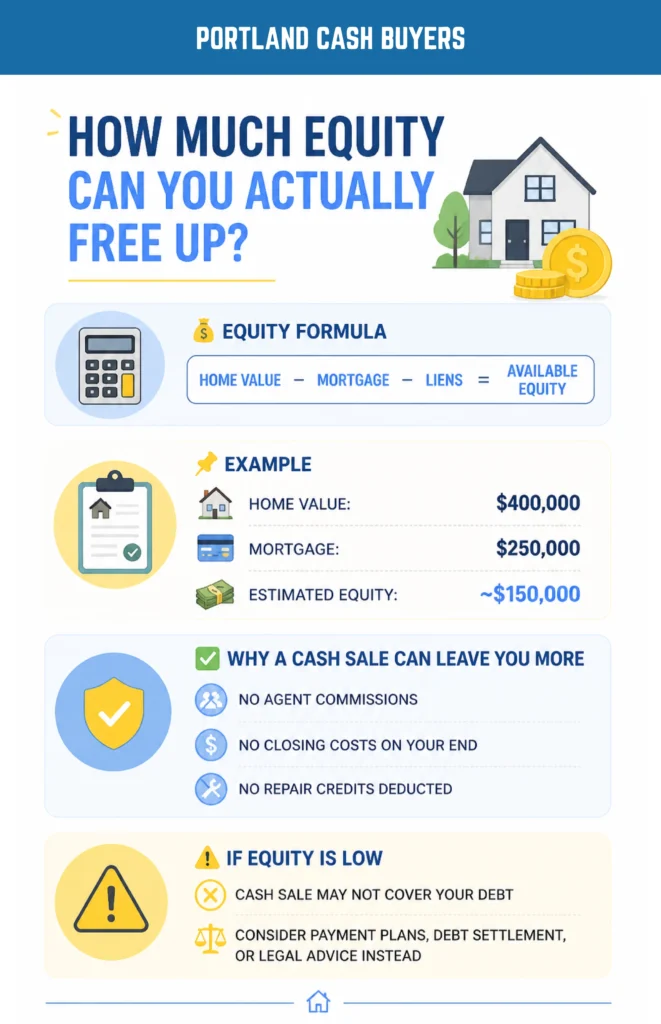
You can free up whatever equity sits in your home after your mortgage balance and any liens are paid off at closing. If your home is worth $400,000 and you owe $250,000 on the mortgage, roughly $150,000 in equity is available to you, minus whatever your specific loan payoff and any recorded liens require.
Selling for cash skips the percentage-based commission and last-minute repair credits that a traditional listing usually adds to that math. I pay closing costs and there are no agent fees, so the number I offer is close to the number that lands in your account. I will walk through the payoff figures with you directly and show exactly how the offer is built, using comps, condition, and carrying costs, before you decide anything.
If the equity is thin or you are underwater on the mortgage, selling for cash may not clear enough to matter, and I will tell you that plainly rather than make an offer that does not serve you. In that case, a payment plan, debt settlement, or, in some situations, facing bankruptcy as a formal option may be worth discussing with an attorney.
Here is how the math usually plays out. Say your home would sell for around $420,000 and your remaining mortgage balance is $260,000. A traditional sale carries a 5 to 6 percent commission plus closing costs, which can total $30,000 or more before repairs are even factored in, leaving roughly $130,000 in net proceeds after several months on the market. A cash sale skips the commission and the closing costs on your end entirely, so more of that same equity gap goes toward the medical debt instead of toward selling expenses.
Speed Matters: How Fast You Can Get Cash
A cash sale to a direct buyer is the fastest way to convert home equity into money, typically closing in seven to fourteen days. A traditional listing, by comparison, usually takes three to six months from list date to a funded closing, and that assumes the buyer’s financing does not fall through along the way.
| Method | Typical Time to Cash |
| Cash sale to a direct buyer | 7 to 14 days |
| Traditional listing with an agent | 3 to 6 months, plus closing time |
| Home equity loan or line of credit | Several weeks, subject to approval |
| Personal loan | Days to weeks, but adds a new monthly payment |
Every option in that table has a place. A home equity loan or personal loan can work if your credit and income can support another payment on top of what you are already managing. A cash sale is the option that removes the debt question entirely, because it converts the asset itself rather than borrowing against it.
If you want to see what your specific numbers look like, I can put together a no-obligation cash offer within 24 hours, with no cost or commitment to you either way.
It is also worth knowing that the three major credit bureaus voluntarily removed paid medical collections from consumer reports starting in 2022, and medical collections under $500 as of April 2023, regardless of what happens with any federal rule. That does not erase a large unpaid balance, but it means a smaller, already-settled medical bill is less likely to be dragging your credit down while you work out how to handle the larger debt.
Selling As-Is When Health Comes First
Selling as-is means you skip repairs, staging, and the months of upkeep a traditional sale usually demands, which matters most when your time belongs to recovery instead of a renovation project. I buy homes in whatever condition they are in, whether that means deferred maintenance, an outdated kitchen, or issues that would normally stall a bank appraisal.
Selling As-Is vs. Making Repairs First
A traditional buyer using bank financing typically expects a home in move-in condition, or expects a credit at closing for anything the inspector flags. Repairs alone can run from a few thousand dollars for cosmetic work into the tens of thousands for anything structural, mechanical, or related to the roof. None of that is money or time you likely have available right now.
A direct cash sale removes the inspection contingency and the repair negotiation entirely. I look at the house as it stands, factor condition into the offer honestly, and close on a timeline you choose. If you would rather list with an agent and the house is in strong shape already, that path can net more before commissions in a strong market, so it is worth weighing both against your actual timeline and energy.
This matters even more if the medical situation involves ongoing care, mobility limits, or a hospital stay that leaves no one available to manage contractors and showings. I have closed on homes across Multnomah, Washington, and Clackamas Counties in Oregon where the seller was still recovering and simply could not take on a renovation, and as-is meant exactly that: no painting, no staging, no open houses, just a closing that fit their timeline.
Using a Fast Home Sale to Pay Medical Bills
Using a fast home sale to pay medical bills works by converting your equity into cash on a timeline measured in days, not months, so the debt gets resolved before interest and collections activity compound it further. The process I use is the same one I have used since 2004, and it has three steps.
- Tell me about your home. A short call or form with your address and situation is all it takes to start. No inspection required up front.
- Get a fair cash offer. I review the property, in person or sight-unseen if that works better for you, and present a no-obligation offer within 24 hours.
- Close and get paid. You pick the closing date. A licensed title company handles the paperwork, and you walk away with the funds to pay down the debt directly.
I am not a wholesaler. I buy with my own funds and never put a house under contract to resell it to someone else for a fee, which is the practice Oregon’s HB 4058 now requires wholesalers to disclose to sellers. Because I buy directly, the offer you accept is the offer that closes, with no assignment fee quietly reducing what lands in your hands.
This approach also fits well if the medical situation is tied to a larger transition. If you are downsizing into a smaller home or assisted living because of a health change, or if a rental property is causing problems while you focus on your health, the same fast, as-is process applies.
Frequently Asked Questions about Medical-Debt Home-Sale
Should I sell my house to pay off medical debt?
Selling makes sense if your medical debt is large relative to your equity and a payment plan would take years to resolve. Portland Cash Buyers can walk through those numbers with you. If the debt is manageable through a hospital plan or a hardship discount, selling is not usually necessary.
Can medical bills force me to sell my home?
Medical bills alone rarely force a sale directly, but unpaid medical debt can end up as a lien or judgment in some cases, and mounting collections pressure often pushes homeowners toward a sale sooner than they would otherwise choose.
How fast can I access my equity for medical costs?
With a direct cash buyer, you can typically access your equity in 7 to 14 days. A traditional listing usually takes several months before funds are available.
Are there alternatives to selling for medical debt?
Yes. Hospital payment plans, charity care programs, bill negotiation, and Oregon Health Plan coverage through the Oregon Health Authority are all worth exploring before you sell, since they can reduce or eliminate the balance without touching your home.
Will a fast cash sale affect my benefits eligibility?
A home sale can affect income-based or asset-based benefit programs depending on how the proceeds are used and held, so this is a question worth asking a benefits counselor or financial advisor directly rather than assuming either way.
Selling Your House to Pay Medical Bills
If medical bills have left you weighing difficult financial decisions, you do not have to figure everything out on your own. Explore payment plans, financial assistance, and other available options first. If selling your home turns out to be the right solution, Portland Cash Buyers can provide a fair, no-obligation cash offer with no repairs, agent commissions, or pressure to move forward.
Whether you need funds for ongoing treatment, long-term care, or to avoid falling deeper into medical debt, we can help you understand exactly how much equity you could access and how quickly you can close. Our process is straightforward, compassionate, and built around your timeline so you can focus on your health instead of the home-selling process.
Ready to take the next step? Contact Portland Cash Buyers today or call 503-770-0145 to receive a no-obligation cash offer. You choose the closing date, and if you decide to sell, we’ll handle the details so you can move forward with confidence.