

If you’re selling your Portland home to relocate, one of the biggest decisions you’ll face is whether to sell or rent your house. If you’re moving for a new job, retirement, or a fresh start, choosing the right option can affect your finances long after the move. I’m Quinn Irvine, and I’ve bought homes from relocating Portland-area sellers since 2004. One of the most common questions I hear is whether keeping a home as a rental is worth it or if selling is the smarter choice.
Whether you should sell or rent your house when relocating comes down to your equity, your appetite for remote landlording, and how soon you plan to move back. Selling gives you a clean break and immediate cash with no ongoing costs. Renting can work if the numbers cash flow, and you’re comfortable managing a property from a distance, but it ties up your equity and adds real risk.
- Selling gives you a clean exit, immediate access to your equity, and no landlord duties from out of state.
- Renting only pencils out if the rent covers your mortgage, taxes, insurance, and a repair reserve, with room left over.
- You generally have 3 years after moving out to sell and still qualify for the home-sale tax exclusion under the 2-of-5-year rule.
- Long-distance landlording adds real costs: property management, vacancy, maintenance calls you can’t handle in person, and tenant risk.
- I buy homes as-is, so selling before you relocate is often the faster and simpler path if renting doesn’t clearly pencil out.
Sell or Rent When Relocating: The Core Trade-Off
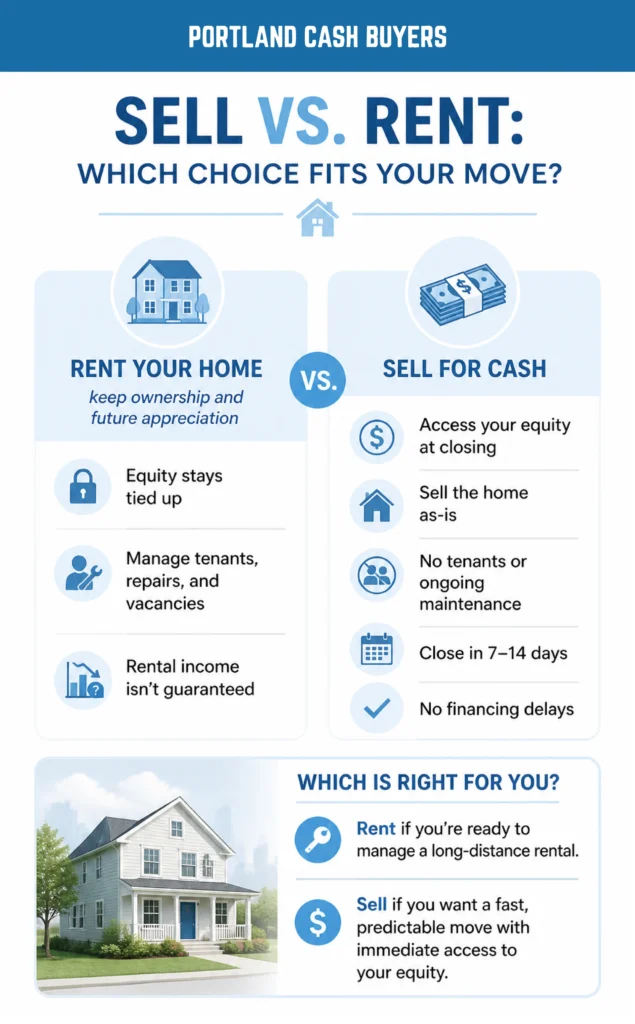
Sell or rent when relocating comes down to one trade-off: cash now and a clean break, versus ongoing rental income and the work of managing a property you no longer live near. Selling converts your equity into cash you can use for the move, a down payment on your next place, or simply breathing room. Renting keeps you in the real estate market and can build long-term wealth, but only if you’re prepared to be a landlord from another city or state.
Most Portland-area sellers I talk with aren’t torn between two equally good options. They already know which one fits their life. The question is usually whether the numbers support the choice they’re leaning toward, and that’s where a side-by-side look at real costs matters more than gut feeling. If you want the full week-by-week logistics of the move itself, I cover that separately in my guide to selling a house out of state for relocation.
When Renting It Out Makes Sense
Renting your Portland-area home makes sense when the math and your timeline both point the same direction. It works best in a specific set of situations, not as a default fallback while you figure things out.
- Your mortgage rate is well below current market rates, so the rent covers your payment with margin to spare.
- You expect to move back to the Portland metro within a few years and don’t want to buy back into a market that may have moved on you.
- The home is in good condition with no deferred maintenance that would eat into cash flow right away.
- You have cash reserves for vacancy, repairs, and property management, separate from your moving budget.
- You’re comfortable hiring and overseeing a local property manager, since you won’t be there to handle tenant calls yourself.
When Selling Is the Smarter Move
Selling is the smarter move when renting would tie up money you actually need, or when the property or your situation makes remote landlording more trouble than it’s worth.
- You need the equity for a down payment, moving costs, or a financial cushion in your new city.
- The rent wouldn’t clear your mortgage, taxes, insurance, and a repair reserve with room to spare.
- You’re relocating permanently, or you’re not sure when or if you’d return to Portland.
- The house needs work you don’t want to manage from out of state, or you’re downsizing into a smaller footprint at the same time you’re relocating.
- You’d rather have a problem rental property behind you than in front of you. I hear this often from sellers who’ve landlorded before and don’t want to do it again from a distance.
Sell vs. Rent: Side-by-Side Comparison
The side-by-side numbers usually make the decision clearer than any pros-and-cons list. Here’s how selling to a cash buyer compares with becoming a long-distance landlord, using the same factors for both.
| Factor | Rent It Out | Sell to Portland Cash Buyers |
| Access to cash | Equity stays tied up in the property | Full net proceeds at closing |
| Ongoing effort | Tenant screening, repairs, and management from a distance | None; the sale is done in 7 to 14 days |
| Monthly risk | Vacancy, late rent, and repair calls you handle remotely | No ongoing exposure once you close |
| Upfront cost | None to list, but repairs often needed to rent-ready the home | None, I buy the house as-is |
| Certainty | Rental income and appreciation are not guaranteed | All-cash, no financing fall-through risk |
A property manager can make renting hands-off in exchange for a monthly fee, and an agent listing through my sell-your-house guide can make sense too if the home is in good shape and you’re not on a tight timeline. Neither is wrong. The comparison above is simply meant to show you the trade-offs side by side before you decide.
The Hidden Costs of Long-Distance Landlording
The hidden costs of long-distance landlording are the ones sellers underestimate most, because they don’t show up until months after the move. A single bad tenant, a busted water heater, or a stretch of vacancy can erase a year of rental income.
Becoming a Long-Distance Landlord From Out of State
show the unit, handle a maintenance emergency, or deal with a difficult tenant in person. Property management in the Portland metro typically runs a meaningful percentage of monthly rent, on top of leasing fees when you turn over a tenant. That cost comes straight out of the cash flow you were counting on.
If a tenant stops paying or the property sits vacant during a slow rental season, you’re still covering the mortgage from your new city, sometimes alongside rent or a mortgage on your next home. That’s the scenario that turns a rental decision into a financial emergency fast, and it’s the risk sellers mention most often when they call me after trying to rent. If missed rent turns into missed mortgage payments on your end, that can put you on the path toward late payments and eventual foreclosure risk, which is a far worse outcome than simply selling before you move.
Break-Even Rent: Will the Numbers Actually Work?
Break-even rent is the minimum monthly rent that covers your mortgage, property taxes, insurance, a maintenance reserve, and property management, with nothing left for profit. Add up those five costs before you commit. If market rent in your neighborhood barely clears that number, you’re taking on landlord risk for little or no upside, and a slow month can put you underwater.
Oregon Landlord Rules You’d Be Taking On
Renting out a Portland-area home means stepping into Oregon’s statewide landlord-tenant rules, not just collecting a check. Under Oregon law, you can generally raise rent only once every 12 months, and only after 90 days’ written notice, with an annual cap tied to inflation for most units older than 15 years. After a tenant’s first year in the unit, you generally can’t end the tenancy without cause under ORS 90.427, so an ordinary lease non-renewal isn’t always an option if your plans change.
If you’re inside Portland city limits and later end a tenancy without cause, the city’s mandatory Renter Relocation Assistance ordinance can require you to pay the tenant relocation costs, which run from roughly $2,900 for a studio up to $4,500 for a three-bedroom or larger unit. None of this makes renting a bad choice. It just means the decision to rent isn’t reversible on a whim if your relocation plans shift again, the way selling is. This is general information, not legal advice, so confirm current requirements with an Oregon landlord-tenant attorney before you sign a lease.
What Happens to Your Section 121 Exclusion If You Rent First
Renting out your home doesn’t automatically eliminate your capital gains tax exclusion, but it can affect how long you have to claim it. Under IRS rules, you generally must have owned and lived in the property as your primary residence for at least 2 of the 5 years before selling to qualify for the exclusion. If you convert the home into a rental and sell it within about 3 years of moving out, you can often still qualify. Waiting longer may reduce or eliminate your eligibility, so it’s worth reviewing IRS Publication 527 before making a decision.
This is general information and not tax advice. Every situation is different, so talk with a tax professional about your specific timeline before you decide, since rental income and expenses come with their own reporting rules once the home becomes a rental.
If you’re leaning toward a clean break instead of managing a rental from a distance, reach out, and I’ll put together a free, no-obligation cash offer to compare directly against what renting would actually net you, with no pressure either way.
Deciding Whether to Sell or Rent Before You Relocate
Deciding whether to sell or rent before you relocate starts with the break-even rent math above, then layers in your timeline and your appetite for managing property from out of state. If the numbers are close and you’re unsure, run them twice, once assuming everything goes right, and once assuming a bad tenant or a month of vacancy. If the second scenario worries you, that’s your answer.
Four questions tend to settle it for most Portland-area sellers I talk with:
- Does market rent clear your break-even number by a real margin, not just barely?
- Do you know, and trust, who will handle a maintenance call or a tenant problem while you’re hundreds of miles away?
- Do you have cash reserves set aside for vacancy and repairs, separate from your moving budget?
- Would you regret selling more than you’d regret the work of managing a rental you don’t live near?
If you answered no to any of the first three, selling is usually the safer path. If the fourth question is the only one giving you pause, that’s a personal call, not a purely financial one, and there’s no wrong answer as long as you go in with real numbers instead of a guess. If you’d rather work through the general financial trade-offs of owning versus renting on your own first, the CFPB has a plain-language breakdown of the decision that’s a useful starting point, even though it’s written for buyers rather than someone deciding whether to rent out a home they already own.
Paul R., one of my reviewers, described a move with a lot of moving parts on a tight timeline, and said I came through when it mattered. That’s the kind of situation I deal with regularly, since relocation rarely happens on a convenient schedule. You can read more reviews like his on my testimonials page.
If relocating is tied to retirement rather than a job, the math often tilts toward selling, since a retirement move usually favors predictable income over a property to manage from a distance. And if the property came from an estate rather than being your own home, my guide on inherited house capital gains in Oregon covers the tax side of that specific situation in more depth.
I’ve been owner-operated and trusted in the Portland metro since 2004, and I’ve helped more than 1,000 Portland-area families sell their homes. I’m BBB A+ accredited with a 5-star Google rating, and you work directly with me, not a call center or a rotating cast of reps. You can read more about how I work on my About Us page.

Frequently Asked Questions about Sell-or-Rent Relocation
Is it better to sell or rent my house when I move?
It depends on your equity needs and your appetite for remote management. Selling is usually better if you need the cash or don’t want landlord duties from a distance. Renting can work if the numbers clearly cash flow and you’re prepared to manage it or hire someone who will.
What are the tax implications of renting instead of selling?
Rental income becomes taxable, and you can deduct expenses like mortgage interest, property taxes, insurance, and depreciation. If you later sell, you may still qualify for the home-sale exclusion if you sell within about 3 years of moving out. This is general information, not tax advice, so confirm your specific timeline with a tax professional.
How much does long-distance property management cost?
Property managers typically charge a percentage of monthly rent, plus a leasing fee when they place a new tenant. Get quotes from a couple of Portland-area property managers before you commit to renting, since that cost directly reduces your break-even rent.
Will I lose my capital gains exclusion if I rent it out first?
Not automatically. You generally need to have owned and used the home as your main residence for 2 of the last 5 years before the sale. If you rent it out and sell within roughly 3 years of moving out, you typically still qualify. Waiting longer puts the exclusion at risk.
Can I sell quickly if renting doesn’t work out?
Yes. If you’ve tried renting and it isn’t working, whether from a bad tenant, thin margins, or the stress of managing it from out of state, I buy homes as-is with tenants in place or vacant. I can get you a no-obligation cash offer within 24 hours and close in as few as 7 days.
Should You Sell or Rent Your House When Relocating?
Every relocation is different, and there’s no one-size-fits-all answer to whether you should sell or rent your house when relocating. The right choice depends on your equity, expected rental income, timeline, and how comfortable you are managing a property from another city or state. Comparing both options with real numbers is the best way to make a confident decision.
If selling looks like the better fit, I’m happy to help you compare a real cash offer against what your home could realistically earn as a rental. You’ll receive a straightforward, no-obligation offer within 24 hours, giving you a clear benchmark before making your final decision. Learn more about selling your home as-is for cash.
I’m Quinn Irvine, and I’ve been buying Portland-area homes directly since 2004. I buy houses in any condition, cover all standard closing costs, and can close in as few as 7 days on your schedule. Call (503) 770-0145 today or learn how to sell your home as-is for cash to get your free, no-obligation cash offer.