

Can One Spouse Sell the House Without the Other in Oregon? Here’s What the Law Actually Says
So, can one spouse sell the house without the other in Oregon? In almost every case, the answer is no—not legally, and not without serious consequences. Oregon law treats marital property as jointly owned, and the home is usually the biggest asset in that pool.
Here is what that means in practice:
- Both spouses must sign the deed to transfer ownership of marital real estate.
- The type of ownership on the title (tenancy by the entirety, joint tenancy, or tenancy in common) determines exactly how restrictions apply.
- A spouse who tries to sell unilaterally risks legal challenges, title disputes, and court sanctions.
- When spouses disagree, a court can intervene and order a sale.
Understanding how Oregon handles this issue can save you months of confusion — and real money.
Oregon Marital Property Law and the Family Home
Oregon is an equitable distribution state, not a community property state. That distinction matters. In equitable distribution states, courts divide marital assets based on what is “just and proper” under ORS 107.105(1)(f), rather than splitting everything 50/50 automatically.
However, Oregon law starts with a strong presumption: both spouses contributed equally to any property acquired during the marriage. That presumption holds even if only one spouse paid the mortgage, earned the income, or holds the title in their name alone.
This means the family home purchased during a marriage belongs to both spouses—regardless of whose name is on the deed. A spouse who owns the deed solely in their name cannot simply walk that deed to a title company and close a sale without the other spouse’s signature.
Pro Tip: If your name is not on the deed but you contributed to the home during the marriage—through mortgage payments, improvements, or as a homemaker — you still have legal rights to that property under Oregon law. Do not assume you have no leverage just because your name is not on the title.
Joint Tenancy vs. Tenancy in Common in Oregon
How a property is titled affects what each spouse can do with it. Oregon recognizes three main forms of co-ownership relevant to married couples.
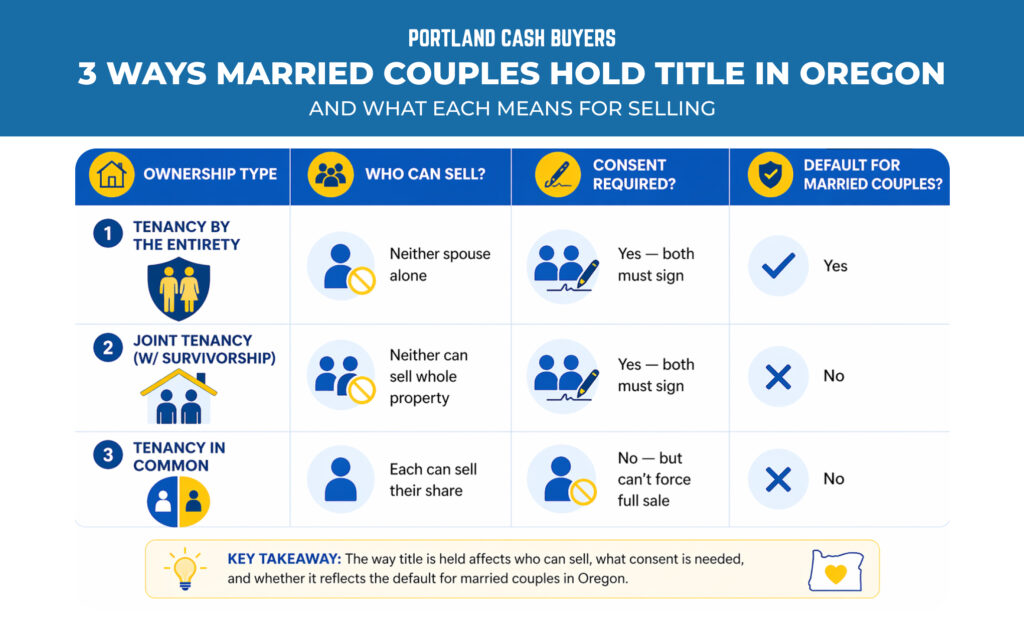
Tenancy by the Entirety (Default for Married Couples)
This is the default ownership form when a married couple buys real estate in Oregon, per ORS 93.180(1)(b). Under tenancy by the entirety:
- Neither spouse can sell the property without the other’s consent.
- Neither spouse can encumber the property (take out a loan against it) without the other signing.
- The property passes automatically to the surviving spouse at death.
This form of ownership provides the strongest protection against unilateral action. A title company will refuse to process a sale without both spouses executing the deed.
Tenancy in Common
Tenancy in common is less common for married couples but does occur. Each spouse owns a defined share (often 50%) and can sell their interest without the other’s approval. However, they cannot sell the entire property or force the other spouse to give up their share — at least not without a court order for partition.
Joint Tenancy with Right of Survivorship
Oregon generally abolishes joint tenancy in real property unless the deed clearly states a right of survivorship. When it does exist, neither co-owner can sell the whole property unilaterally. Attempting to sever a joint tenancy by selling one’s interest converts the arrangement to a tenancy in common.
Pro Tip: Pull your property deed before assuming how it is held. The language on the deed controls everything. A title company or real estate attorney can read it with you in minutes. If you are heading into a divorce, understanding your title structure is one of the first steps to take.
What Happens When One Spouse Refuses to Sell?
This is one of the most common sticking points in Oregon divorce cases involving real estate. If one spouse wants to sell and the other refuses, you have limited options outside of court — but those options are meaningful.
Negotiate a buyout. One spouse can buy out the other’s share of equity and refinance the mortgage solely in their name. This requires both parties to agree on the home’s value, which may call for an independent appraisal.
Agree on a third-party sale. Both spouses can agree to list the home, sell it to a buyer, and divide the net proceeds according to their divorce settlement.
Request a court order. If negotiation fails, either spouse can ask the divorce court to order a sale as part of the property division. Courts in Oregon have broad authority under ORS 107.105 to order the sale of marital property and divide the proceeds.
A spouse who simply refuses to cooperate — refusing to sign the deed, blocking showings, or otherwise obstructing a court-ordered sale — risks contempt of court and can face sanctions.
Court-Ordered Sale of a Home in Oregon
When divorcing spouses cannot agree, Oregon courts can and do order the sale of marital homes. The court will consider factors including:
- Each spouse’s financial situation and earning capacity
- Whether minor children live in the home
- The length of the marriage
- Each party’s contributions to the acquisition and maintenance of the property
- What division would be just and proper under the circumstances
A court-ordered sale does not mean you will receive exactly half the proceeds. The court will set the division as part of the broader property settlement. Debts secured against the property — including the mortgage — are paid first from the sale proceeds.
Notably, court-ordered sales often take longer and cost more than voluntary sales. Attorney fees, appraisal costs, and the slower timeline of litigation can reduce what both parties ultimately receive.
How Portland Cash Buyers Works With Contested Home Sales
Divorcing couples who both agree to sell often discover that the traditional listing route adds friction to an already difficult process. Months of showings, repair demands from buyers, and unpredictable closing timelines create financial and emotional strain when both parties need a clean exit.
Here is why cash buyers make sense in contested divorce situations:
- Speed. Portland Cash Buyers can close in as few as 7 days. There is no waiting on mortgage approvals or buyer financing.
- No repairs required. The home is purchased as-is. Neither spouse needs to agree on renovations or prep work.
- No commissions or closing costs. Portland Cash Buyers pays all closing costs, removing a common source of disagreement between divorcing parties.
- One clean transaction. A single visit replaces months of showings. There are no strangers walking through the home repeatedly.
- Certainty. A cash offer is a guaranteed close. There is no risk of the deal falling through due to financing.
For couples who have agreed to sell — or who are working toward that agreement — a cash sale eliminates the variables that make a traditional listing so stressful during divorce proceedings.
If your situation involves a court order, a mediator, or attorneys on both sides, Portland Cash Buyers has worked through those processes before. Quinn understands that timing and paperwork coordination matter when multiple parties are involved.

Frequently Asked Questions About Can One Spouse Sell the House Without the Other in Oregon
Can a spouse sell a house without the other in Oregon if only one name is on the deed?
No. Oregon courts presume equal contribution to marital property. Even a deed in one name requires both spouses to sign for a valid sale of marital real estate.
What if my spouse already transferred the house without my knowledge?
A transfer made without your consent may be voidable. Consult a family law attorney immediately. Oregon courts can unwind fraudulent or unauthorized transfers of marital property.
Can I force my spouse to sell our house during an Oregon divorce?
You can ask the court to order a sale as part of property division under ORS 107.105. If spouses cannot agree, a judge decides based on what is just and proper.
Does it matter whose name is on the mortgage?
No. The mortgage is separate from ownership rights. Title ownership determines who must sign the deed. Both matters are addressed during divorce property division.
What is a partition action in Oregon?
A partition lawsuit allows a co-owner to force the physical division or sale of jointly owned property. For tenants in common, this can be filed even outside of divorce proceedings under ORS 105.205.
Can One Spouse Sell the House Without the Other in Oregon: Your Next Steps
Can one spouse sell the house without the other in Oregon? The short answer is no, and attempting to do so carries legal risks that can complicate an already difficult divorce. Understanding how Oregon’s marital property rules apply to your home and how your title is structured gives you a clear starting point.
If both you and your spouse are ready to sell, or if a court order is in place, Portland Cash Buyers can help you move through the process quickly and cleanly. Quinn Irvine has worked with Portland homeowners going through divorce for over two decades. He pays all closing costs, buys the home as-is, and closes on your timeline—removing as many friction points as possible from a situation that already has plenty.
For more information on how Oregon handles the family home during a divorce, see our related guides on selling a house during divorce in Portland and what happens to the house in a divorce in Oregon. You can also request a cash offer for your Portland home at any stage of the process—even before you have finalized your divorce agreement.